

Why Professional Growth Needs Both Coaches and Mentors
Supporting professional growth through mentoring and coaching creates a powerful combination that accelerates career development. While both guide your professional journey, they serve distinctly different purposes, and understanding these differences is key to maximizing your potential.
Quick Comparison: Coaching vs. Mentoring
| Aspect | Coaching | Mentoring |
|---|---|---|
| Focus | Performance improvement, specific skills | Long-term career development, wisdom sharing |
| Timeline | Short-term (weeks to months) | Long-term (months to years) |
| Structure | Formal sessions with clear agendas | Informal conversations and guidance |
| Relationship | Professional partnership | Nurturing, advisory relationship |
| Approach | Asks powerful questions to open up potential | Shares experiences and provides direct advice |
The impact is significant. For instance, research has shown that employees in mentorship programs are up to six times more likely to be promoted. Meanwhile, coaching is equally powerful for achieving specific goals through structured, performance-focused sessions.
The magic happens when you combine both. A coach helps you climb the mountain faster by improving your technique and keeping you accountable. A mentor, having climbed similar peaks, shows you which mountains are worth climbing.
This dual approach addresses both immediate skill gaps and long-term career strategy, giving you tactical support for current challenges and the strategic vision for your entire career path.
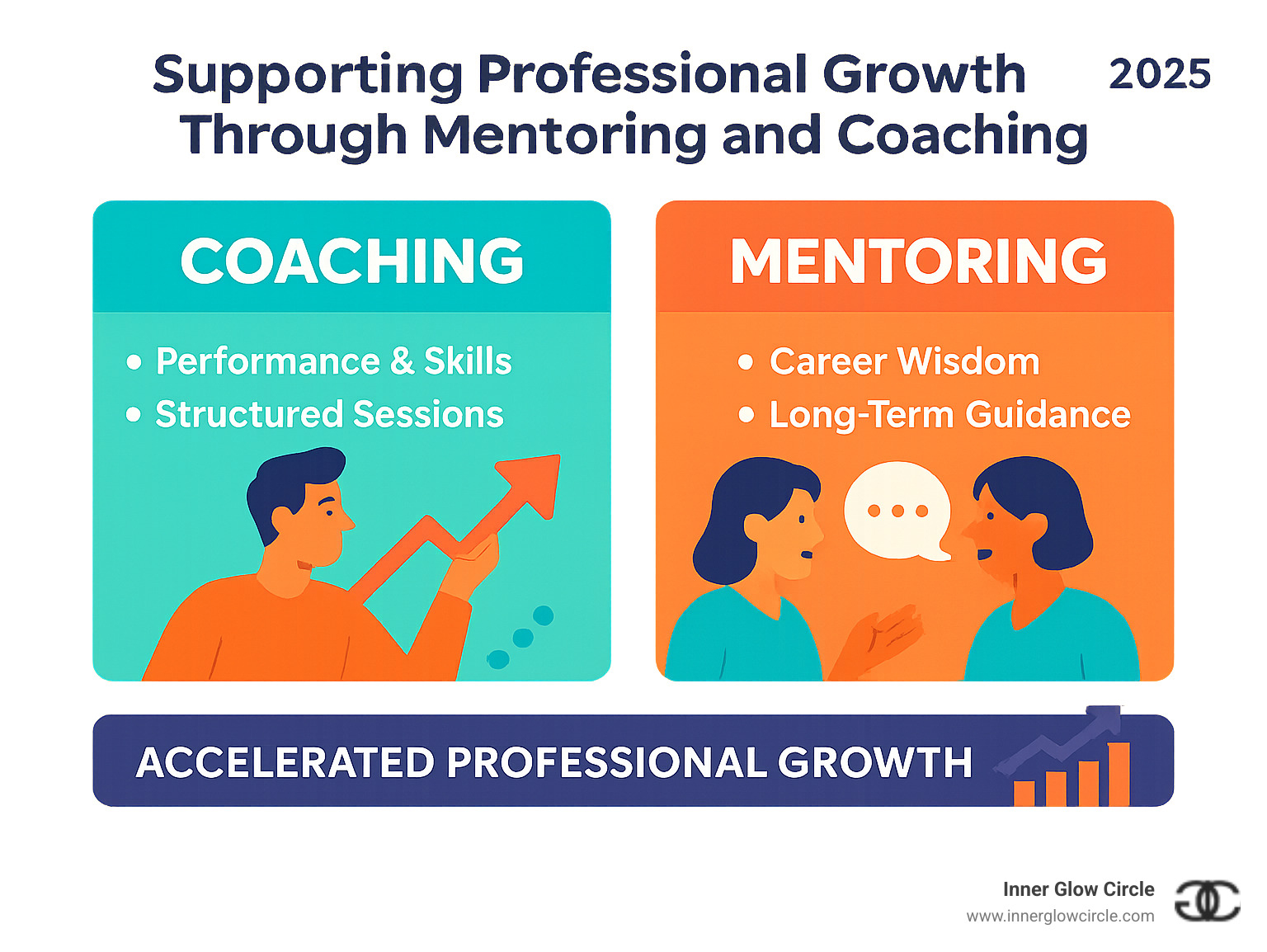
Know your supporting professional growth through mentoring and coaching terms:
Decoding the Roles: Core Differences Between Coaching and Mentoring
Understanding the unique roles of coaching and mentoring is crucial for supporting professional growth through mentoring and coaching. Though often used interchangeably, they are distinct. Think of it this way: a coach helps you perfect your swing, while a mentor teaches you which game to play. For a broader historical perspective on how mentoring has evolved, see the Mentorship entry on Wikipedia.
| Aspect | Coaching | Mentoring |
|---|---|---|
| Objective Orientation | Specific, time-bound goals for performance improvement | Long-term career development, personal growth, and wisdom transfer |
| Hierarchy & Expertise | Often an egalitarian relationship; coach doesn’t need direct experience in coachee’s field but is trained in methodology | Involves a more experienced individual guiding a less experienced one, sharing expertise and navigating professional environments |
| Nature of Relationship | Task-oriented and typically temporary | Nurturing, enduring, and relationship-focused, often akin to a friend or parental figure |
| Timeframe | Short-term (weeks to months) | Long-term (months to years) |
| Focus | Performance-driven; enhancing specific skills and addressing immediate challenges | Development-driven; overall career strategy, knowledge transfer, and psychosocial support |
| Structure | Formal, structured sessions with clear agendas | Often informal, though can involve regular check-ins; less rigid |
| Approach | Guides you to find your own solutions through powerful questions and self-findy | Provides advice, shares experiences, and offers insights from their own journey |
| Feedback | Crucial, two-way, and focused on optimizing processes and achieving measurable outcomes | Helpful but not always crucial; often involves sharing personal experiences and wisdom |
Many successful professionals benefit from both approaches simultaneously, creating a comprehensive support system for their growth.
The Coach: A Performance-Focused Partner
A coach is your secret weapon when you need to hit specific targets or overcome a performance hurdle, like public speaking anxiety. Coaching is about opening up your potential through structured, goal-oriented sessions. A coach’s superpower isn’t expertise in your field, but in asking the right questions to help you find your own solutions.
Instead of telling you what to do, a skilled coach holds up a mirror, helping you see your strengths and address performance challenges. This collaborative approach builds genuine confidence because the insights come from you. Your coach provides accountability, structured feedback, and targeted strategies to help you reach measurable goals, a methodology at the heart of Executive Coaching for Professional Growth.
The Mentor: An Experience-Based Guide
A mentor is your experienced guide when you’re at a career crossroads or new to an industry. Mentoring is about wisdom transfer and long-term guidance. Having been where you want to go, a mentor shares their roadmap, including successes and failures. Unlike coaches, mentors typically have direct experience in your field, making their insights incredibly relevant.
The relationship is like having a wise friend in your corner. A mentor becomes a trusted sounding board for career decisions, helping you understand industry dynamics and introducing you to valuable networks. This nurturing, long-term relationship is transformative and central to successful Mentorship Programs and Benefits, where wisdom sharing creates lasting impact.
The Synergy Effect: How Combining Approaches Accelerates Growth
The real magic in supporting professional growth through mentoring and coaching happens when you combine both approaches. It’s like having a personal trainer (coach) to perfect your technique and a wise guide (mentor) to help you choose which mountains to climb. Together, they create a complete support system for your immediate needs and long-term vision.

This combined approach creates holistic development, leading to improved problem-solving, increased accountability, and genuine confidence. It’s particularly powerful for women navigating complex career transitions, which is why we see incredible results with Career Coaching for Women.
Gaining a 360-Degree Support System
With both a coach and a mentor, you build a complete support ecosystem. Your coach is your accountability partner for the here and now, helping you develop skills and turn goals into actionable steps. Your mentor is your career compass for the bigger picture, sharing wisdom and helping you steer industry dynamics.
Together, they create balanced growth. Your coach might help you nail a presentation, while your mentor explains how that presentation fits into your broader career narrative. This combination truly empowers you, the kind of change we aim for with every Empowerment Coach we train.
Real-World Application Meets Personal Insight
Coaching and mentoring complement each other to create lasting change. Coaching gives you the tools through actionable strategies and goal clarification. Your coach asks tough questions and holds you accountable for taking action. Mentoring provides the context through experiential wisdom and career navigation. Your mentor shares the real story, helping you understand unwritten rules and anticipate challenges.
This powerful combination helps you overcome barriers more effectively by approaching them from multiple angles. You gain both tactical support and strategic insight, a comprehensive approach that helps women Find Your Purpose: Be a One-on-One Coach.
The Organizational Impact: Supporting Professional Growth Through Mentoring and Coaching
Supporting professional growth through mentoring and coaching creates ripple effects throughout entire organizations, building stronger, more resilient companies. The numbers tell a compelling story: companies with strong mentorship see higher retention and promotion rates. This isn’t just good for employees; it means organizations are developing their own talent pipeline instead of constantly recruiting from outside.

Career progression and leadership development become natural byproducts. Participants in such programs report increased leadership awareness, better stress-coping skills, and greater confidence. The diversity and inclusion benefits are also impressive, as these programs provide underrepresented groups with the visibility and support needed to advance their careers. Furthermore, they create a knowledge transfer system that prevents organizational wisdom from leaving when senior employees retire. This is particularly relevant for our work in Mentoring for Leadership Development.
Building a Thriving Coaching and Mentoring Culture
Creating a coaching culture fundamentally shifts how people grow together. Success hinges on several factors:
- Training leaders in coaching skills: Teach managers to ask powerful questions and provide constructive feedback.
- Fostering psychological safety: Create an environment where people feel safe sharing challenges and asking for help.
- Promoting a growth mindset: Frame mistakes and challenges as learning opportunities to encourage innovation.
- Blending resources: Use a mix of internal coaches who know the culture and external coaches who bring fresh perspectives.
This comprehensive approach aligns with our philosophy of training women for Leadership Coaching for Women who want to create positive change.
How to Effectively Measure Impact
Measuring the success of these programs requires tracking both quantitative metrics and qualitative feedback.
- Quantitative Data: Track Key Performance Indicators (KPIs) like sales figures or project completion rates. Monitor retention and promotion statistics to build a clear business case. Use employee engagement surveys and 360-degree feedback to measure behavioral changes.
- Qualitative Feedback: Conduct interviews and collect testimonials to capture the personal stories and human impact that numbers can’t fully express.
Successful organizations use this data not just to prove ROI, but to continuously refine their programs, understanding that supporting professional growth through mentoring and coaching is an ongoing journey.
Maximizing Your Journey: Best Practices for Individuals
Your professional development is your own, and supporting professional growth through mentoring and coaching works best when you take an active role. As the CEO of your career, you’re not just along for the ride—you’re steering the ship.

Approach coaching and mentoring with intention. Define clear objectives before you start. What skills do you need? What milestone is just out of reach? Clarity is essential. Be open to feedback, even when it’s uncomfortable, as this is where growth happens. Most importantly, take ownership of your development by preparing for sessions and following through on commitments. The most successful people we see in our Personal Development Coaching Services are those who treat each session as an investment in themselves.
Finding the Right Coach or Mentor for You
Finding the right guide is like finding a great friend—chemistry and shared values matter.
- Assess your needs: Do you need help with specific skills (coach) or long-term career navigation (mentor)?
- Research credentials and experience: Look for reputable training for coaches and relevant career paths for mentors. Our Team of Coaches combines both.
- Do a chemistry check: Use introductory calls to see if their communication style resonates with you. Do you feel heard?
- Set clear expectations: From the start, agree on communication, session structure, and what success looks like.
Best practices for supporting professional growth through mentoring and coaching as an individual
Once you’ve found your match, make every interaction count:
- Prepare for sessions: Bring specific challenges and questions to explore.
- Act on advice: Implement what you learn or discuss your hesitations honestly.
- Provide feedback to your guide: Two-way communication strengthens the relationship and improves the guidance.
- Celebrate milestones: Acknowledge your progress, big and small, to stay motivated.
- Pay it forward: When you’re ready, share your knowledge by helping others. This creates a positive cycle of growth.
Frequently Asked Questions about Coaching and Mentoring
We love chatting with women curious about supporting professional growth through mentoring and coaching. Here are answers to some of the most common questions we hear.
What are the core differences between coaching and mentoring?
Think of it this way: a coach is a personal trainer for your skills, focusing on performance improvement and specific, short-term goals. They ask powerful questions to help you find your own solutions. A mentor is an experienced guide for your career journey, focusing on long-term development and sharing wisdom. They offer advice based on their own experiences.
Can one person be both a mentor and a coach?
While it’s possible, it’s challenging because the roles require different mindsets. A coach holds back their opinions to help you find your own path, while a mentor actively shares their advice. If one person fills both roles, they must be skilled at “switching hats” and communicating which role they’re playing. However, we generally recommend finding separate people for these roles to get the full, unconfused benefit of each approach.
How do I know if I need a coach or a mentor?
Get honest about what you need right now.
- You might need a coach if: You have a specific skill gap or performance goal. You know what you want to achieve but are struggling with how to get there and need structured support and accountability.
- You might need a mentor if: You’re asking bigger questions about your career path, like “What’s my next move?” or “How do I steer my industry?” You crave insights and guidance from someone who has been where you want to go.
Many women benefit from both relationships, sometimes even at the same time. The most important step is recognizing that investing in yourself is always worth it.
Conclusion
Your professional journey doesn’t have to be a solo trip. As we’ve explored, supporting professional growth through mentoring and coaching creates a transformative partnership that can accelerate your career. Coaching provides focused training for immediate challenges, while mentoring offers a strategic roadmap for the bigger picture.
The power of synergy is a career game-changer. You gain a 360-degree support system that improves your performance, clarifies your vision, and builds lasting confidence. For organizations, investing in these practices boosts retention, strengthens leadership, and fosters a healthier culture.
Taking control of your career means being an active participant. Define what you want, communicate openly, and take action on what you learn. Investing in yourself is about becoming the confident, capable person you were meant to be—developing that inner glow that comes from knowing you’re growing and making a difference.
At Inner Glow Circle, we’ve seen this combination transform lives. We are passionate about Women Empowering Women because we know your success creates ripples that lift others.
Whether you’re looking to improve your current role or guide others, growth is always possible. The question isn’t whether you have potential—it’s whether you’re ready to Transform Your Life With Expert Life Coaching and step into the leader you’re becoming.


