

Why Sales Training for Coaches is Different from Traditional Sales
Sales training for coaches isn’t about pushy tactics. It’s about guiding potential clients through a decision using the same skills that make you an exceptional coach.
Top 5 Sales Training Approaches for Coaches:
- Methodology-Based Training – Structured frameworks that provide repeatable processes.
- Relationship-Focused Training – Client-centered approaches aligned with coaching ethics.
- Personalized One-on-One Coaching – Individual feedback, role-playing, and deal-specific strategy.
- Self-Paced Online Courses – Flexible learning with downloadable tools and certification.
- Integrated Business Development Programs – Holistic strategy covering niche, branding, and client attraction.
Most coaches struggle with sales because they see it as separate from coaching. But research shows that 75% of reps who receive sales coaching consistently hit their quotas. They learned to view sales as service, not manipulation.
Many aspiring coaches feel this tension. You have the passion to transform lives, but the fear of “selling” holds you back.
The good news is your core coaching competencies—active listening, building trust, asking powerful questions—are exactly what modern buyers want. Customers complete 70% of the buying process before ever talking to a salesperson. They’re not looking for a pitch; they’re looking for a trusted advisor.
This shift to relationship-based selling is where coaches have a natural advantage. The right sales training teaches you to leverage who you already are.
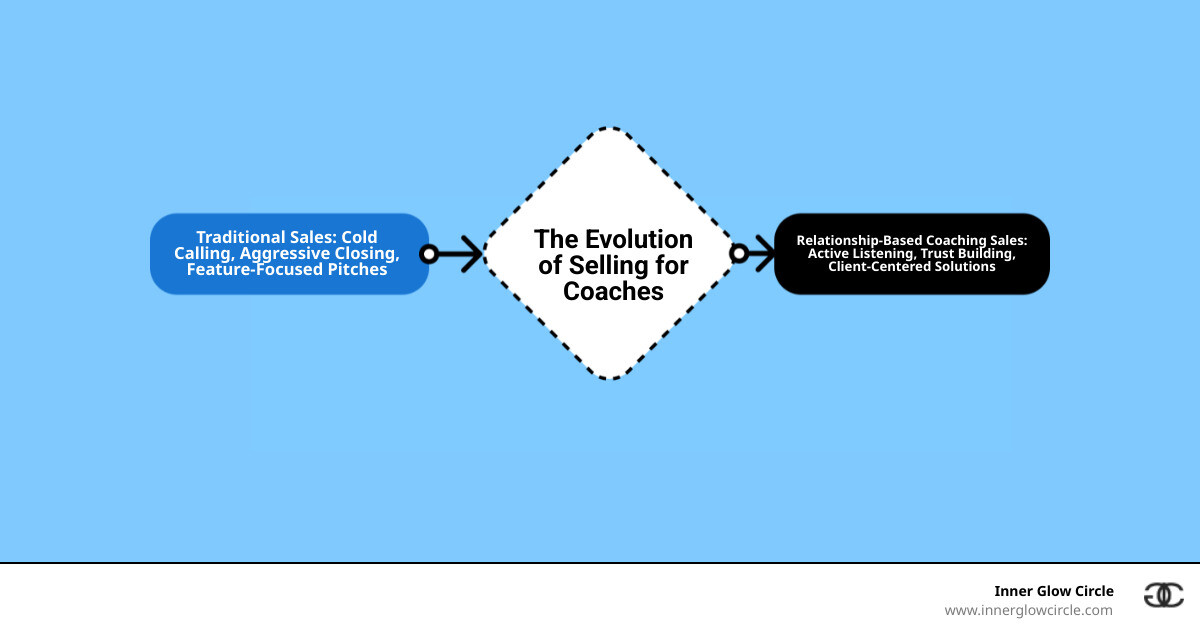
Why Your Coaching Skills Are Your Greatest Sales Advantage
The skills that make you an exceptional coach also make you naturally gifted at sales. Your abilities to listen deeply, ask the right questions, and create “aha!” moments are pure gold in a sales conversation.
Consider active listening. You listen to understand what’s not being said—the hesitation, the underlying fear, the unspoken dream. When a potential client feels this genuine attention, trust builds immediately.
You also naturally build trust and rapport. Your ability to create a safe space for vulnerability translates beautifully into sales conversations, making people comfortable sharing their real challenges before they invest in coaching.
Your ability to ask powerful questions is also invaluable. Instead of telling, you guide potential clients to their own insights. They self-diagnose their needs and understand how coaching can help, finding the answer for themselves rather than being sold one.
This connects to evoking awareness, where you guide potential clients to realize the value of coaching on their own. The decision to invest becomes their own empowered choice.
This is why traditional high-pressure sales tactics don’t work for coaches. Aggressive techniques clash with the coaching ethos of empowerment and guidance. The trusted advisor model and client-centered selling are far more effective.
Customers complete 70% of the buying process before talking to a salesperson. They’ve done their research and identified their problem. They don’t need a hard sell; they need an expert to help them make an informed decision.
Your coaching skills position you perfectly for this landscape. You’re having a meaningful conversation to help someone see if your coaching is the right fit. That’s not selling—it’s serving, and it’s a natural extension of who you are as a coach.
The 5 Best Types of Sales Training for Coaches
Sales training for coaches isn’t one-size-fits-all. You need an approach that matches your learning style, values, and business journey. Let’s explore the five most effective types, each with unique benefits.
1. Methodology-Based Training
If you love having a clear plan, methodology-based training provides structured frameworks and repeatable processes that take the guesswork out of sales. It’s like a GPS for your sales journey, providing a proven route instead of leaving you to guess.
One example is The Challenger Sale, which focuses on teaching and tailoring conversations. You actively challenge a potential client’s assumptions and guide them to new insights, similar to how you evoke awareness in coaching.
This approach builds confidence through repetition. Research shows a structured coaching program can lead to a 28% higher win rate and an 88% increase in productivity.
However, rigid systems can feel scripted or inauthentic to some coaches. If you thrive on intuition, these frameworks might feel constraining. The key is to choose what fits you.
2. Relationship-Focused Sales Training for Coaches
If rigid systems aren’t for you, consider relationship-focused sales training for coaches. This approach is about building genuine connections and viewing sales as an extension of the trust you naturally create.
It aligns perfectly with coaching ethics by focusing on deepening your relationship-building skills for enrollment conversations, not on manipulation.
Timeless Dale Carnegie principles teach you to ask meaningful questions, listen deeply, and offer value by understanding what potential clients genuinely need. It’s about mutual respect and finding solutions that serve everyone.
Approach findy calls as conversations to understand a person’s world: their challenges, fears, and dreams. Your natural empathy and listening skills become your greatest assets.
Research backs this up: 97% of sellers say coaching helps them speak to buyers from a more informed standpoint. When you truly understand someone, your recommendations carry weight and your authenticity shines through. This type of training also helps you build a pipeline through relationships and referrals.
3. Personalized One-on-One Sales Coaching

Personalized one-on-one sales coaching offers powerful, focused learning custom to your specific challenges. It’s a dedicated partnership with someone who understands your unique situation, strengths, and blind spots.
For example, you can role-play a difficult findy call to anticipate objections, refine pricing conversations, and practice responses. Afterward, you can debrief with your coach to learn from the experience.
This individualized feedback is invaluable. Your coach can review your calls and proposals, help you develop deal-specific strategies, and provide accountability to ensure you follow through.
The numbers tell a compelling story: Sellers are 63% more likely to be a Top Performer with regular ongoing coaching. Consistent, personalized guidance helps you bridge the gap between knowing what to do and actually doing it. This support can transform sales from a source of anxiety into a confident, repeatable process.
4. Flexible Self-Paced Online Courses
As a busy coach, finding time for professional development can be difficult. Self-paced online courses are a game-changer for sales training for coaches, allowing you to learn on your own schedule.
Beyond convenience, online courses are typically more affordable than workshops or one-on-one coaching, making quality sales education accessible.
Most programs include downloadable resources—templates, scripts, and worksheets—that help you translate learning into action. Some even offer certifications to add credibility. The flexibility means you can fit learning into the natural rhythms of your life.
The catch is that self-paced learning requires discipline. Without external accountability, it’s easy to fall behind. However, for motivated, autonomous coaches, this format is perfect.
5. Integrated Business Development Programs
For a big-picture approach to building a sustainable business, integrated business development programs are the most comprehensive option. They recognize that sales is connected to your niche, brand, and marketing.
A holistic program helps you define your coaching niche, which is crucial for standing out. When you’re clear on who you serve, sales conversations become much easier.
These programs also focus on personal branding, teaching you to tell your story and articulate your value to attract ideal clients.
The magic is in integrating marketing and sales. All your efforts—social media, email, website, findy calls—should create a cohesive client journey where each touchpoint builds trust and moves potential clients closer to saying yes.
Modern programs incorporate current tools and strategies to help you craft compelling messaging and develop systems for consistent growth. The goal is to build a business ecosystem that attracts ideal clients sustainably.
Key Components of an Effective Program
Not all sales training for coaches delivers lasting results. Research shows that 70% of sales training is forgotten after just one week without proper reinforcement.
Effective programs are structured like a supportive journey with checkpoints, practice, and accountability—just like good coaching. Key components include:
- Clear goals and objectives: Know what success looks like before you start, whether it’s handling pricing conversations or improving conversion rates. Specific targets allow you to measure progress.
- Individualized learning paths: Many programs fail by treating everyone the same. A good program adapts to your unique strengths, challenges, and learning style.
- Reinforcement and practice: To combat knowledge decay, ongoing practice is critical. You need opportunities to role-play, get feedback, and apply what you’re learning in real-world interactions to transform knowledge into skill.
- Accountability structures: Just as you support your clients, you need support too. Regular check-ins and progress reviews keep you moving forward when motivation dips.
- Measuring progress: To know if your investment is paying off, you need to track improvement. This could be monitoring conversion rates, findy calls booked, or client lifetime value. Tangible progress reinforces your commitment.
At Inner Glow Circle, we believe sustainable growth comes from honoring these principles. We focus on creating a supportive learning environment for lasting change and genuine confidence.
Measuring Your Sales Growth and ROI
After investing in sales training for coaches, it’s time to see the results. Measuring your sales growth and Return on Investment (ROI) is empowering.
Without tracking progress, you’re driving blind. Measuring Key Performance Indicators (KPIs) provides clarity, showing what’s working and what needs adjustment. For coaches, powerful KPIs include:
- Conversion rates: What percentage of findy calls turn into paying clients? A climbing rate shows your conversations are resonating.
- Client lifetime value: Are clients staying for multiple programs or investing in more offerings? Growth here means you’re building lasting relationships.
- Win rates: What percentage of your proposals close? A higher number means you’re effectively articulating your value. A structured coaching program can lead to a 28% higher win rate.
- Referral rate: When existing clients send new people your way, it’s proof that your coaching and sales approach are creating real impact.
Research shows that 75% of reps who receive sales coaching consistently hit their quotas. While a coach’s “quota” might be a client or revenue goal, the principle is the same: effective training leads to consistent results.
Checking these metrics regularly helps you see patterns and identify where to focus your energy. This isn’t about obsessing over numbers; it’s about honoring your investment. Seeing clear progress allows you to celebrate wins, make adjustments, and grow with confidence.
Frequently Asked Questions about Sales Training for Coaches
It’s natural to have questions about sales training for coaches. Here are the most common ones.
What is the difference between sales training and sales coaching?
This is an important distinction.
Sales training teaches fundamentals, often in a group setting like a workshop or course. It’s a one-time event focused on foundational knowledge—the “what” and “how-to.”
Sales coaching, on the other hand, is an ongoing, individualized process. A coach reinforces skills, diagnoses issues in your specific sales situations, and drives long-term change through feedback, role-playing, and accountability.
This matters because 70% of sales training is forgotten after a week without reinforcement. Training gives you the tools; coaching helps you master them.
How can sales training help if I feel uncomfortable “selling”?
Many coaches feel uncomfortable with “selling,” viewing it as pushy or inauthentic.
Effective sales training for coaches reframes selling as an extension of coaching. It’s not about being transactional, but about service.
The right training shows you how to use your natural abilities—listening, asking questions, building trust—to guide potential clients. You facilitate a conversation where they find their own need for change, helping them buy into their growth journey.
This shift in perspective, combined with client-centered techniques, can transform your experience with sales. Instead of dreading it, you’ll find it empowering because you’re truly serving people.
How do I know which type of sales training is right for me?
Choosing the right training is a personal decision based on your learning style, budget, and immediate business goals.
- If you crave structure, methodology-based training offers a proven system to follow.
- If you value deep connections, relationship-focused training will align with your coaching values.
- If you need personalized attention, one-on-one coaching provides individualized feedback and accountability. Sellers are 63% more likely to be a Top Performer with regular ongoing coaching.
- If you need flexibility and affordability, a self-paced online course lets you learn on your schedule.
- If you want a comprehensive business foundation, an integrated business development program covers everything from niche to branding.
Often, the best approach combines methods. You might start with an online course for foundational knowledge and add one-on-one coaching for personalized support. The key is to identify your biggest sales challenge and choose the training that directly addresses it.
Conclusion
The key takeaway is that sales training for coaches isn’t about changing who you are. It’s about leveraging your existing coaching skills—listening, asking powerful questions, and building trust—to help potential clients.
Sales can be reframed as an act of service. You’re not pushing; you’re guiding a potential client toward clarity. That’s not traditional selling; it’s coaching. The right training, whether it’s a structured framework, a relationship-focused approach, or personalized coaching, empowers you to do this with confidence.
Building a sustainable business requires authentic enrollment so people who need your help can find and work with you.
At Inner Glow Circle, our mission is to empower women to master enrollment without compromising their values. When you can confidently share your services, you expand your impact, help more people, and create the change you’re passionate about.
Your coaching skills are your greatest sales advantage. The right training helps you use them intentionally.
Ready to transform your relationship with sales and build a thriving coaching business? Learn how to build a profitable and impactful coaching business with our certification program.


