

Why Sales Coaching Certification Matters for Your Success
Sales coaching certification is a structured professional development program that equips sales managers, leaders, and aspiring coaches with proven frameworks and skills to improve sales team performance through effective coaching conversations, skill development, and accountability strategies.
Quick Answer: What You Need to Know About Sales Coaching Certification
- What it is: A credential that validates your ability to coach sales professionals using established methodologies like GROW, iGROW, or PeDRO frameworks
- Who needs it: Sales managers, team leaders, sales enablement professionals, and aspiring sales coaches
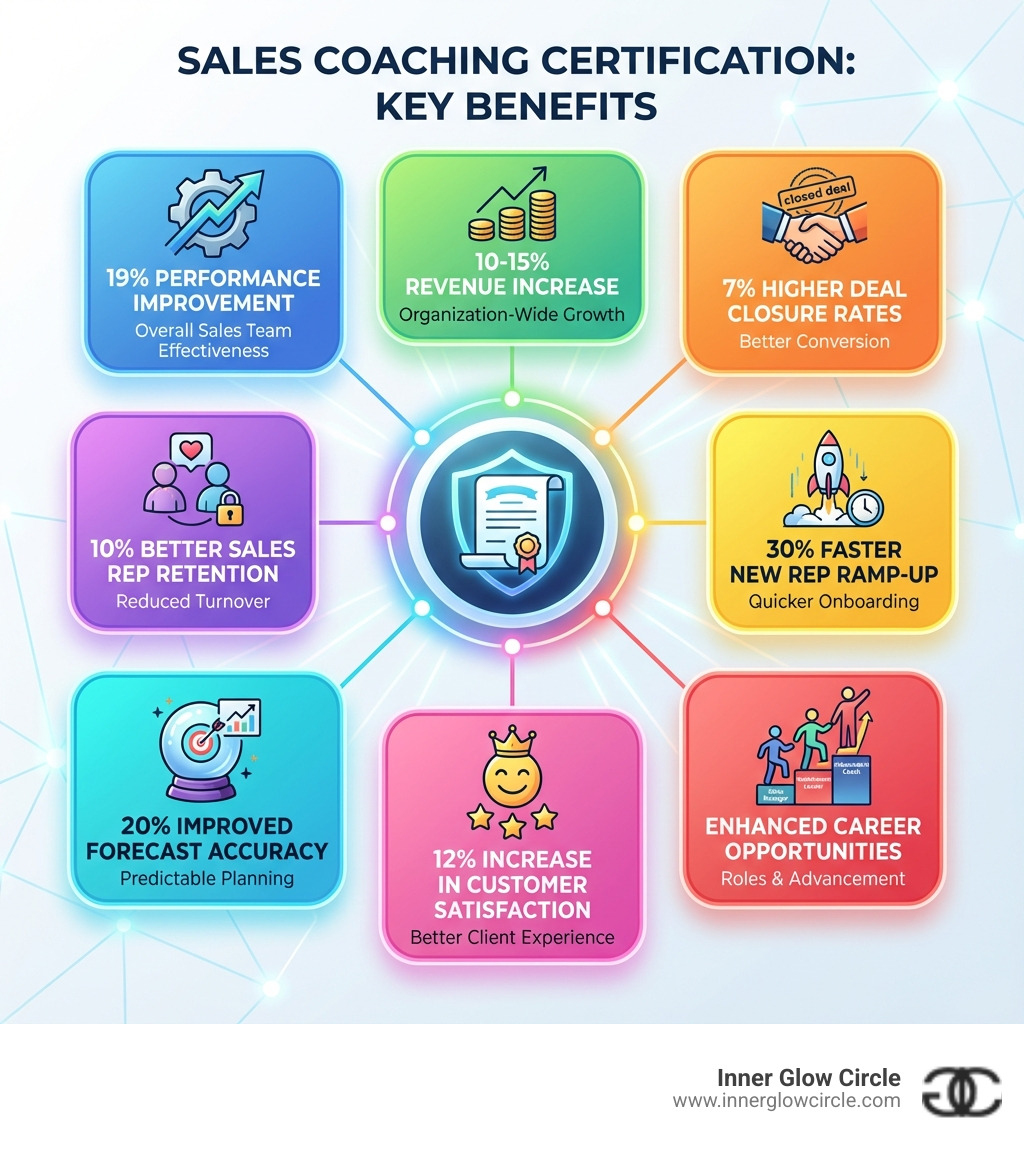
- Key benefits: Up to 19% improvement in sales performance, 10-15% revenue increase for organizations, and improved career opportunities
- Time commitment: Ranges from 3 hours for basic programs to 5+ months for comprehensive certifications
- Cost range: Typically $199-$5,000 depending on program depth and accreditation
- Format options: Self-paced online, live virtual classes, or in-person workshops
The core of sales success isn’t just strategy. It’s the people executing it.
Right now, 87% of sales leaders believe that sales coaching is critical for success. Yet many sales managers struggle to move beyond “ride-along” supervision to structured, impactful coaching that actually changes behavior and drives results.
Sales coaching certification gives you the tools to bridge that gap. It’s not just about learning to give feedback or run a meeting. It’s about mastering how to develop individual seller capabilities, create accountability systems, and use data to drive meaningful performance improvements.
Organizations with effective sales coaching programs see measurable results: a 10-15% increase in revenue, 7% higher deal closure rates, and 30% faster ramp-up time for new sales reps. For individuals, certification opens doors to roles like Sales Enablement Leader, Head of Sales, or independent consultant.
Whether you’re a sales manager wanting to develop your team more effectively, or someone like Sarah who dreams of building a coaching practice, certification provides the structured framework and credibility you need to succeed.
Quick sales coaching certification definitions:
The Transformative Benefits of Becoming a Certified Sales Coach
Becoming a certified sales coach isn’t just a fancy title; it’s a strategic move that open ups a cascade of benefits for individuals and the organizations they serve. We’re talking about tangible improvements that hit the bottom line and lift careers.

First and foremost, a sales coaching certification directly translates to improved individual performance. Sales coaching can improve overall sales performance by up to a whopping 19%. Imagine what that could do for your team! When reps receive targeted, consistent coaching, they sharpen their skills, overcome obstacles, and ultimately close more deals. This individual growth naturally leads to increased team productivity. Sales managers who are formally trained in coaching techniques are 2.5 times more likely to lead top-performing sales teams. That’s not just luck; it’s the power of structured, effective coaching in action.
For organizations, the impact is even more profound. Companies with effective sales coaching programs aren’t just seeing marginal gains; they report a significant 10-15% increase in revenue. This is often fueled by a 7% increase in deal closure rates, meaning fewer opportunities slip through the cracks. Beyond immediate sales, certified coaching also contributes to better sales rep retention. Investing in coaching shows your team you’re committed to their growth, leading to a 10% improvement in retention rates – a huge win in an industry often plagued by high turnover.
On a personal level, obtaining a sales coaching certification hones your leadership skills in ways general management training simply can’t. You learn to inspire, motivate, and develop others, transitioning from a directive manager to an empowering mentor. This expertise opens doors to significant career advancement opportunities. With a certification under your belt, you’re not just a sales professional; you’re a recognized expert in sales development, positioning you for roles such as Sales Manager, Head of Sales, Sales Enablement Leader, or even an independent sales consultant. The skills you gain are highly sought after, making you an invaluable asset in any sales organization. If you’re looking to lift your professional trajectory, we have more info about career development coaching that might pique your interest.
What You’ll Master: Core Skills in a Certification Program
So, what exactly do you learn when you dive into a sales coaching certification program? It’s far more than just “how to talk to people.” These programs are designed to transform you into a strategic development partner for your sales team, equipped with a powerful toolkit of skills and knowledge.
At the heart of any good program are robust coaching frameworks. These provide a structured approach to conversations and development. You’ll often encounter models like:
- GROW Model: Goal, Reality, Options, Will – a classic for guiding individuals toward their objectives.
- iGROW Model: An improved version, often incorporating introspection and insights.
- PeDRO Framework: Plan, Execute, Debrief, Rehearse, Observe – specifically custom for sales scenarios, helping reps refine their approach.
- TIPS²™ Model: A research-backed approach for critical sales coaching, focusing on diagnosing needs and crafting action plans.
- COACHN Model: A proprietary framework designed to accelerate managerial coaching effectiveness.
Beyond frameworks, you’ll master performance evaluation techniques. This isn’t about simply looking at numbers; it’s about understanding the “why” behind them. You’ll learn how to identify skill gaps, diagnose coaching needs, and use diagnostic tools to pinpoint areas for improvement.
One of the most crucial skills is giving constructive feedback. Forget the vague “do better” advice. Certification teaches you how to deliver feedback that is specific, actionable, and motivating, even when addressing difficult conversations. You’ll learn to develop others by focusing on their strengths while gently addressing weaknesses, fostering a culture of continuous growth.
Motivational strategies are another cornerstone. We all know sales can be a rollercoaster, so understanding how to keep your team energized is key. This includes tailoring motivational approaches to individual needs, setting clear and achievable goals, recognizing and rewarding achievements (both big and small), and fostering a supportive team environment. It’s about tapping into intrinsic motivators and helping your team find their inner drive.
In today’s data-rich world, data-driven coaching is non-negotiable. You’ll learn how to integrate sales data – from pipeline metrics to conversion rates – into your coaching conversations to enact meaningful changes in your organization’s coaching structure. This allows you to move beyond gut feelings and coach based on empirical evidence.
The rise of remote work has also made remote coaching tactics essential. Programs cover how to effectively coach salespeople from a distance using various communication channels like phone, video calls, email, and real-time messaging, ensuring your coaching remains impactful regardless of location.
Finally, you’ll gain confidence in handling difficult conversations. Whether it’s addressing underperformance, navigating resistance, or managing conflict, a sales coaching certification equips you with the communication techniques and emotional intelligence needed to turn challenging moments into productive growth opportunities. For more in-depth strategies on honing these skills, check out our Sales Training for Coaches Guide.
Choosing Your Path: How to Select the Right Sales Coaching Certification
Deciding to pursue a sales coaching certification is a big step, but choosing the right program can feel like navigating a maze. With so many options available, how do you find the perfect fit for your goals?

The journey begins with key considerations that align with your personal and professional aspirations. Start by clearly defining your career goals. Are you an aspiring sales manager, a seasoned leader looking to refine your skills, or perhaps an entrepreneur hoping to integrate sales coaching into your consulting practice? Different programs cater to different needs.
Next, carefully examine the program curriculum. Does it cover the specific skills you want to develop, such as data-driven coaching, remote team management, or advanced negotiation coaching? Look for details on methodologies, frameworks, and practical application exercises. Some programs integrate ICF core competencies, while others emphasize agile approaches and data integration.
Finally, consider the instructor expertise. Who is teaching the course? Are they industry veterans with real-world sales and coaching experience? The expertise of your instructors can significantly improve the quality of your learning experience. If you’re looking for a comprehensive guide to selecting the best fit, we offer insights into the Best Coach Training Program that might help.
To better understand the broader coaching field and how different credentials compare, you can also review the overview of professional coaching on Wikipedia’s Coaching (when used in a professional context).
Program Format: Online, In-Person, or Blended?
One of the most flexible aspects of sales coaching certification today is the variety of program formats available. Your choice here often depends on your learning style, schedule, and budget.
Self-paced online learning is a popular option, offering incredible flexibility. Many programs allow you to learn on your own schedule, fitting modules around your existing commitments. This is fantastic for busy professionals, but requires self-discipline. We also offer various Online Coach Training Programs that provide similar benefits.
Live virtual classes offer a structured schedule with the convenience of remote access. These programs often include interactive sessions, role-playing, and direct feedback from instructors and peers. This format can provide a strong sense of community and accountability, mimicking an in-person experience without the travel.
In-person workshops provide an immersive, hands-on learning environment. While less common for sales-specific certifications, some comprehensive training programs incorporate in-class training with pair coaching practice. The benefits include direct networking opportunities and immediate, personalized feedback. However, they typically require travel and a fixed schedule.
Each format has its pros and cons. Online options offer maximum flexibility, while live virtual or in-person programs excel in networking opportunities and real-time interaction. Consider what works best for your learning style and how much interaction you desire.
Understanding the Investment: Cost and Time Commitment
Let’s talk brass tacks: what will a sales coaching certification set you back in terms of time and money? Both are significant investments, but understanding the typical ranges can help you plan.
Typical program costs vary widely based on the depth, duration, and accreditation of the certification. You might find entry-level online courses for as little as a couple of hundred dollars. More comprehensive online programs might be priced monthly or annually, ranging from several hundred to over a thousand dollars. For intensive, executive-level programs, you could be looking at an investment of several thousand dollars per manager. Don’t forget that many providers offer team rates if you’re looking to certify multiple individuals, and some even provide resources to help you make the case to your boss!
The program duration is equally diverse. Some certifications boast as little as a few hours of content, perfect for a quick skill boost. Others are around 16 hours, while many can take less than two months to complete. Longer, more in-depth programs can span 5 months, and some diploma-level certifications can take up to 12 months.
When considering these figures, it’s crucial to think about calculating ROI. While the upfront cost might seem substantial, the potential returns in increased revenue, improved retention, and career advancement often far outweigh the initial investment. Some programs even estimate a return on investment of over 250%. It’s about assessing the value vs. price and understanding that a quality certification is an investment in your future.
How a sales coaching certification differs from general leadership training
You might be thinking, “I’ve already done leadership training, isn’t that enough?” And while general leadership development is valuable, a sales coaching certification offers a distinctly different, more potent approach, especially for revenue-generating teams.
The primary differentiator is a specific focus on sales skills and metrics. General leadership programs might cover communication, delegation, and motivation, but they rarely dig into the nuances of a sales pipeline, prospecting strategies, objection handling, or deal closure techniques. Sales coaching certification, on the other hand, is steeped in the realities of the sales process, teaching you how to coach directly on these critical areas. It’s about coaching on sales, not just coaching people.
This leads to a more action-oriented vs. theoretical approach. While leadership training might provide broad principles, sales coaching certification equips you with specific frameworks (like the PeDRO model) and actionable steps to implement immediately. It moves beyond abstract concepts to practical strategies for improving sales conversations, forecast accuracy, and customer satisfaction.
Furthermore, it emphasizes ongoing development vs. a one-time event. Effective sales coaching is a continuous process of observation, feedback, and skill reinforcement. Certifications prepare you to build a sustainable coaching cadence and culture, rather than delivering a one-off training session. The days of the “ride-along” as the sole coaching method are gone; modern sales coaching requires structured, skill-based interventions. For a deeper dive into this, explore our insights on Business Coaching Deep Dive.
The goal of a sales coaching certification is to have a measurable impact on revenue. While general leadership can indirectly influence performance, sales coaching is directly tied to improving sales performance by up to 19%, increasing deal closure rates by 7%, and boosting revenue by 10-15%. It’s about developing better coaches who, in turn, build better sales teams and drive tangible business results.
The Importance of an ICF-Accredited Sales Coaching Certification
When navigating coaching certifications, you’ll often encounter the acronym ICF. For sales coaching, just as with other coaching disciplines, ICF-accredited sales coaching certification carries significant weight and offers distinct advantages.
The International Coaching Federation (ICF) is the leading global organization for coaches, setting rigorous standards for the profession. An ICF accreditation signifies adherence to these high benchmarks, lending immense accreditation and credibility to your certification. In fact, 85% of clients value coaches with credentials, and clients whose coaches held an ICF credential reported being 28% more satisfied with their coaching experience. This demonstrates that clients trust ICF-credentialed coaches more, giving you a competitive edge. You can learn more about these rigorous benchmarks by exploring the ICF Coaching Standards.
Beyond initial credibility, ICF-accredited programs often contribute to Continuing Coach Education (CCE) units. This is crucial for maintaining your professional development and, if you pursue it, for renewing an ICF credential (ACC, PCC, MCC). These units ensure you stay current with best practices, new methodologies, and ethical considerations in the changing coaching landscape.
A core tenet of ICF is upholding ethical standards. ICF-approved programs integrate the ICF Code of Ethics, which provides clear guidelines for ethical behavior, confidentiality, and professionalism in coaching relationships. This commitment to ethics builds trust and ensures you operate with the highest level of integrity, which is paramount in any coaching role, especially one that directly impacts an organization’s revenue. For those interested in pursuing an ICF credential, we offer comprehensive resources on ICF Coaching Certification.
While not all sales coaching certifications are ICF-accredited, those that are demonstrate a commitment to a globally recognized standard of coaching excellence, which can significantly improve your professional standing and client trust.
Leveraging Your Certification for Organizational Success
Once you’ve earned your sales coaching certification, the real magic begins: translating that expertise into tangible organizational success. Your certification isn’t just a personal achievement; it’s a powerful tool to transform your entire sales force.
One of the most impactful ways to leverage your certification is by building a coaching culture. This involves integrating coaching into the daily fabric of your sales operations, moving from reactive problem-solving to proactive development. As a certified coach, you can model effective coaching behaviors, train other managers, and establish a consistent coaching cadence across teams. This shifts the mindset from “managing” to “developing,” empowering reps to take ownership of their growth.
Your newfound expertise allows you to play a pivotal role in standardizing best practices. By applying proven frameworks and methodologies learned in your certification, you can help define and reinforce effective sales behaviors across the organization. This ensures consistency in messaging, sales processes, and customer interactions, leading to a more predictable and scalable sales engine.
A significant benefit is reducing new rep ramp-up time. New hires often struggle to get up to speed, but structured coaching can drastically shorten this period. Sales coaching can reduce the ramp-up time for new sales reps by an impressive 30%. Imagine getting your new talent productive almost a third faster – that’s a huge win for any sales leader. Your certification equips you with the tools to onboard new reps effectively, providing targeted coaching that accelerates their learning curve and confidence. For instance, knowing how to run a powerful discovery call is a skill that can be coached to new reps immediately.
Beyond new hires, certified coaching contributes directly to improving forecast accuracy. By coaching reps on pipeline management, deal qualification, and realistic opportunity assessment, you can instill greater discipline and insight into their forecasting process. This leads to more reliable sales predictions, with sales coaching improving forecast accuracy by up to 20%.
Finally, structured sales coaching programs have been shown to increase customer satisfaction by 12%. When sales reps are well-coached, they become more adept at understanding customer needs, building rapport, and delivering value. This leads to stronger client relationships, fewer post-sale issues, and ultimately, happier, more loyal customers. By fostering a team of confident, skilled, and customer-centric sellers, your sales coaching certification becomes a catalyst for comprehensive organizational success.
Frequently Asked Questions about Sales Coaching Certification
We know you’ve got questions, and we’re here to answer them! Let’s address some common queries about sales coaching certification to help you make an informed decision.
What are the career opportunities with a sales coaching certification?
A sales coaching certification can be a game-changer for your career trajectory, opening doors to a variety of influential roles. You’ll be highly sought after for positions that require both sales acumen and leadership development skills. Common career paths include:
- Sales Manager: Transition from managing to truly developing your team, leading to higher performance and retention.
- Head of Sales / VP of Sales: Influence sales strategy and culture at a higher level, building high-performing sales organizations.
- Sales Enablement Leader: Design and implement comprehensive training, tools, and coaching programs that empower the entire sales force.
- Independent Sales Coach: Launch your own business, consulting with individuals or companies to lift their sales performance.
- Sales Consultant: Advise businesses on optimizing their sales processes, training, and coaching strategies.
The skills you gain are transferable and valuable across industries, making you a versatile and impactful professional. For a broader perspective on how coaching can impact your professional journey, explore how we Empower Your Path: Life and Career Coaching.
How long does it take to get certified?
The time commitment for a sales coaching certification varies significantly, depending on the program’s depth, format, and your own pace. There’s truly something for everyone:
- Short courses: Some introductory programs can be completed in as little as a few hours. These are great for a quick skill boost or an overview.
- Mid-range programs: Many certifications can be completed in less than two months, often involving around 16 hours of content spread out over several weeks.
- Comprehensive certifications: More intensive programs might span 5 months of virtual sessions and practice. Some diploma-level certifications can take up to a year to complete.
Self-paced flexibility means you can often adapt the learning to your schedule, but be mindful of the total content hours. Always check the typical time commitments listed by the program provider to ensure it aligns with your availability.
Can I become a sales coach without direct sales experience?
This is a fantastic question, and the answer is nuanced: yes, but it helps to have a strong understanding of sales fundamentals.
While direct, extensive sales experience certainly provides a valuable foundation, many programs are designed for individuals who possess strong coaching skills and are looking to apply them in a sales context. Some are explicitly designed for coaches and entrepreneurs who want to improve their business development skills, acknowledging that many lack innate sales ability.
The importance of sales fundamentals cannot be overstated. You need to understand the sales process, common challenges, and key metrics to effectively coach sales professionals. However, a good sales coaching certification will cover these essentials. Some programs are specifically designed as programs for beginners or those new to sales coaching, teaching you the core sales concepts alongside coaching methodologies.
Strong transferable skills from other coaching or leadership roles (like active listening, goal setting, motivation, and feedback) are incredibly valuable. Your perspective as a trained coach can bring fresh insights and a structured approach that even seasoned sales professionals might lack. If you’re passionate about helping others succeed and willing to learn the sales landscape, a sales coaching certification can definitely pave your way. If you’re curious about the broader coaching world, you might also like to explore How to Become a Life Coach.
Conclusion: Empower Your Team and Your Career
The journey to mastering sales coaching certification is more than just acquiring a new credential; it’s about open uping your full potential as a leader and empowering those around you to achieve extraordinary results. We’ve seen how this specialized training can lead to significant benefits, from improving individual sales performance by up to 19% to boosting organizational revenue by 10-15%.
It’s a strategic investment in yourself and your team, providing you with the frameworks, skills, and confidence to steer the complex world of sales development. You’ll master everything from data-driven coaching and remote tactics to handling difficult conversations and building a thriving coaching culture. This empowerment through skill-building doesn’t just lift sales numbers; it fosters a more engaged, productive, and satisfied sales force.
At Inner Glow Circle, we believe in helping women become confident and effective leaders in any field, and sales coaching is no exception. This certification is a powerful step towards becoming the influential, high-impact coach you were meant to be.
Ready to take the next step and transform your career and your team? We invite you to explore how you can leverage these powerful coaching skills.


