

Why Understanding Mentorship and Coaching Matters for Your Growth
Mentorship and coaching are powerful tools for professional development, but they’re often confused. If you’re seeking growth, you’ve likely wondered whether you need a coach, a mentor, or both.
Here’s the quick answer to the core difference:
Coaching vs. Mentoring – Key Differences:
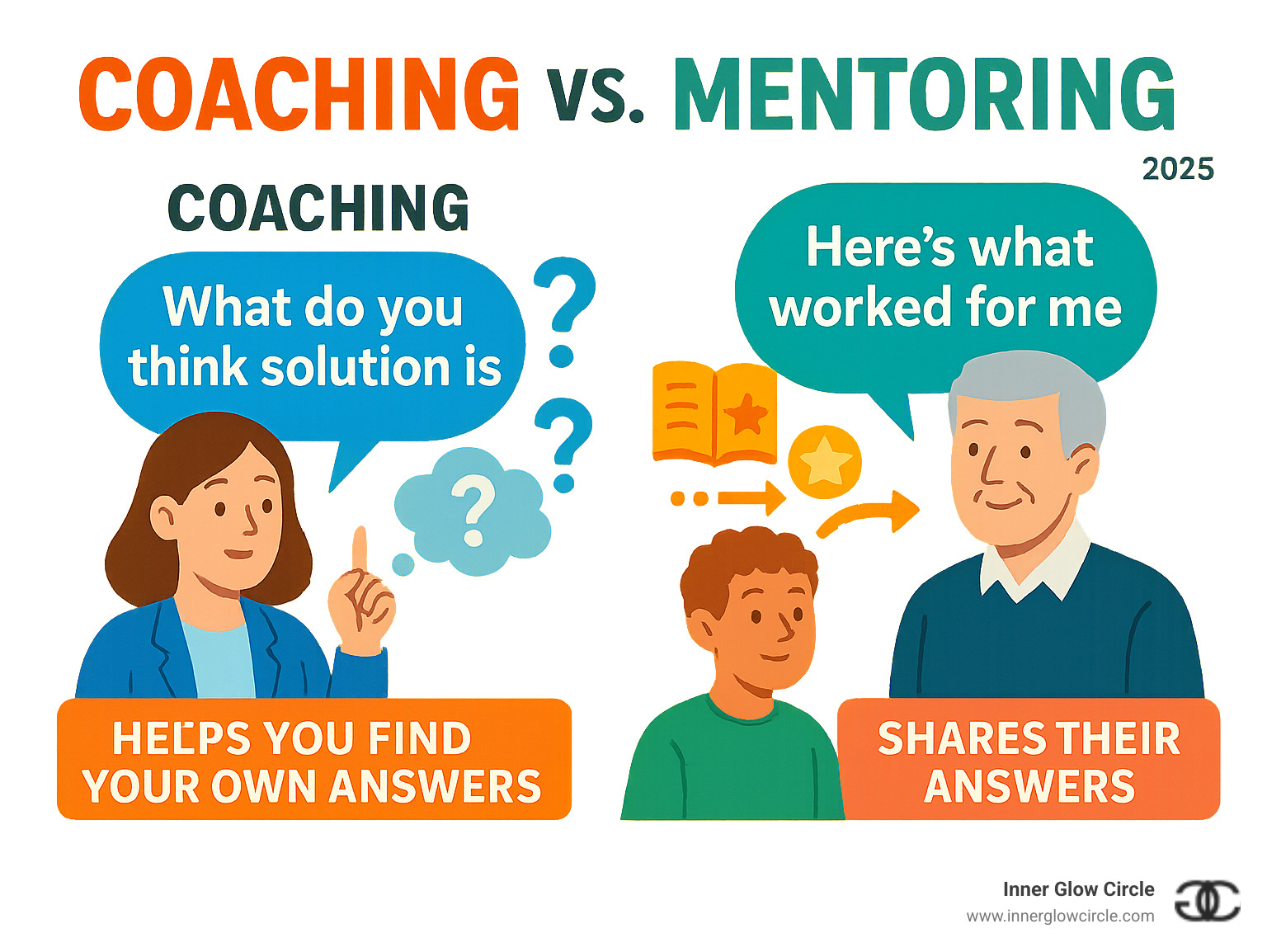
- Coaching: Performance-focused and short-term, where a coach helps you find your own solutions.
- Mentoring: Development-focused and long-term, where an experienced professional shares their knowledge.
- Focus: Coaches improve specific skills; mentors guide overall career development.
- Duration: Coaching typically lasts months; mentoring can span years.
- Approach: Coaches ask powerful questions; mentors provide direct advice.
The numbers tell a compelling story. Research shows that 90% of employees with a career mentor are happy at work, while 70% of people who receive coaching report improved work performance. Even more impressive: 86% of companies say they recouped their investment in coaching programs.
For aspiring professionals, knowing when to seek coaching versus mentoring can accelerate your growth. Whether you want to build confidence, develop skills, or steer your career, choosing the right approach saves time and maximizes results.
While both involve guidance, choosing the right one for your situation can transform your professional journey from uncertain to unstoppable.
Mentorship and coaching vocab to learn:
What is Coaching? The Performance-Driven Path

Think of a coach as a skilled partner who helps you open up your potential. The International Coach Federation defines coaching as “Partnering with clients in a thought-provoking and creative process that inspires them to maximize their personal and professional potential.” This captures coaching’s unique quality: it helps you find your own answers, rather than being told what to do.
Coaching is performance-driven with a focus on specific, measurable goals. Unlike long-term mentoring, coaching is typically short-term, lasting several months to a year. The structure is formal and organized, with regular sessions and clear objectives. The agenda is co-created, meaning you build your own path with expert guidance, focusing on targeted improvement with measurable outcomes.
For example, if you freeze during presentations, a coach helps you explore the root cause and find your own strategies for confidence, creating an authentic action plan.
More info about what life coaching is
The Coach’s Role and Required Skills
A coach is your guide and facilitator. They are process experts, not necessarily subject matter experts in your field. Their expertise lies in helping you think through challenges to find your own solutions.
This happens through thought-provoking questions. Instead of giving advice, a coach asks, “What do you think might work?” This approach builds confidence and ensures the solutions are yours. Many coaches use frameworks like the GROW model (Goal, Reality, Options, Will) to guide conversations.
Essential coaching skills include active listening, neutrality (not pushing their own opinions), and goal setting. Their feedback is specific and constructive, focusing on behavior. Genuine empathy and presence create a safe space for growth.
More info on how to become a life coach
When to Seek a Coach
Coaching is ideal for specific objectives when you’re ready for action. Consider a coach for:
- Skill development: Mastering public speaking or negotiation.
- Performance improvement: Overcoming plateaus or work challenges.
- Preparing for advancement: Strengthening your leadership presence for a promotion.
- Leadership development: Refining decision-making or team connection.
- Overcoming specific challenges: Managing stress, time, or difficult conversations.
The key is having clear goals and a willingness to do the work. If you want focused, actionable support for measurable results in a short time, coaching is your ideal choice.
More info on executive coaching for professional growth
What is Mentoring? The Development-Driven Journey

Picture someone who has walked the path you’re on, faced similar challenges, and achieved the success you’re working toward. This is the essence of mentoring.
A mentor is an “experienced and trusted advisor.” BusinessDictionary.com defines mentoring as a system where a senior individual advises or guides a junior one. It’s like having a wise guide who shares their roadmap with you.
Unlike coaching, mentoring is development-driven, taking a holistic and long-term approach. These relationships often span years, are informal and relationship-based, and grow from mutual respect. The agenda is mentee-driven; you bring your questions, and your mentor shares their wisdom.
While a coach improves a specific skill, a mentor helps you understand how that skill fits into your overall career, industry politics, and the unwritten rules of success.
More info about mentorship programs
The Mentor’s Role and Required Skills
A mentor is an advisor and role model. Unlike coaches, mentors are subject matter experts with direct experience in your field. In mentoring, the mentee asks for guidance, and the mentor responds by sharing what they’ve learned.
The magic is in this exchange of real experience. A mentor shows what’s possible by sharing their journey. Key skills include sharing experience in a relevant way, relationship building to create a safe space, and providing advice and guidance with context. A valuable gift a mentor offers is networking opportunities, opening doors and making introductions. Research shows that mentoring is linked to higher job satisfaction, better pay, and more promotions.
When to Seek a Mentor
Mentoring is invaluable for broader guidance and long-term perspective. Seek a mentor for:
- Career guidance: Navigating big-picture questions about your professional path.
- Navigating organizational culture: Understanding unspoken rules and avoiding political landmines.
- Succession planning: Preparing for leadership roles by learning what it takes to succeed.
- Expanding professional network: Gaining access to connections that could take years to build alone.
- Personal development: Growing as a person by learning about work-life balance, confidence, and integrity.
More info on personal development coaching services
Key Differences: Mentorship and Coaching at a Glance
Here’s a quick reference guide comparing mentorship and coaching.
| Aspect | Coaching | Mentoring |
|---|---|---|
| Focus | Performance-driven, specific skills | Development-driven, holistic growth |
| Timeframe | Short-term (weeks to months) | Long-term (months to years) |
| Structure | Formal, structured meetings | Informal, relationship-based |
| Agenda | Co-created, goal-oriented | Mentee-driven |
| Role | Guide, facilitator, process expert | Advisor, role model, subject matter expert |
| Outcome | Specific, measurable improvements | Broad personal and professional growth |
The fundamental difference is simple: coaching improves performance, while mentoring fosters development. A coach helps you find your own solutions through powerful questions. A mentor shares their experience and insights, offering perspective from their own journey.
Despite differences, both relationships are built on trust, confidentiality, and excellent communication. The magic happens when you find someone who genuinely cares about your growth.
More info on finding your purpose
Can a Coach Also Be a Mentor?
Yes, a coaching relationship can evolve into a deeper, hybrid role. For example, after a coach helps you with a specific skill, the relationship might shift to broader career questions, with the coach sharing their own experiences. This relationship evolution is common and valuable.
The key is to recognize and discuss this shift openly. It’s important to maintain boundaries and clarity. The best hybrid coach-mentors will clarify which role they’re playing, saying, “As your coach…” or “From my experience…”
Choosing Between Mentorship and Coaching
Deciding which path is right starts with an honest self-assessment of your needs and goals. Ask yourself:
- Are you looking to solve a specific challenge or develop a particular skill? Coaching is likely your answer.
- Do you need broader guidance on your career path from someone with experience? A mentor could be perfect.
Consider your career stage. Early-career professionals may benefit more from a mentor’s guidance on industry norms, while established professionals facing specific challenges might prefer a coach.
You don’t have to choose just one. Many successful professionals use both. Aligning with your goals is what matters most. If your goal is clear and short-term, choose coaching. If you’re looking for long-term wisdom, choose mentoring.
Both paths lead to growth; they just take different routes.
The Impact of Mentorship and Coaching in the Workplace

Mentorship and coaching are more than perks; they are strategic investments that create measurable, lasting change for individuals and organizations. The numbers are impressive, showing real change that helps employees thrive.
Benefits for Individuals
For individuals, the changes are often profound. When someone is invested in your growth, work becomes a place to flourish.
- Job satisfaction: 90% of mentored employees report being happy at work.
- Higher compensation and promotions: Guided employees are more likely to advance and earn more.
- Performance improvements: 70% of coached individuals report better work performance.
- Confidence boost: Supportive guidance opens doors to leadership and entrepreneurship, especially for women.
More info on confidence for female entrepreneurs
Benefits for Organizations
Smart organizations know that investing in people is profitable. The benefits are clear:
- Return on investment (ROI): 86% of companies say they recouped their investment in coaching.
- Employee retention: Mentoring is essential for keeping talent, as 40% of unmentored employees consider quitting.
- Learning culture: When knowledge flows freely, collaboration and innovation flourish.
- Succession planning: Organizations can nurture future leaders from within, creating continuity and preserving institutional knowledge.
More info on business coaching
Implementing and Supporting Effective Programs
Successful programs require thoughtful planning and support. Key elements include:
- Designing effective programs: Start with clear objectives, such as skill development or improved retention.
- Matching participants: Thoughtful matching considers personality, goals, and communication styles.
- Training: Essential training in active listening, feedback, and questioning improves program effectiveness.
- Clear guidelines: Establish expectations for meeting frequency and confidentiality.
- Measuring success: Use surveys and track career advancement to improve programs over time.
Avoid common pitfalls like unclear objectives, poor matching, lack of commitment, and insufficient training. Protecting confidentiality is paramount to building trust.
More info on diversity in coaching
Thoughtfully implemented programs create a win-win where individuals grow and organizations benefit.
Frequently Asked Questions about Mentorship and Coaching
Here are answers to common questions about mentorship and coaching to help you choose the right path for your growth.
What is the single biggest difference between a coach and a mentor?
The core difference: coaching is task-oriented (performance), while mentoring is relationship-oriented (development).
A coach helps you find your own answers through powerful questions. A mentor shares their own answers and experiences, offering direct advice and connections. The best choice depends on whether you need help finding your own solutions or want to receive wisdom from an expert.
Should I get a coach or a mentor for my career?
This decision depends on your current needs.
Choose a coach for specific, short-term goals. If you’re preparing for a promotion or want to improve a skill, a coach provides a structured process and accountability.
Choose a mentor for long-term, broad career guidance. A mentor is perfect for navigating culture, networking, and getting big-picture perspective.
You don’t have to pick just one. Many successful women use both, sometimes simultaneously, as their needs evolve.
Can my manager be my mentor?
While your manager can provide guidance, an effective mentor is often not your direct supervisor. This is because your manager’s responsibility for your performance review can make it difficult to be fully transparent about challenges or aspirations.
A mentor outside your reporting line provides a safer space for honest conversations. They also offer a broader perspective on the organization and industry, free from day-to-day team dynamics. For these reasons, many companies encourage cross-departmental mentoring.
Conclusion: Charting Your Course for Growth
I hope you’re now clearer on the distinction between mentorship and coaching. Think of coaching as a performance GPS—structured and focused on helping you find your own way. Mentoring is like having a trusted travel companion who shares insights from their journey. Both require trust, open communication, and commitment to be effective.
The key is matching your current needs with the right support. Need to master a skill? A coach is your partner. Seeking broad career guidance? A mentor is your guide.
The statistics are powerful: 90% of mentored employees are happy at work, and 70% of coached individuals see improved performance. This represents genuine, positive change.
At Inner Glow Circle, we know understanding these differences is a game-changer for women. Our approach combines the structured skill-building of coaching with the supportive wisdom of mentoring. We believe every woman deserves to feel confident and empowered, whether seeking guidance or ready to guide others.
Your growth doesn’t have to be a solo journey. Taking the first step toward coaching or mentoring is what matters most. Ready to find your path? Your future self will thank you.
Become a certified coach or find a mentor


