

Why Leadership Coaching Programs Are Essential for Career Growth
Mentor and coaching programs for leadership are essential investments for advancing your career and building stronger organizations. If you’re struggling to transition from individual contributor to effective manager, you’re not alone.
Quick Answer: What Are Leadership Coaching and Mentor Programs?
- Coaching programs improve current job performance by helping you resolve specific challenges and improve skills with a professional coach.
- Mentoring programs focus on your future career path by pairing you with experienced leaders who share knowledge and expand your network.
- Combined programs offer both immediate skill development and long-term career guidance.
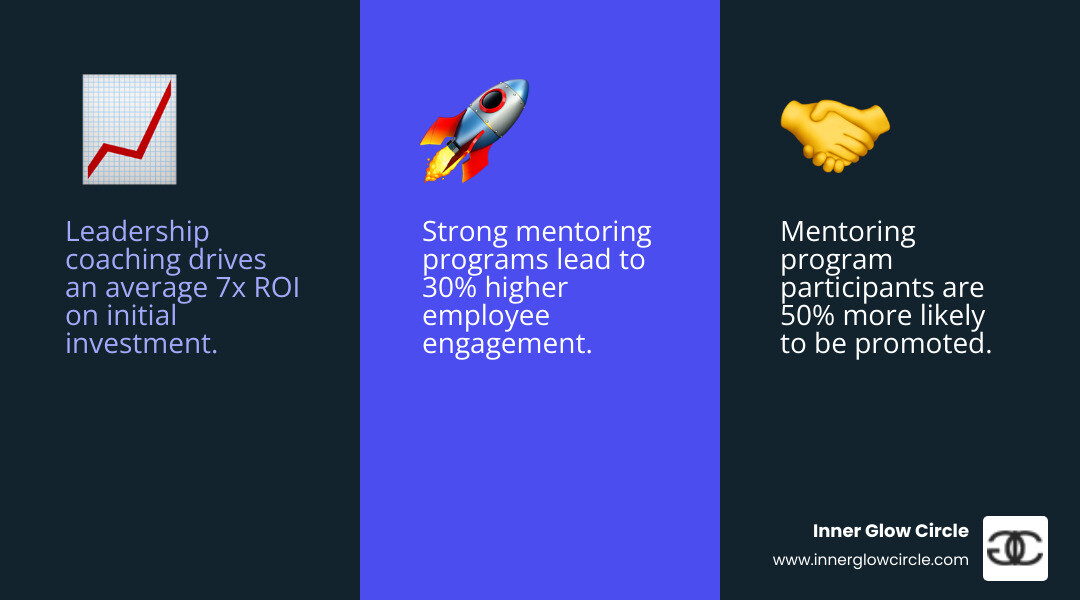
These programs deliver real results. Organizations see an average ROI of 7 times their initial investment in leadership coaching. Participants in mentoring programs are 50% more likely to be promoted, and their companies report a 30% higher employee engagement rate.
The skills that made you a great individual contributor aren’t always enough to make you a great leader. Challenges like delegating, managing former peers, or battling imposter syndrome are exactly what coaching and mentoring are designed to address. As the demands on leaders evolve, the right program can transform how you lead, whether you’re a new manager or a seasoned executive.
Related content about mentor and coaching programs for leadership:
Understanding the Landscape: Coaching vs. Mentoring for Leaders

Many people confuse coaching and mentoring, but understanding the difference is key to your development.
What is Coaching in a Leadership Context?
Think of a leadership coach as a guide for the present. Coaching focuses on your current job performance, helping you work through specific challenges like having a difficult conversation or learning to delegate effectively. A coach doesn’t give you answers; they ask powerful questions to help you find your own. This process of co-created support builds deep self-awareness, which is the foundation of great leadership. The coaching relationship is typically structured and task-oriented, with clear goals for improving specific skills.
What is Mentoring in a Leadership Context?
Mentoring looks to the future. A mentor is an experienced guide who has already walked the path you’re on. They share wisdom from their own career to help you steer yours. This intentional, developmental relationship is focused on your long-term career path. A mentor can expand your professional network, introduce you to new opportunities, and advocate for your advancement. The relationship is often longer-term and relationship-oriented, preparing you for tomorrow’s challenges.
Key Differences Between Coaching and Mentoring
| Feature | Coaching | Mentoring |
|---|---|---|
| Goal Focus | Task-oriented, performance-driven | Relationship-oriented, development-driven |
| Timeframe | Short-term, addressing immediate needs | Long-term, career path and future growth |
| Primary Focus | Skill development and current performance | Career guidance and future capability |
| Relationship Dynamic | Often formal, structured sessions | Can be formal or informal, more organic |
| Direction | You set the agenda; the coach facilitates. | The mentor shares wisdom and guidance. |
In short, coaching asks, “How can you perform better today?” while mentoring asks, “Where do you want to be in five years?”
The Synergy of Both Approaches: Mentor-Coaching
You don’t have to choose. The most effective mentor and coaching programs for leadership blend both. A mentor-coach might share a personal experience (mentoring) and then use coaching questions to help you find your own solution. This integrated approach provides immediate help with current challenges plus long-term guidance for future opportunities, creating a powerful support network for your growth.
The Transformative Benefits of Leadership Coaching and Mentoring

Investing in mentor and coaching programs for leadership creates tangible changes for both individuals and the organizations they work for.
What Individual Leaders Gain
Coaching and mentoring build more effective leaders from the inside out. A primary benefit is increased self-awareness, which transforms communication and decision-making. You learn to listen more effectively and ask better questions, shifting from a manager people work for to a leader they want to work with.
The career impact is significant. Employees in mentoring programs are 50% more likely to be promoted because they gain access to new networks, learn the unwritten rules of advancement, and have an advocate for their growth. Most importantly, these programs build resilience and confidence. Having a safe space to process challenges helps leaders not just survive, but thrive.
What Organizations Experience
The benefits ripple across the entire company. Organizations with strong mentoring programs see 30% higher employee engagement and can improve retention by up to 50%. When people feel their company is invested in their growth, they are more loyal and motivated.
Productivity also increases. A culture of coaching can lead to a 15% increase in organizational productivity and a 20% reduction in the time it takes for new managers to become effective. This all contributes to the bottom line: companies that invest in leadership coaching see an average ROI of 7 times their initial investment.
The most strategic benefit is building a stronger leadership pipeline. By developing talent from within, organizations ensure they have capable, culturally-aligned leaders ready to step up, creating a sustainable competitive advantage.
Exploring Different Types of Mentor and Coaching Programs for Leadership
Not all leadership development programs are the same. The best mentor and coaching programs for leadership are custom to different needs, whether you’re a new manager or a C-suite executive. Understanding the various program structures helps you find the right fit for your goals.
Executive Coaching Programs
Executive coaching is a highly personalized form of leadership development for C-suite leaders, senior executives, and high-potential individuals. The focus is on providing customized guidance for unique, high-stakes challenges, such as leading organizational change or improving board communication.
These relationships are built on confidentiality, creating a safe space for leaders to have honest conversations without judgment. Executive coaches often act as strategic thought partners, asking powerful questions that open up new perspectives on complex decisions. Many programs also blend one-on-one coaching with workshops and peer communities for a comprehensive development experience.
Team and Group Coaching
Team and group coaching leverage the power of collective wisdom. Instead of learning alone, you grow alongside peers facing similar challenges.
- Cohort-based learning brings a group of leaders together to progress through a curriculum. This not only provides structured learning but also builds lasting professional relationships and a strong support network.
- Peer advisory groups act as a personal board of directors. In these small, confidential groups, leaders can work through their challenges with the benefit of diverse perspectives and shared accountability.
- Team coaching focuses on developing the team itself as a single unit. The goal is to improve team dynamics, communication, and collective performance, which can boost a team’s effectiveness by up to 20%.
Specialized and Niche Mentor and Coaching Programs for Leadership
Sometimes, you need a program that understands your specific context. Specialized programs are designed to address the unique challenges of different leadership journeys.
- New leader support is crucial for first-time managers. These programs focus on the difficult transition from individual contributor to leader, addressing common problems like delegation, managing former peers, and imposter syndrome.
- Programs for women in leadership address the unique obstacles women face in the workplace. They provide not only skills but also powerful networks, advocacy, and a community of peers who understand the journey, helping to close the leadership gap.
- Industry-specific programs recognize that leadership in tech is different from leadership in healthcare or non-profits. These programs offer relevant, contextual guidance custom to the norms and challenges of a particular field.
- Innovative models like reciprocal coaching, where professionals coach emerging leaders from underrepresented backgrounds, develop inclusive leadership skills while driving social impact.
The diversity of programs available means there is a path for every leader. The key is to identify what you need now and find the program that can deliver it.
How to Design and Implement a Successful Program

Designing and implementing effective mentor and coaching programs for leadership requires thoughtful planning and commitment. Simply launching a program is not enough; it must be built on a solid foundation.
Assessing Organizational Needs and Defining Objectives
First, understand your organization’s specific challenges. Are new managers struggling? Do senior leaders need strategic support? A clear diagnosis of your needs allows you to define specific, measurable objectives. Instead of a vague goal like “improve leadership,” aim for a concrete target, such as “increase new manager retention by 15% within 12 months.”
Creating a Supportive Culture with Senior Leadership Buy-in
A program’s success depends on the surrounding culture. A “culture of coaching” requires psychological safety, where leaders feel comfortable asking for help. This starts at the top. When senior leaders champion the program, participate as mentors, and openly discuss their own development, it signals that growth is a core value. Their buy-in secures resources and makes development a strategic priority, not just an HR initiative.
Program Design Best Practices
- Start small: Pilot the program with a small group to refine your approach before a full rollout.
- Train everyone: Provide training for mentors, mentees, and coaches to ensure everyone understands their roles and how to maximize the experience.
- Ensure diverse pairings: Mix genders, backgrounds, and career stages to enrich the learning experience with different perspectives.
- Establish confidentiality: Clear rules on confidentiality are essential for building the trust needed for honest conversations.
- Measure and adapt: Regularly track outcomes and gather feedback to continuously improve the program.
Finding the Right Coach or Mentor
The right coach or mentor is critical. Look for key qualities like empathy, strong communication skills, and the ability to listen deeply. For mentors, relevant industry experience is invaluable. For coaches, a proven track record and an understanding of leadership challenges are key.
Professional coaching credentials from bodies like the International Coaching Federation (ICF) indicate a coach has met rigorous training and ethical standards. Finally, a thoughtful matching process that considers personality and goals is crucial, as the chemistry between participants can make or break the experience.
Measuring the Success of Mentor and Coaching Programs for Leadership
To prove value and drive improvement, you must measure success.
- Identify Key Performance Indicators (KPIs): Track metrics like promotion and retention rates, leadership competency scores (using 360-degree feedback), team productivity, and employee engagement.
- Connect to Business Impact: Draw a line from the program to tangible business results, such as increased revenue, cost savings, or improved customer satisfaction.
- Calculate ROI: Quantify the program’s financial benefits (e.g., reduced turnover costs) and compare them to the costs. An average ROI of 7x the initial investment is a powerful data point.
- Gather Qualitative Feedback: Use surveys and interviews to understand participants’ experiences and gather stories that illustrate the program’s impact.
Measurement should be an ongoing process used to refine and adapt your program over time.
Frequently Asked Questions about Leadership Development
Investing in mentor and coaching programs for leadership is a big decision. Here are honest answers to the most common questions we hear.
What specific challenges do new leaders face and how can coaching help?
The transition to leadership is often harder than expected. New leaders commonly struggle with:
- Shifting from “doer” to “leader”: Realizing their success now depends on their team’s performance, not just their own.
- Delegation: Trusting their team with work they could do faster themselves.
- Imposter syndrome: Feeling unqualified in a new, high-stakes role.
- Managing former peers: Navigating the awkward shift in relationship dynamics.
- Time management: Juggling strategic responsibilities with daily operational demands.
Coaching provides a confidential, supportive space to steer these challenges. A coach helps new leaders gain perspective, develop crucial skills like giving feedback and delegating effectively, and build the confidence to grow into their role.
What is the typical cost and ROI of leadership coaching?
The cost of leadership coaching varies based on the coach’s experience and the program’s length and format, ranging from a few thousand to tens of thousands of dollars. Group coaching is typically more affordable than one-on-one executive coaching.
However, the return on this investment is significant. Research shows companies see an average ROI of 7 times their initial investment. This return comes from measurable improvements in:
- Productivity: Coached leaders empower their teams more effectively.
- Retention: Better leadership creates environments where people want to stay.
- Decision-making: Leaders gain clarity and strategic focus.
For an individual, coaching can accelerate career growth and lead to promotions that far outweigh the cost. For an organization, it’s a strategic investment in building a stronger, more effective workforce.
What role do senior leaders play in the success of these programs?
Senior leaders are essential for a program’s success. Their role is to:
- Champion the initiative: Their public endorsement signals that leadership development is a strategic priority.
- Secure resources: They allocate the budget and personnel needed for a high-quality program.
- Serve as mentors: By sharing their experience, they provide invaluable, real-world wisdom to emerging leaders.
- Model the behavior: When senior leaders engage in coaching themselves, they create a culture of psychological safety and continuous learning.
Without active senior leadership buy-in, development programs can be seen as optional or remedial. With it, they become powerful tools for building the organization’s future.
Conclusion
Leadership is a journey you don’t have to walk alone. Mentor and coaching programs for leadership provide the support system to transform not just individual careers, but entire organizations.
We’ve seen the difference between coaching (excelling in your current role) and mentoring (opening doors to your future), and how combining them creates comprehensive support. The results are clear: leaders gain confidence and self-awareness, while organizations see a 7x ROI, 50% better retention, and 30% higher engagement. From executive coaching to specialized programs for new managers, there is a pathway for every leader.
These programs work because they address the human side of leadership—the difficult transitions, the imposter syndrome, and the challenge of leading people. They create a space for honest conversation and real growth.
At Inner Glow Circle, we’ve witnessed the change that happens when women leaders receive the support, training, and community they need to thrive. We believe in coaching as a catalyst for authentic leadership.
Your leadership journey is unique. The question isn’t whether these programs work—the research is clear that they do. The question is: are you ready to invest in yourself?
Explore our mentor coaching programs and find how we can support your journey to confident, authentic leadership.


