

Why Your Growth as a Manager Matters
Manager personal development goals are objectives that improve your leadership skills and effectiveness in guiding your team. Key areas to focus on include:
- Strategic Thinking: Develop long-term vision and align team goals with company objectives.
- Communication: Master active listening, feedback, and conflict resolution.
- Emotional Intelligence: Build self-awareness, empathy, and stronger relationships.
- Coaching: Learn to mentor and empower your team members.
- Delegation: Trust your team and avoid micromanagement.
- Time Management: Prioritize effectively and boost productivity.
- Adaptability: Lead through change with resilience.
- Cross-Functional Knowledge: Understand different departments and foster collaboration.
Your growth directly impacts your team’s success. In fact, managers account for at least 70% of the variance in employee engagement scores. As leadership expert John Maxwell’s “leadership lid” concept explains, a team cannot grow beyond its leader’s ability. Your struggles become your team’s struggles.
The good news is that great leaders are made through continuous learning. When you invest in your growth, you create a ripple effect: your team becomes more engaged, your organization more productive, and you become a more confident leader. Setting clear development goals is the roadmap to transform from managing tasks to inspiring people.

The Ripple Effect: Benefits of Setting Manager Personal Development Goals
When you invest in yourself as a manager, everyone wins. Setting manager personal development goals creates a ripple effect, benefiting you, your team, and your organization. Your growth shapes the culture around you, and as Harvard Business Review notes, positive work cultures are significantly more productive.
Organizations that support manager development see higher retention and attract better talent. When you commit to continuous learning, you become more adaptable and better equipped to guide your team through challenges.
Benefits for You as a Manager
Achieving your leadership goals boosts your confidence and ability to handle bigger challenges. Professional satisfaction goes beyond promotions; it’s about forming meaningful relationships and achieving a healthy work-life balance.
Prioritizing your well-being makes you happier, less stressed, and a better performer. This prevents you from being promoted beyond your capabilities. Career advancement becomes a natural outcome of your development, allowing you to steer your career confidently.
To accelerate your journey, life coach coaching can provide valuable support.
Benefits for Your Team and Organization
Your growth directly impacts those around you. As you develop stronger leadership skills, team morale and engagement improve. When you provide meaningful feedback and coaching, your team becomes more productive.
For the organization, this translates to lower turnover, stronger team performance, and a culture where innovation thrives. When you lead by example—seeking feedback and learning from mistakes—you empower your team to do the same. This commitment to growth transforms your entire workplace, creating an environment where everyone can flourish.
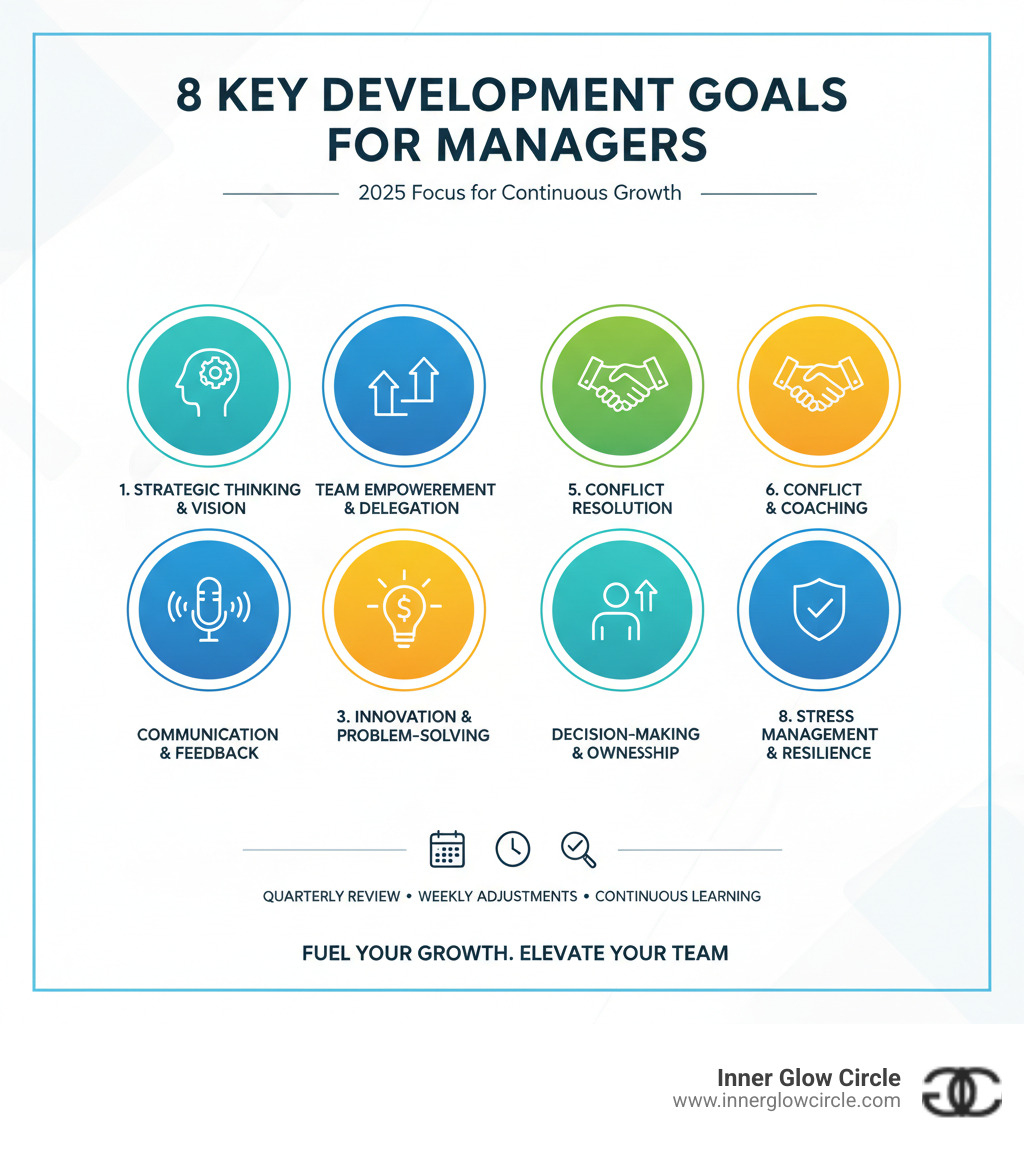
8 Key Development Goals to Lift Your Leadership

As a manager, you’re constantly juggling tasks. These eight manager personal development goals provide a clear roadmap for growth, focusing on the leadership and soft skills that truly make an impact.
1. Master Strategic Thinking and Vision
Strategic thinking is about seeing the bigger picture and connecting your team’s work to it. Developing this skill improves long-term planning, risk assessment, and alignment of team tasks with company objectives. When your team understands the “why” behind their work, their focus sharpens and they achieve more. This also involves understanding financial forecasting and how business decisions impact the bottom line. If these skills feel overwhelming, a Personal and Professional Development Coach can help break them down into manageable steps.
2. Improve Your Communication and Influence
Clear, empathetic communication is the foundation of effective management. This goal includes active listening, providing effective feedback, public speaking, conflict resolution, and negotiation. Since 80% of employees who receive meaningful feedback weekly are highly engaged, regular communication is a powerful tool. Build influence by involving your team in decisions and listening to their input. Simple actions like restating ideas in meetings or editing emails for clarity can build trust. Mastering this skill creates an environment where people feel heard, valued, and motivated. For more support in this area, explore our Communication Coaching and Resources.
3. Develop Stronger Emotional Intelligence (EQ)
Emotional intelligence (EQ) is the ability to understand and manage your own emotions while reading and influencing others’. Your mood affects your team, so self-awareness and self-regulation are critical manager personal development goals. When you stay composed under pressure, your team follows your lead. Build your EQ by practicing empathy—respond to concerns with active listening and support. Mindfulness exercises can also help you stay grounded. These practices create a psychologically safe environment where people feel comfortable taking risks. Managers with high EQ foster positive relationships and harmonious teams. For support, consider Executive Coaching for Professional Growth.
4. Become an Effective Coach and Mentor for Your Team
How you coach and mentor your team significantly impacts their engagement. Teams are more engaged when managers focus on their strengths. Becoming an effective coach means discussing goals, giving constructive feedback, offering praise, and identifying future leaders. While coaching focuses on current performance and mentoring guides long-term career development, you’ll likely do both. Investing in your coaching abilities creates a supportive, growth-oriented environment that empowers your team and strengthens its capabilities. To learn more about guiding others, see our Mentorship Coaching: Complete Guide.
5. Improve Delegation and Team Empowerment
Effective delegation is a powerful tool for empowering your team, fostering their growth, and freeing you up for strategic work. It builds trust and confidence, whereas micromanagement leads to resentment and burnout. Great delegation involves defining tasks clearly, providing resources, and offering support without hovering. Trusting your team to handle tasks—even if their approach differs from yours—helps them develop new skills. Think of delegation as succession planning in action; it creates a resilient workforce and demonstrates trust. For more insights, explore our resources on Leadership and Delegation Coaching.
6. Sharpen Your Time Management and Productivity
Effective time management is a managerial superpower. The “10/90 rule” suggests that 10% of time spent on planning saves 90% of the time in execution. This skill involves prioritization, systematic task management, and reducing distractions. Experiment with systems like time-blocking or the Pomodoro technique to find what works for you. A quick win is to identify and cut non-essential tasks. When you model good time management, your team learns to plan effectively and meet deadlines, which also helps you reduce stress and prevent burnout. For inspiration, see The Daily Routine of a Woman Entrepreneur.
7. Lead Through Change with Adaptability and Resilience
In a constantly changing business environment, leading with adaptability and resilience is essential. During unexpected shifts, your team will look to you for cues. A calm, focused response can prevent anxiety from spreading. Building resilience involves embracing continuous learning, staying informed about industry changes, and cultivating curiosity to find innovative solutions. It also means managing your own stress and regulating your emotions during turbulent times. This emotional steadiness inspires your team to adopt a proactive, agile outlook. For support, consider exploring Resilience and Change Coaching.
8. Expand Your Cross-Functional Knowledge
Great leaders understand their organization is an ecosystem. Expanding your cross-functional knowledge means learning how other departments operate and fostering collaboration. Seek cross-training experiences, like shadowing a colleague in another department, to broaden your perspective. Understanding how different parts of the organization fit together helps you make better decisions, spot collaboration opportunities, and align your team with broader strategic goals. This holistic view makes you more valuable, enabling you to bridge gaps and contribute to high-level strategic conversations. To explore this further, check out our Professional Development Goals and Programs and Self-Discovery Coaching Program.
How to Set and Achieve Your Development Goals

Setting manager personal development goals is exciting, but achieving them is where change happens. With the right framework and planning, you can turn aspirations into tangible results.
Define Your Goals Using the SMART Framework
The SMART framework provides a clear roadmap for personal development.
- Specific: Be crystal clear. Instead of “be a better communicator,” aim to “lead weekly team meetings where everyone contributes.”
- Measurable: Track your progress. Aim to “delegate three major projects this quarter and receive positive feedback.”
- Achievable: Set realistic goals that stretch but don’t break you. Commit to one new framework per quarter, not five in a month.
- Relevant: Ensure goals align with your career and life aspirations. This “why” will keep you motivated.
- Time-bound: Set deadlines to create healthy urgency and accountability.
For practical tools, explore our Goal Setting for Managers resources.
Create an Actionable Individual Development Plan (IDP) for your manager personal development goals
An Individual Development Plan (IDP) is your personalized roadmap for growth.
- Start with a self-assessment: Honestly evaluate your strengths and weaknesses. Ask trusted colleagues for feedback to uncover blind spots.
- Break down goals: Divide large goals into smaller, manageable tasks (e.g., read one book on strategy this month).
- Set milestones: Create checkpoints to stay motivated and track progress.
- Identify resources: Determine what you need, whether it’s a coach, mentor, online courses, or dedicated time in your calendar.
- Create a timeline: Set realistic dates to create accountability.
An IDP is a living document that evolves with you. Collaborating with HR or leadership can help align your plan with organizational goals as you Find Your Purpose.
Tracking Progress and Overcoming Common Challenges
Consistent tracking is key to follow-through. Schedule regular check-ins with a supervisor or mentor, and use journaling to reflect on wins and struggles. Actively seeking feedback from your team provides real-time data on your progress.
Be prepared for common challenges:
- Time constraints: Treat your development time as sacred. Even one hour a week makes a difference.
- Workload management: Use your delegation skills to free up time for growth.
- Lack of resources: Get creative with free webinars, podcasts, and informal mentorship.
- Resistance to change: When you feel resistance, reconnect with your “why” to stay motivated.
Celebrate small wins to build momentum and confidence. The journey isn’t always smooth, but what matters is that you keep moving forward. This dedication applies to any growth journey, including learning How to Start Making Money as a Coach.
Frequently Asked Questions about Manager Personal Development Goals
Here are answers to common questions about manager personal development goals.
How do personal development goals differ from performance goals?
Personal development goals are about who you’re becoming. They focus on long-term growth and skill acquisition, like “improve active listening skills.” They are investments in your future capabilities.
Performance goals are about what you’re achieving now. They focus on measurable, short-term results tied to your job responsibilities, like “increase team sales by 15% in Q3.”
While performance goals keep you accountable for today’s results, personal development goals prepare you for tomorrow’s challenges.
How often should I review my development goals?
Review your goals more often than you think. A manager’s IDP should be formally reviewed and updated at least quarterly to ensure progress and alignment with organizational needs. However, the most successful managers treat growth as a continuous process. Weekly or bi-weekly personal check-ins help you stay on track and make small adjustments. This ensures your goals remain dynamic and adaptable.
How can my organization support my growth as a manager?
Your organization plays a pivotal role in your development. Support can come in several forms:
- Training budgets: Funding for courses, certifications, and workshops.
- Mentorship programs: Pairing you with experienced leaders for guidance.
- Dedicated time: Protecting your calendar for learning and development activities.
- A learning culture: Creating a safe environment where experimentation and learning from mistakes are encouraged.
- Access to coaching: Providing personalized support through leadership coaching programs.
When senior leadership prioritizes development, it creates a powerful ripple effect. HR and leaders can help tailor your IDP to meet both individual and organizational needs.
Conclusion: Your Journey to Exceptional Leadership Starts Now

Becoming an exceptional leader is a journey of continuous growth. Every step you take creates a ripple effect, touching your team and organization. By setting intentional manager personal development goals, you invest in your career, empower your team, and foster a culture of growth.
We’ve explored eight key development areas—from strategic thinking to cross-functional knowledge—that offer a pathway to becoming a leader who inspires people. Your impact is profound, as you account for a significant portion of your team’s engagement. Committing to your own evolution inspires others and creates a positive work culture where innovation thrives.
At Inner Glow Circle, we believe the best leaders are those who are committed to their personal evolution. When women invest in their growth and take consistent action, magic happens in their careers and lives.
So, where do you go from here? Start small. Pick one or two development areas, use the SMART framework to define your goals, and create your IDP. Your journey to exceptional leadership starts now.
Ready to take the next step? Learn more about career and personal development and find how we can support you in open uping your full potential.


