

Open uping Your Full Potential Through Coaching
Life coaching for personal growth is a collaborative partnership that helps you identify goals, overcome obstacles, and achieve meaningful change in your life. If you’re wondering what exactly this transformative process involves, here’s what you need to know:
- Definition: A structured relationship where a trained coach helps you maximize your personal and professional potential
- Focus: Future-oriented development rather than past healing
- Process: Goal-setting, accountability, powerful questioning, and action planning
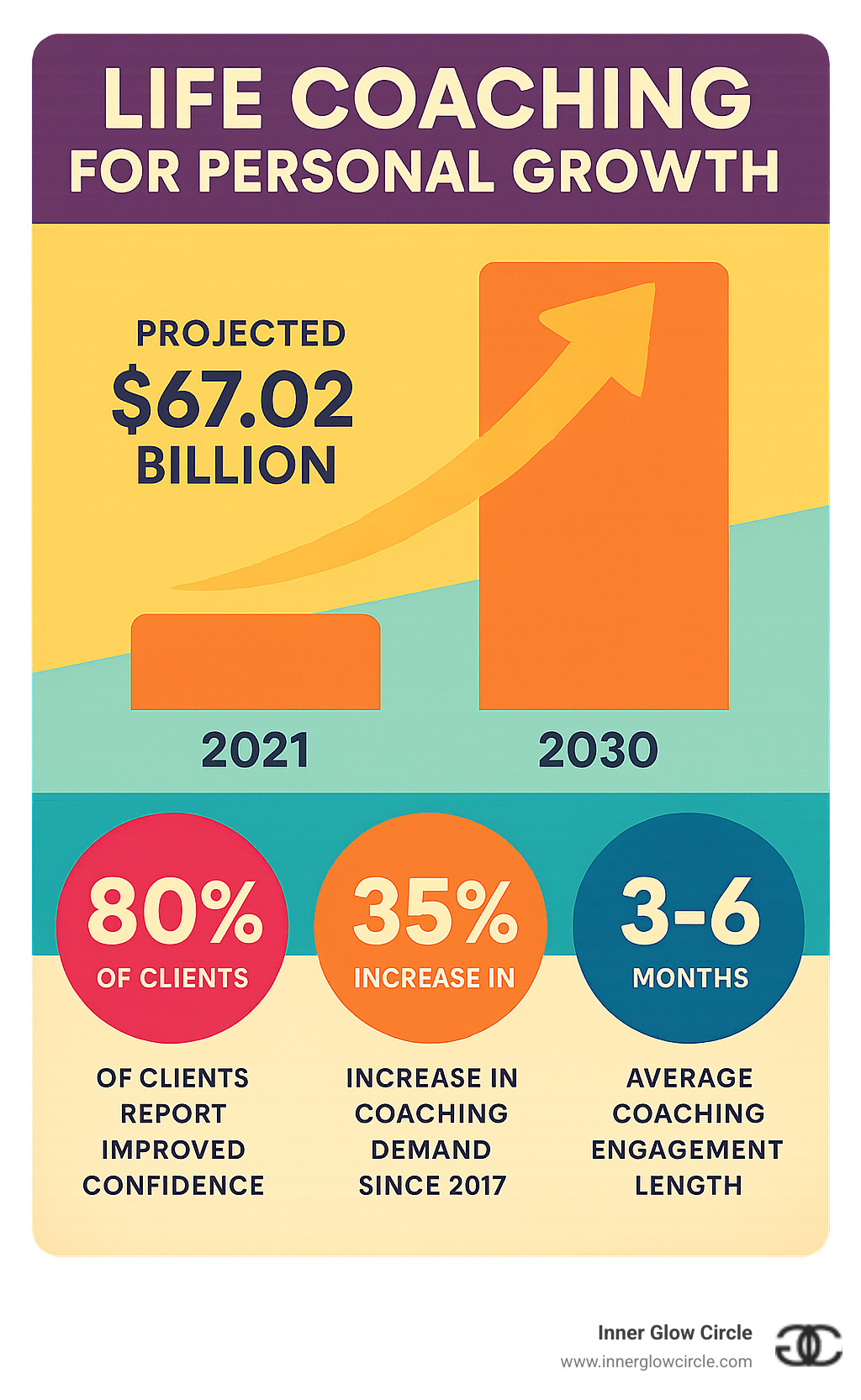
- Benefits: Increased self-confidence (80% of clients report improvement), improved communication skills, better work-life balance
- Investment: Typically 3-6 months with 1-2 hour sessions
Life coaching fills a unique space between therapy (which focuses on healing past issues) and consulting (which provides expert advice). Instead, coaches partner with you in a thought-provoking, creative process that inspires you to maximize your own capabilities.
“Life coaching, when done right, can shift the entire trajectory of a person’s life, no matter who they are or where they come from, in an incredibly short time,” notes a coaching industry expert. This explains why the personal development market has boomed to nearly $44 billion in 2022 and is projected to reach $67 billion by 2030.
What makes coaching so powerful? Unlike other helping professions, coaching is built on the premise that you already have the answers within you. A skilled coach simply helps you access your inner wisdom, clarify your goals, and create practical pathways to achieve them.
The coaching relationship provides the structure, accountability and support that most people need to move from where they are to where they truly want to be. It’s like having a co-pilot who helps you steer life’s complexities while keeping you focused on your destination.
Whether you’re feeling stuck in your career, struggling with confidence, or simply wanting to level up your life, working with a life coach can help you break through limitations and create lasting positive change.
Simple guide to life coaching for personal growth:
– careers and personal development
– coaching and personal development
– development coaching
What Is Life Coaching for Personal Growth?
Life coaching for personal growth is like having a trusted partner on your journey of self-findy and improvement. It’s a whole-person approach that helps you become more self-aware, get crystal clear on your values, and take meaningful steps toward the life you truly want.
Think of coaching as a dance between two equals. Your coach doesn’t lead by telling you what to do—instead, they move with you, asking questions that help you find your own rhythm and direction. The International Coach Federation (ICF) beautifully describes coaching as “partnering with clients in a thought-provoking and creative process that inspires them to maximize their personal and professional potential.”
When you work with a personal development coach, you’re signing up for a relationship that honors your wisdom while helping you see beyond your current perspective. Your coach becomes your ally in:
Spotting those pesky blind spots that might be holding you back (we all have them!)
Getting super clear about what truly matters to you at your core
Creating meaningful goals that actually align with who you really are
Developing step-by-step strategies that turn dreams into reality
Staying accountable (because we all know how easy it is to let ourselves off the hook)
Celebrating your wins—both big and small—while adjusting course when needed
What makes life coaching for personal growth so powerful is that it doesn’t fragment your life into separate boxes. A good coach understands that you’re a whole person—your career satisfaction spills into your relationships, your physical wellbeing affects your productivity, and your sense of purpose colors everything else.
As one coaching client so perfectly put it: “I showed up thinking I just needed some career advice, but finded that aligning my work with my deeper values was what really changed everything. My coach helped me connect dots I didn’t even know existed.”
The Science Behind Coaching Change
The magic of coaching isn’t just feel-good fluff—it’s backed by solid science. Your brain’s incredible ability to form new neural connections (neuroplasticity) explains why coaching creates lasting change. Each time you practice a new way of thinking or behaving with your coach’s guidance, you’re literally rewiring your brain for success.
Goal-setting theory also supports why coaching works so well. Psychologists Edwin Locke and Gary Latham found that specific, challenging goals lead to much better performance than vague or easy ones. A skilled coach helps you craft exactly these kinds of powerful goals.
The evidence speaks for itself. A study published in the National Library of Medicine found that coaching significantly improved goal achievement, resilience, and workplace wellbeing while reducing depression and stress. This aligns perfectly with ICF statistics showing that a whopping 80% of coaching clients report better self-confidence after working with a coach.
The science reveals that coaching works because it hits the sweet spot between support and challenge. Your coach creates accountability structures that boost your follow-through, offers objective feedback you can’t get from just reflecting on your own, helps you leverage your natural strengths while addressing limitations, and builds your resilience by guiding you through setbacks.
As neuroscientist Dr. David Rock insightfully notes, “Coaching helps people think better, not just know more.” This distinction is crucial—life coaching for personal growth isn’t about filling your head with more information. It’s about changing how you process information and make decisions that shape your life.
Coaching vs Therapy, Mentoring & Counseling: The Real Differences
Feeling confused about which personal development path is right for you? You’re not alone. Many people wonder how life coaching for personal growth differs from therapy, mentoring, and counseling. While these approaches may seem similar at first glance, they each serve distinct purposes in your development journey.
Think of it this way: if personal growth were a house, therapy might focus on repairing the foundation, mentoring would be like having an experienced architect share their blueprints, counseling offers specific advice for immediate renovations, while coaching helps you design and build your dream addition.
| Aspect | Life Coaching | Therapy | Mentoring | Counseling |
|---|---|---|---|---|
| Primary Focus | Future goals & potential | Past healing & mental health | Expertise & knowledge transfer | Problem-solving & advice |
| Timeframe | Present & future | Past & present | Present & future | Present & immediate future |
| Relationship | Partnership of equals | Provider-patient | Expert-novice | Advisor-advisee |
| Approach | Questions & accountability | Diagnosis & treatment | Guidance & modeling | Analysis & recommendations |
| Duration | 3-6 months typically | Often long-term | Variable | Often short-term |
| Credentials | ICF certification (not legally required) | Licensed by state boards | Experience-based | Licensed by state boards |
What makes life coaching for personal growth unique is its “process consultation” approach. As one coach beautifully put it, “I don’t give you a fish or even teach you to fish—I help you find your own unique fishing style.” This captures the essence of coaching’s empowering philosophy.
Therapy, while incredibly valuable for mental health support, typically looks backward to heal wounds and treat psychological conditions. Your therapist might explore how childhood experiences shaped your current patterns, while your coach asks what future you want to create and what might be standing in your way.
When you work with a mentor, you’re essentially learning from someone who’s walked the path before you. They’ll likely share direct advice based on their experience: “Here’s how I steerd this industry, and these approaches might work for you too.” It’s wisdom-sharing at its finest.
Counseling tends to address specific problems with targeted guidance. Your counselor might recommend resources and strategies for handling particular challenges, whereas a coach helps you develop your own solutions from within.
Why Choose Life Coaching for Personal Growth Over Other Modalities
So why might you choose life coaching for personal growth over these other valuable approaches? The answer lies in what you’re truly seeking.
Coaching offers remarkable speed to results—many clients experience significant positive changes within just a few months. This efficiency comes from coaching’s forward-looking orientation, perfect if you’re more excited about creating your future than analyzing your past.
The empowerment aspect of coaching is truly special. Your coach sees you as whole, capable, and resourceful—not broken or needing fixing. As one client shared with me, “Therapy helped me understand why I was stuck, but coaching helped me get unstuck and moving forward.”
Regular check-ins and action plans provide the accountability that many of us need to follow through on our intentions. Let’s be honest—how many great ideas have you had that never materialized because life got in the way? A coach helps keep those important personal goals front and center.
Coaching’s whole-person approach also means you’re not compartmentalizing issues. Your career affects your relationships, your health impacts your productivity—everything’s connected, and coaching honors that reality.
The confidential nature of the coaching relationship creates a judgment-free zone to explore possibilities. Even when employers sponsor coaching, ethical coaches maintain client confidentiality, allowing for authentic exploration of options and feelings.
For those ready to take meaningful action rather than simply gaining insight, opening up to coaching can accelerate personal growth in uniquely powerful ways.
Key Benefits & Focus Areas of Life Coaching

When you start on a life coaching for personal growth journey, you’re not just checking boxes on a self-improvement list—you’re creating ripples of positive change that touch every corner of your life. While your coaching experience will be as unique as your fingerprint, I’ve seen certain changes happen time and again with my clients.
Think about what it would feel like to wake up with genuine confidence in your abilities. Nearly half of coaching clients report this exact shift—moving from self-doubt to self-assurance. This isn’t about puffing yourself up with empty affirmations, but developing authentic belief in yourself through consistent action and reflection.
Resilience is another beautiful gift of coaching. Life will always throw curveballs, but coaching equips you with the emotional agility to bend without breaking. As one of my clients recently told me, “I used to be floored by setbacks for weeks. Now I can acknowledge the disappointment and still move forward the same day.”
Communication transforms too. The 2022 ICF Global Consumer Awareness Study found this to be the top benefit reported by coaching clients. Imagine expressing your needs clearly, listening deeply to others, and navigating difficult conversations with grace—these skills ripple outward, touching every relationship in your life.
Decision-making becomes less agonizing when you have clarity about your values and vision. Rather than spinning in circles of “should I or shouldn’t I,” you’ll develop an internal compass that guides choices large and small. This clarity extends to productivity as well, as you’ll identify what truly deserves your time and energy.
That elusive work-life balance? Life coaching for personal growth helps you define what balance means for you personally (hint: it’s not the same for everyone) and establish boundaries that honor your whole self. Your emotional intelligence grows through regular reflection, and as you understand yourself better, your connections with others naturally deepen.
As one client beautifully put it: “I signed up to get better at my job, but ended up becoming a better parent, partner, and friend in the process.”
Personal Growth Topics Coaches Address
Life coaching for personal growth can help you tackle the inner obstacles that keep you playing small. That persistent inner critic that whispers “you’re not good enough”? A coach helps you recognize those thoughts and transform them into constructive feedback rather than paralyzing judgment.
Your self-talk patterns have enormous power. Research from Verywell Mind confirms that shifting how you speak to yourself can significantly reduce stress and boost performance. Imagine replacing “I always mess this up” with “I’m learning and improving each time”—small shifts with big impacts.
Clarifying your core values might sound abstract, but it’s practical. When you know what truly matters to you—whether it’s creativity, connection, contribution, or countless other possibilities—decisions become easier and your actions more aligned with your authentic self.
Building sustainable habits becomes less about white-knuckling through willpower and more about designing systems that work with your unique wiring. And relationships transform as you bring more self-awareness and intention to your interactions.
Many clients come to coaching feeling a nagging emptiness—despite external success, something feels missing. Finding purpose isn’t about dramatic life overhauls; it’s often about connecting your existing activities to deeper meaning or making targeted adjustments that bring more fulfillment.
Not sure where your personal growth journey should begin? Our Find Your Purpose Quiz can help you identify which areas might benefit from focus right now.
Professional, Emotional & Relational Impact
The beauty of life coaching for personal growth lies in how improvements in one area create positive ripples everywhere else. That leadership presence you develop at work? It helps you parent with more confidence too. The boundary-setting skills you practice with friends? They make you more respected at the office.
Professionally, coaching can help you advance your career through improved leadership skills and workplace relationships. When you communicate more clearly and align your work with your values, job satisfaction naturally increases. With demand for personal development coaching up 35% since 2017, more people are recognizing these benefits—and considering we spend about one-third of our lives at work, these improvements matter tremendously.
Emotionally, coaching helps you manage stress more effectively, reducing anxiety and increasing your capacity for joy. You’ll develop personalized techniques for staying centered during challenges and learn to focus intentionally on what brings you fulfillment. Research on resilience confirms that having specific coping strategies—a common coaching focus—significantly improves emotional well-being during difficult times.
In your relationships, the self-awareness you gain through coaching creates space for deeper connections. You’ll listen better, set healthier boundaries, and show up more authentically. One client shared with me: “I used to say yes to everything out of guilt, then resent people for asking. Learning to honor my needs transformed every relationship in my life.”
The interconnected nature of these benefits creates a beautiful upward spiral—progress in one area naturally supports growth in others, making coaching a truly holistic approach to personal development.
Inside a Coaching Engagement: From Findy Call to Change
Ever wondered what actually happens when you work with a coach? Let me walk you through the journey of life coaching for personal growth from start to finish. Think of it as a road trip where you’re in the driver’s seat, but you’ve got an expert navigator helping you chart the most efficient route to your destination.
The trip typically begins with what we call a “findy call” – that initial conversation (often free) where you and a potential coach get to know each other. This isn’t just about the coach interviewing you; it’s a two-way street where you both determine if you’re a good match. You’ll discuss your hopes, challenges, and what success looks like for you, while also learning about their coaching style and practical details like scheduling and fees.
Once you’ve found your coaching match, the real work begins. Those first few sessions focus on clarity – understanding where you are now and where you want to go. Your coach might use tools like the Wheel of Life assessment, which helps identify which areas of your life feel balanced and which need more attention. One client described this phase as “finally putting on glasses after squinting my whole life.”
With this clearer vision, you’ll work together to establish SMART goals – Specific, Measurable, Achievable, Relevant, and Time-bound. The beauty of coaching is that these goals stretch you just enough – challenging but not overwhelming. As one client put it: “My coach helped me dream bigger than I dared on my own, but kept me grounded enough that I didn’t float away.”
From there, you’ll develop strategies that play to your unique strengths while addressing potential roadblocks. This isn’t about following a cookie-cutter approach – it’s creating a personalized roadmap that fits your life and learning style.
Most life coaching for personal growth relationships involve regular sessions (typically every other week) over 3-6 months. This cadence provides the perfect balance of support and independence – enough time between sessions to take action but not so much that you lose momentum. The regular check-ins create natural accountability, which many clients say is the “secret sauce” that finally helped them follow through on their intentions.
Typical Session Flow & Tools
Individual coaching sessions have a rhythm that maximizes their impact while feeling natural and conversational. A typical session might start with a check-in about your progress since last time – celebrating wins and exploring any challenges that came up.
Your coach will use powerful questions to help you go deeper than you typically would on your own. Unlike friends who might jump in with advice, a skilled coach creates space for you to find your own answers. “The questions my coach asked me weren’t ones I’d ever think to ask myself,” shared one client. “They opened doors I didn’t even know existed.”
During sessions, you might explore what success truly looks like for your specific goals through visualization exercises. You’ll develop concrete action steps and decide exactly what you’ll commit to before your next meeting. Most sessions end with a reflection on key insights – those “aha moments” that often drive the biggest changes.
Coaches use various tools to support this process, from values assessments that ensure your goals align with what matters most to you, to strength finders that help you leverage your natural talents. Action planning templates provide structure for your commitments, making follow-through more likely.
Curious about what this looks like in practice? Check out this sample session or learn how coaches conduct an effective findy call.
Tracking Progress & Maintaining Momentum
One of the most valuable aspects of life coaching for personal growth is learning how to measure progress and maintain motivation – skills that serve you long after the coaching relationship ends.
Your coach will help you identify meaningful ways to track your journey. This might include concrete metrics tied to specific goals (like tracking networking conversations or meditation minutes), subjective scales (rating your confidence from 1-10), or reflective journaling to capture shifts in your thinking. Regular progress reviews help celebrate wins (something we often skip over) and identify patterns that might be helping or hindering your growth.
Maintaining momentum between sessions is crucial, so your coach will help you develop strategies that work for your personality and lifestyle. This might include breaking larger goals into smaller milestones that give you regular wins, creating accountability structures, or developing habit stacking techniques that connect new behaviors to routines you already have in place.
As behavioral scientist BJ Fogg points out, “Celebrating small wins triggers your brain to release dopamine, which helps wire in the new behavior.” Your coach will help you create meaningful celebration rituals – whether that’s a simple acknowledgment or a more significant reward – that reinforce your progress.
The skills you develop through asking powerful questions of yourself and tracking your own progress often become lifelong practices. As one client shared, “I still use the weekly reflection process my coach taught me, five years later. It keeps me focused on what matters most instead of getting lost in the day-to-day chaos.”
How to Choose the Right Coach & Get Started

Finding your perfect match in the life coaching for personal growth world is a bit like dating – chemistry matters! The connection between you and your coach will significantly shape your experience, so it’s worth taking time to find someone who genuinely resonates with you.
When I talk to people who’ve had transformative coaching experiences, they almost always mention the relationship first. As one client told me, “My coach just got me in a way nobody else had before.” This doesn’t happen by accident – it happens through intentional selection.
Start by looking for coaches with credible certifications, particularly from the International Coach Federation (ICF). While coaching isn’t regulated like therapy, these credentials indicate the coach has completed structured training and adheres to professional standards. Think of it as a basic quality assurance check.
Next, consider specialization. Many coaches focus on specific areas like career transitions, relationships, or leadership development. Someone who specializes in helping entrepreneurs might not be the best fit if you’re primarily focused on personal relationships. Look for someone with experience in the areas you want to address.
Pay attention to their coaching approach too. Some coaches are more directive, offering structured frameworks, while others are more reflective, focusing primarily on powerful questions. During your initial consultation (most coaches offer these for free), ask about their methodology and notice how it feels to you. Does their style energize you or make you uncomfortable? Trust your instincts here.
The practical stuff matters too – session format (in-person or virtual), scheduling flexibility, and fee structure should all align with your needs and budget. And don’t skip checking testimonials! Look for specific outcomes in client feedback rather than generic praise.
“I was skeptical at first,” one coaching client shared, “but during our free consultation, my coach asked questions no one had ever asked me before. I knew immediately this was different from advice from friends or reading self-help books.”
First-Session Expectations & Prep
Once you’ve found your coaching match, a little preparation goes a long way toward making your first full session productive. Most coaches will send intake forms beforehand – take time to complete these thoughtfully. They’re not just paperwork; they’re the first step in your change.
Before meeting, spend some quiet time reflecting on what you truly want from coaching. What would make this investment worthwhile? What’s working well in your life, and what would you love to change? Knowing your priorities helps your coach tailor their approach to your specific needs.
Your first session typically involves establishing or refining your coaching goals, discussing confidentiality, and getting clarity on the process. You’ll likely sign a coaching agreement that outlines responsibilities and logistics – this creates a solid foundation for your work together.
Coaching is a judgment-free zone. The more honest you can be about where you really are (not where you think you should be), the more effectively your coach can help you get where you want to go. As one coach beautifully puts it, “I can only help you steer from your actual location, not from where you wish you were starting.”
Want to learn more about what goes into a coaching session? Explore life coaching courses for deeper insights into the process.
Busting Common Misconceptions About Life Coaching for Personal Growth
Despite growing mainstream acceptance, life coaching for personal growth still battles some persistent myths. Let me clear these up:
Many people believe coaching is only for those with problems or who are somehow “broken.” Nothing could be further from truth! While coaching certainly helps during challenges, many clients are already successful people who simply want more fulfillment or to reach new heights. The Olympic athlete with a coach isn’t failing – they’re committed to excellence.
Another misconception is that coaches tell you what to do. In reality, the magic of coaching lies in helping you find your own answers through thoughtful questions and structured reflection. Your coach isn’t there to impose solutions but to help you uncover the wisdom you already have within you.
Some skeptics claim there’s no evidence coaching works. While more research is always valuable, existing studies already demonstrate coaching’s effectiveness for goal achievement, well-being, and performance improvement. The industry’s rapid growth to $44 billion reflects the real value individuals and organizations have found.
“My coach believes in me completely while refusing to let me off the hook” is how one client described the experience – far from the “expensive cheerleading” that critics sometimes suggest. Good coaches certainly encourage you, but they also challenge your thinking, help you recognize blind spots, and hold you accountable to your commitments.
Finally, many high-achievers think they should figure everything out independently. But even the most successful people benefit from outside perspective. Just as professional athletes rely on coaches to see what they can’t see themselves, personal coaching helps you achieve more than you likely would alone.
Ready to take the first step? Finding the right coach is worth the effort – the relationship you build could be the catalyst for the next extraordinary chapter of your life.
Frequently Asked Questions about Life Coaching for Personal Growth
What qualifications or certifications should I look for?
When you’re investing in your growth, you want to make sure you’re working with a qualified professional. While coaching isn’t regulated like therapy, there are respected certifications that indicate a coach has received proper training.
The International Coach Federation (ICF) provides the most widely recognized credentials, which come in three levels:
- Associate Certified Coach (ACC): These coaches have completed at least 60 hours of training and have logged over 100 hours of coaching experience
- Professional Certified Coach (PCC): A step up, with 125+ hours of training and 500+ hours of coaching experience
- Master Certified Coach (MCC): The most experienced level, requiring 200+ hours of training and an impressive 2,500+ hours of coaching experience
All ICF-credentialed coaches follow a comprehensive Code of Ethics and have demonstrated their skills in core coaching competencies. You might also encounter coaches with credentials from the Center for Credentialing and Education (BCC) or the European Mentoring and Coaching Council (EMCC), which are also well-respected in the industry.
Remember though, credentials are just one piece of the puzzle. The chemistry between you and your coach matters tremendously. As one client shared with me, “My coach’s certification got my attention, but it was our connection in the findy call that convinced me she was the right fit.”
How long does a typical coaching engagement last?
Most life coaching for personal growth journeys unfold over three to six months, with sessions typically happening every other week. This timeline isn’t random—it’s designed to give you enough space to create meaningful change.
Think of it as a journey with natural phases:
First, you’ll build rapport with your coach and get crystal clear on what you want to achieve. Then, you’ll develop and implement action plans custom to your goals. As you progress, you’ll work through obstacles (because real growth always includes challenges) and refine your strategies. Finally, you’ll integrate new habits and perspectives, creating a sustainability plan to maintain your growth beyond coaching.
“Three months is usually enough time to create meaningful change in one or two areas, but lasting change often takes longer,” explains one experienced coach. Some clients wrap up after achieving their initial goals, while others renew for additional cycles to tackle new areas or deepen their work.
Your coaching rhythm should align with your personal needs. Some coaches offer intensive programs with weekly sessions for a shorter period, while others provide extended partnerships with monthly sessions over a longer timeframe. The right approach depends on your goals, learning style, and resources.
Is life coaching truly effective?
If you’re wondering whether life coaching for personal growth actually works, the research and client feedback paint a clear picture—it does, and often profoundly so.
According to the 2022 ICF Global Consumer Awareness Study, 80% of coaching clients report improved self-confidence. Most experience better communication skills, and many achieve that elusive work-life balance while boosting their productivity.
Beyond these statistics, peer-reviewed journal studies show coaching significantly improves goal attainment, builds resilience, improves overall well-being, and reduces stress and anxiety. That’s quite a powerful combination!
Of course, like any personal development approach, results vary. The effectiveness of coaching depends on several key factors: your readiness for change, your coach’s competence, the quality of your relationship with them, the clarity of your goals, and your commitment to implementing what you learn between sessions.
The growing demand for coaching (a 35% increase since 2017) speaks volumes about its perceived value. As one client beautifully summarized: “Coaching wasn’t magic—it was hard work. But having the right support, structure, and accountability made changes possible that I’d been trying to make on my own for years.”
When you’re ready to take that step toward change, the right coach can be the difference between wishing for change and actually creating it.
Conclusion & Next Steps
Life coaching for personal growth isn’t just another self-help trend—it’s a transformative partnership that can genuinely change your life. Throughout our journey together in this article, we’ve explored how coaching creates a unique space where you can find your true potential, break through limitations, and build the life you really want.
What makes coaching so special is its perfect balance of structure and flexibility. Your coach provides the framework and accountability, while you bring your wisdom and determination. Unlike therapy or counseling, coaching keeps its gaze firmly on your future, focusing on possibilities rather than problems.
The benefits we’ve discussed touch every part of your life. Imagine moving through your days with newfound confidence, communicating more effectively in all your relationships, and making decisions that truly align with your values. Picture yourself being more productive at work while actually enjoying better work-life balance—something that feels impossible to many of us!
It’s no wonder the personal development industry is booming, expected to reach $67 billion by 2030. More people are finding what you’re learning right now: with the right support, remarkable change is possible.
Whether you’re standing at a crossroads, feeling stuck in some area of life, or simply ready to level up, coaching provides the structure, support and accountability most of us need to create lasting change. Even the most motivated among us benefit from having someone in our corner who believes in our potential while keeping us honest about our commitments.
If you’re wondering about next steps, here’s what I recommend:
- Take some time to reflect on which areas of your life would benefit most from coaching support right now
- Research coaches who specialize in those areas, looking for ICF credentials and experience
- Schedule those complimentary consultations—chemistry matters!
- Approach your first real session with both clear intentions and open curiosity
- Change happens between sessions, in your daily choices and actions
At Inner Glow Circle, we believe deeply in coaching’s power to transform lives. If you’re feeling called to explore coaching as a profession yourself, our Coach Training Program provides women with a supportive community and comprehensive training to develop coaching skills that make a difference.
Personal growth isn’t always comfortable—in fact, the most meaningful changes rarely are. But with a skilled coach by your side, the journey becomes not just manageable but truly rewarding. As I often ask my clients: “What would become possible for you with the right support?”
Your answer might just be the first step toward the life you’ve always wanted.


