

Finding Your Path to Life Coach Certification
Starting on your life coach training journey is like opening a door to endless possibilities—both for yourself and the clients you’ll one day empower. This transformative educational process equips you with much more than just a certificate. It’s where you’ll develop the heart, mind, and skills needed to guide others toward their greatest potential.
The coaching landscape has blossomed in recent years, changing from a little-known profession to a thriving global industry. According to the International Coaching Federation (ICF), the coaching world expanded by an impressive 54% between 2019 and 2022, with over 109,200 coaches now practicing worldwide. This growth reflects something powerful: people are increasingly recognizing the value of having someone in their corner who believes in them and knows how to help them create meaningful change.
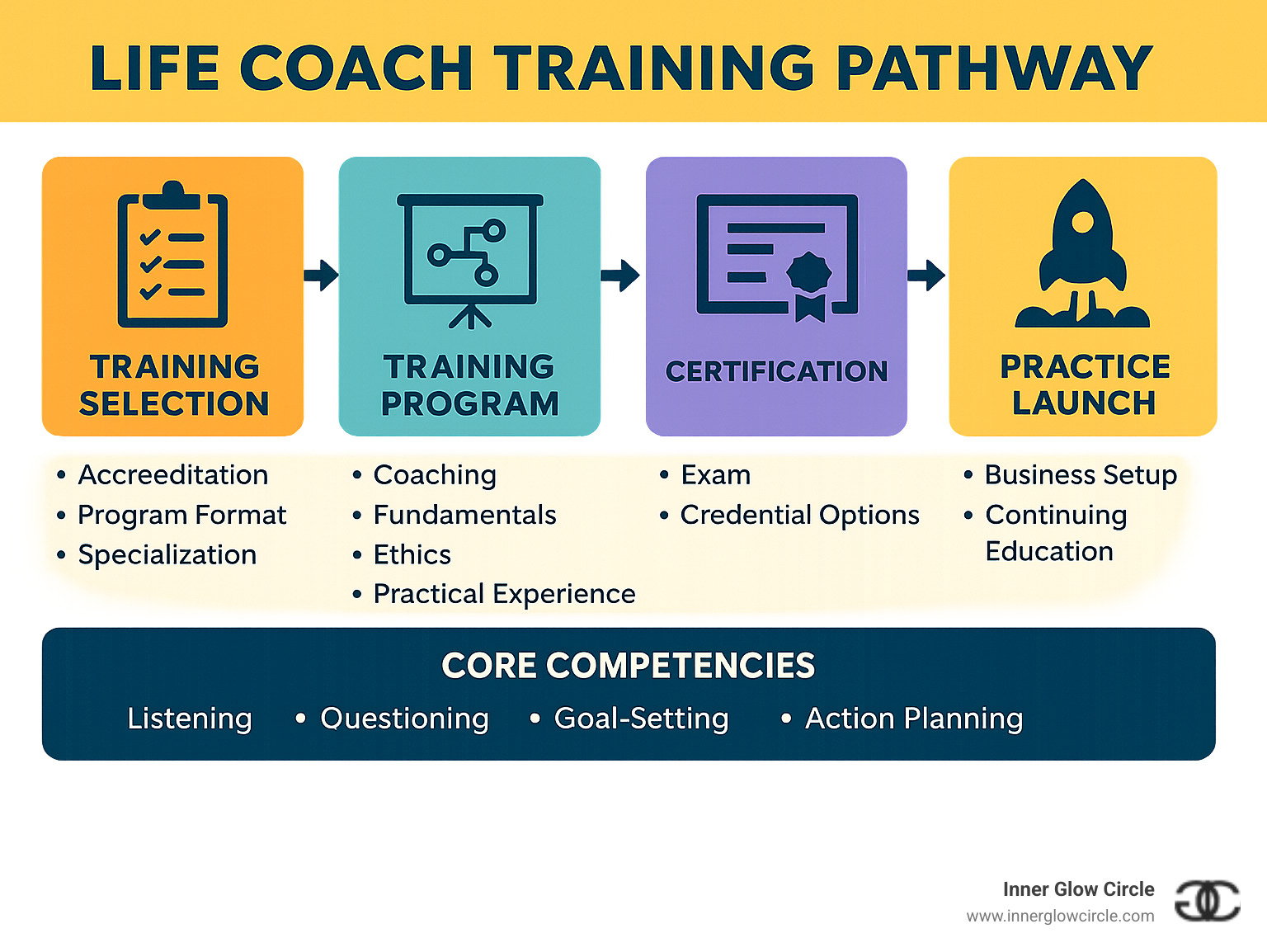
Quick Guide to Life Coach Training Programs:
| Program Type | Duration | Cost Range | Best For |
|---|---|---|---|
| ICF Accredited | 60-125 hours | $3,000-$12,000 | Professional credentials |
| Weekend Intensives | 3-5 days | $300-$2,000 | Quick certification |
| Self-Paced Online | 30-60 hours | $200-$2,000 | Flexibility |
| University-Based | 3-6 months | $1,500-$5,000 | Academic approach |
When you dive into life coach training, you’ll find it’s not just about learning techniques—it’s about personal change. You’ll master specialized communication skills that help others see possibilities they couldn’t before. You’ll develop a coaching mindset that focuses on potential rather than problems. And you’ll learn frameworks that create the space for genuine, lasting change in your clients’ lives.
“Coaching is distinguished from other advising and helping roles by its unique ability to drive breakthrough and lasting change.”
Finding the right program might feel overwhelming at first—I get it! The good news is that today’s training landscape offers something for everyone. Whether you’re juggling family responsibilities, working full-time, or ready to dive in completely, there’s a pathway that fits your life. From weekend bootcamps that provide quick certification to comprehensive six-month programs that dive deep into coaching psychology, you have options for every schedule and budget.
While life coaches don’t currently need a universal license to practice, investing in reputable training makes all the difference. In a marketplace where 85% of coaches now hold professional credentials, quality certification through organizations like ICF doesn’t just build your skills—it builds client trust. This foundation of credibility is priceless when you’re starting your coaching journey.
At Inner Glow Circle, we believe that life coach training should feel as supportive as it is challenging. Our women-focused approach recognizes that the best coaches bring their authentic selves to their work—and our training helps you uncover and strengthen your unique coaching voice while mastering the proven techniques that create results for clients.
What Does a Life Coach Do & Why Training Matters
Picture yourself sitting across from someone who’s feeling stuck in their career or personal life. As a life coach, you’re not there to give advice or share what worked for you. Instead, you’re equipped with powerful questions and active listening skills that help your clients find their own answers.
Life coaches help clients identify specific goals, map out the steps to achieve them, and create actionable plans while spotlighting strengths and addressing potential roadblocks. Unlike mentors who typically share personal experiences, coaches create a space where clients can find their own solutions.
When you become a skilled life coach, you’ll build trusting relationships with clients, create structured plans for achieving goals, adjust strategies when needed, encourage self-findy, and promote accountability for positive change.
The coaching profession is experiencing remarkable growth. By 2022, there were 109,200 coach practitioners worldwide—a impressive 54% increase from 2019. This surge reflects the growing recognition of coaching’s value in both personal and professional development.
Wondering about income potential? The 2023 ICF Global Coaching Study reports that life coaches earn an average of $67,800 annually. According to the Financial Times, experienced coaches command rates averaging $231 per hour, with beginners starting under $100 and seasoned specialists charging upwards of $300 per hour.
Key Differences: Coaching vs. Therapy vs. Counseling
“So are you like a therapist?” This is a question you’ll hear often as a coach. Understanding these distinctions is crucial for both you and your future clients:
Life coaching is future-focused and action-oriented. You’ll work with functional clients who want to achieve specific goals, starting with their present circumstances to create desired outcomes. Coaching doesn’t involve diagnosing or treating mental health conditions and typically involves shorter-term engagements with specific objectives.
Therapy often analyzes past behavior to understand current issues and treats diagnosed mental health conditions. It’s usually longer-term and process-oriented, requiring specific licensing and mental health credentials, with a focus on healing psychological wounds.
Counseling addresses specific issues or challenges and provides guidance in specialized areas. It may incorporate elements of both coaching and therapy, often requires specific certifications, and can be short or long-term depending on the issue at hand.
As one life coach training resource explains: “Therapists analyze a client’s past to understand current behavior, while life coaches focus on identifying obstacles and strategies to achieve future goals.”
Why Formal Life Coach Training Lifts Results
You might naturally be good at helping others, but formal life coach training provides essential structure and professionalism that significantly improves client outcomes.
Improved credibility is a major benefit—85% of coach practitioners now hold a certification from a professional coaching organization. This trend reflects clients’ increasing expectations for properly trained coaches. When you’re certified, potential clients immediately feel more trust in your abilities and commitment to ethical standards.
Skills mastery is another crucial advantage. Training teaches specific techniques that even naturally gifted helpers don’t intuitively know, such as powerful questioning frameworks and goal-setting methodologies that actually work.
Training also ensures you understand ethical guidelines, including professional boundaries, confidentiality requirements, and when to refer clients to mental health professionals—something that protects both you and your clients.
Finally, there’s the matter of your earning potential. The Bureau of Labor Statistics found that certified coaches reported an average annual income of about $61,900, with specialized and experienced coaches commanding significantly higher rates.
As one graduate shared: “The course helped me with my career journey! It was laid out in a methodical way and truly prepared me to work with clients. I was able to tailor the exercises to fit my practice clients and use that skill in my career.”
When you invest in life coach training, you’re not just learning a new skill—you’re positioning yourself as a professional in a growing industry where proper credentials make all the difference.
Understanding Life Coach Training
Ever wondered what happens behind the scenes of life coach training? Think of it as learning the art and science of change—both for yourself and your future clients. Programs come in all shapes and sizes, but they share a common goal: developing your ability to guide others through meaningful change.
When you explore the landscape of coaching education, you’ll find a rich variety of options. Some people thrive in foundational programs that cover the essentials in 30-60 hours, while others prefer to dive deeper with advanced specialized training. Many aspiring coaches choose ICF-accredited programs that align with established competencies and ethics, while some prefer the academic structure of university-based programs. And if you already know your passion lies in a specific niche, specialized training might be your perfect match.
Before jumping in, most programs suggest taking a moment for honest self-reflection. Are you naturally curious about others? Do you find yourself listening more than speaking? Can you support someone without taking over their journey? These natural tendencies often indicate coaching might be a great fit for your personality and skills.
Typical Requirements & Prerequisites for Life Coach Training
Good news—the path to becoming a coach is more accessible than many helping professions! Most life coach training programs welcome people from diverse backgrounds without demanding extensive prior qualifications.
When it comes to age and education, most programs simply require you to be at least 18 (sometimes 21+) with a high school diploma or equivalent. Some university-affiliated programs may ask for a bachelor’s degree, but they rarely specify which field it should be in. This openness makes coaching an inviting career path for people with varied life experiences.
On the technical side, you’ll need the basics: reliable internet for online programs, a computer with video capability for virtual sessions, and enough digital literacy to steer learning platforms. Nothing too intimidating!
Communication skills naturally matter in this field. You’ll need fluency in the program’s teaching language (typically English) and the ability to express thoughts clearly. But remember—good coaching is about drawing out others’ wisdom, not showcasing your own eloquence.
The personal qualities that make successful coaches include emotional maturity, ethical judgment, openness to feedback, and commitment to your own growth journey. After all, you’ll be asking clients to stretch and evolve—something you should be willing to do yourself.
How Long Does Life Coach Training Take?
“How quickly can I become a coach?” It’s one of the most common questions, and the answer is: it depends on your chosen path. Life coach training timelines vary widely, giving you flexibility to match your life circumstances.
If you’re looking for a quick start, short-format options might appeal to you. Weekend bootcamps pack 25-40 hours of learning into 3-5 intensive days. One-day introductory certifications offer basic overviews in 8-10 hours. And if you’re self-motivated, accelerated online programs let you complete about 30 hours at your own pace—potentially in just a week or two.
Most standard certifications require a bit more time for integration. Typical 60-hour programs take about 2-3 months when studied part-time. ICF Level 1 programs, which include both training and mentoring, usually span 3-6 months. University-based programs typically follow a semester schedule of 3-4 months.
For those seeking mastery, comprehensive programs provide deeper learning. ICF Level 2 programs with 125+ training hours may take 6-12 months. Dual certification programs combining coaching with another discipline also run 6-12 months. Programs that include business development components typically require 4-8 months to complete.
As one training provider reassuringly notes: “98% of our students work full-time, and we’ve designed our program for busy people like you who are already living a full life but want to take living to the next level.” The most effective timeline gives you space to practice what you’re learning and integrate feedback—skills that develop through application, not just study.
Core Competencies Covered in Life Coach Training
At the heart of quality life coach training lies a set of essential skills that transform ordinary conversations into catalysts for change. Most reputable programs build their curriculum around the ICF Core Competencies framework, which has been refined through years of research and practice.
The foundation begins with ethical standards and mindset. You’ll learn coaching ethics, how to establish clear agreements with clients, maintain appropriate confidentiality, and develop your unique “coaching presence”—that special way of being fully present that creates a safe space for growth.
Communication excellence forms the backbone of coaching skill. You’ll master active listening that goes beyond words to hear underlying meanings, develop powerful questioning techniques that spark insights, and practice direct communication that cuts through confusion. These skills help clients see their situations with fresh eyes.
The ability to facilitate growth and results separates coaching from casual conversation. You’ll learn proven goal-setting frameworks, methods for creating actionable plans, structures for maintaining accountability, and techniques for measuring progress. These tools help transform client aspirations into reality.
Finally, you’ll develop coaching process mastery—the ability to structure sessions that flow naturally while building strong relationships. You’ll learn to recognize and work with resistance, track changes over time, and adapt your approach to each unique client.
According to the International Coach Federation’s research, active listening and powerful questioning consistently rank as the most impactful competencies for client outcomes. These foundational skills create the conditions where change becomes possible. The ICF defines eight core competencies organized into four domains: Setting the Foundation, Co-Creating the Relationship, Communicating Effectively, and Facilitating Learning and Results. Scientific research on coaching competencies confirms these skills can be developed through structured training and practice.
The journey to becoming a coach is both personal and professional. As you develop these competencies, you’ll likely notice positive changes in all your relationships—not just with clients. That’s the beautiful ripple effect of learning to truly listen, ask better questions, and hold space for others’ growth.
Accreditation, Formats & Costs: Comparing Programs
When you’re searching for the perfect life coach training program, three factors will shape your experience more than anything else: accreditation, format, and cost. These elements don’t just affect your learning journey—they determine how valuable your certification will be once you’re ready to coach clients.
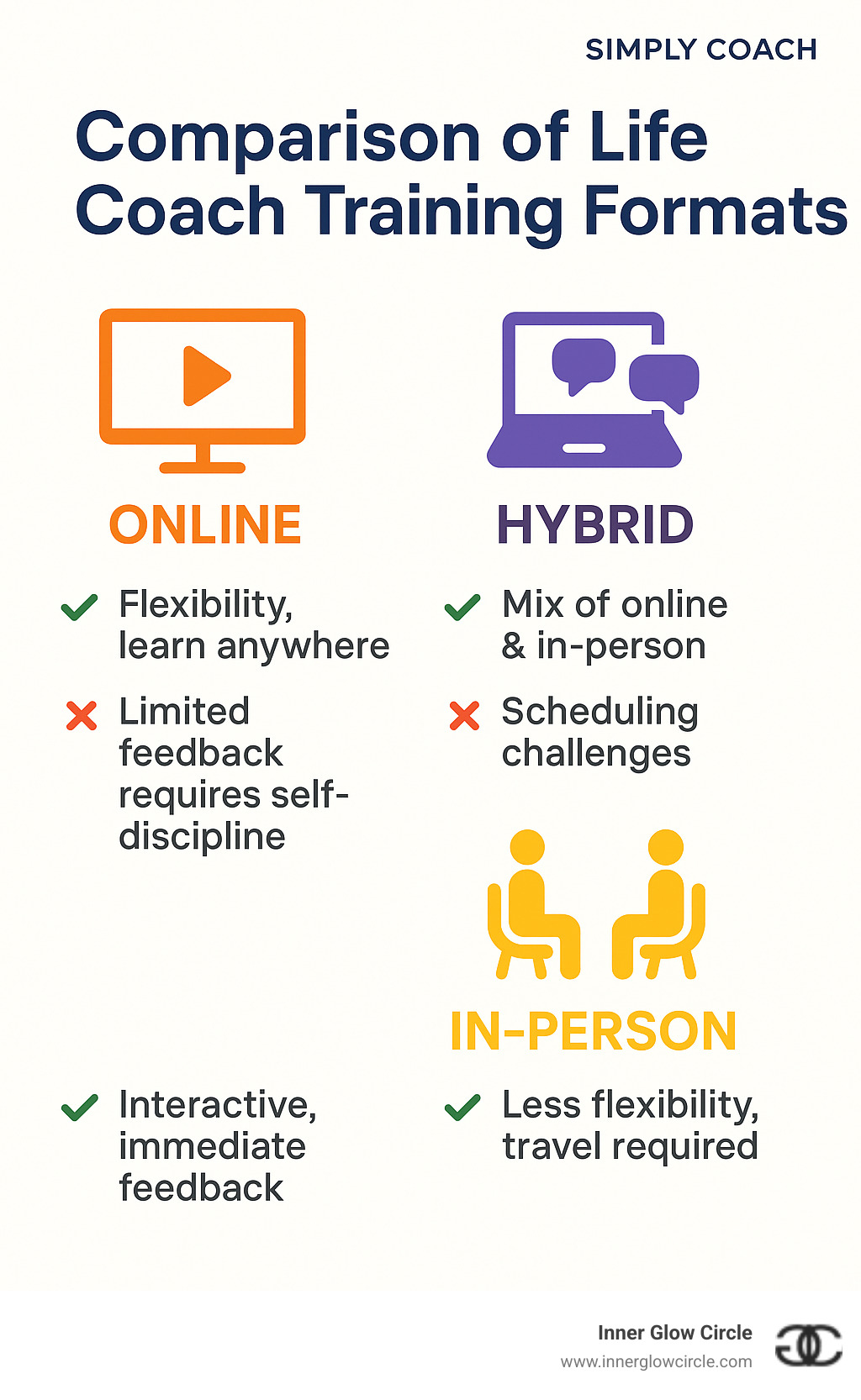
| Format | Pros | Cons | Best For |
|---|---|---|---|
| 100% Online Self-Paced | Flexibility, often lower cost, learn anywhere | Limited live feedback, requires self-discipline | Self-motivated learners with busy schedules |
| Online Live/Virtual | Real-time interaction, community building, immediate feedback | Scheduled time commitment, requires stable internet | Those wanting structure with geographic flexibility |
| Hybrid (Self-paced + Live Components) | Combines flexibility with community support | May have synchronous components to schedule around | Balanced approach for busy professionals |
| In-Person Intensive | Immersive experience, networking, hands-on practice | Travel costs, time away from work/family, less flexibility | Full immersion learners who value in-person connection |
| University-Based | Academic rigor, potential credits toward degrees | Higher cost, fixed schedules, more theory-heavy | Those wanting academic credentials alongside coaching skills |
Why ICF & Other Accreditations Matter for Life Coach Training
Think of accreditation as your quality guarantee in an industry that doesn’t have universal regulation. It’s like the difference between a home-cooked meal and one prepared by a certified chef—both might taste good, but you know which one follows proven standards.
The International Coaching Federation (ICF) stands as the gold standard in the coaching world. Their three-tiered accreditation system includes Level 1 programs (formerly ACSTH) with a minimum of 60 training hours, Level 2 programs (formerly ACTP) with 125+ comprehensive training hours including mentorship, and Level 3 specialized training for coaches who already have experience.
Other respected accrediting bodies include the International Association of Professional Recovery Coaches (IAPRC) for recovery-focused programs and the International Certification of Excellence in Organizations and Systems (ICOES), which evaluates educational standards.
Why should you care about these credentials? For starters, ICF accreditation gives your certification global recognition—a must if you plan to work with international clients. It also ensures you’re learning curriculum that meets established standards and follows ethical guidelines. Perhaps most importantly, clients increasingly look for coaches with recognized credentials, with 85% of practicing coaches now holding some form of certification.
As one coach put it: “My ICF accredited training didn’t just teach me coaching—it opened doors that would have remained firmly shut without it.”
At Inner Glow Circle, we proudly offer an ICF Accredited Coach Training Program designed specifically for women who want to lift their coaching skills while connecting with a supportive community.
Program Formats & Time Commitments
Life coach training comes in as many flavors as your local ice cream shop—each with its own unique benefits and time requirements.
If you’re juggling family responsibilities and a full-time job, self-paced online programs might be your perfect match. You’ll access pre-recorded videos and written materials whenever it fits your schedule, typically completing the program within 3-6 months depending on your pace. These programs shine for independent learners who value flexibility above all else.
Craving more interaction? Live virtual training brings real-time instruction and immediate feedback to your computer screen. You’ll typically commit to 3-4 hours weekly for 3-6 months, building relationships with instructors who can answer questions on the spot.
For those who thrive in community, cohort-based programs create a special magic. You’ll progress through training with the same group, developing deep connections and built-in practice partners. These programs typically require 4-8 hours weekly for several months, but the relationships often last much longer.
Short on time but able to fully immerse for a brief period? Weekend intensives and bootcamps pack months of learning into 2-5 consecutive days of 8-10 hour sessions. These programs deliver rapid skill development in a concentrated environment—perfect for learners who prefer to dive in headfirst.
Many students find their sweet spot with hybrid models that blend self-paced learning with scheduled live components. As one student shared: “The flexibility of watching lessons on my own time combined with weekly live practice sessions gave me the perfect balance of freedom and accountability.”
Most quality programs also include opportunities for mentored coaching practice, observed sessions with expert feedback, and peer coaching arrangements to hone your skills in real-world settings.
What Does Life Coach Training Cost?
When it comes to investing in your coaching future, the price range is as wide as the Grand Canyon—but there’s something for nearly every budget.
Entry-level options under $500 offer basic online certifications and introductory programs with minimal support. These programs often carry alternative accreditations or none at all. They’re like dipping your toe in the coaching waters before deciding to swim.
The mid-range programs ($1,000-$3,000) represent the sweet spot for many aspiring coaches. This price point typically covers most 60-hour certification programs, including many ICF Level 1 accredited courses. You’ll receive moderate support and resources—enough to build a solid foundation without breaking the bank.
Looking for the full package? Comprehensive programs ($3,000-$7,000) offer complete ICF Level 2 accreditation with extensive mentoring and business development components. These programs don’t just teach coaching—they prepare you to build a sustainable business.
At the top end, premium offerings ($7,000-$12,000+) from boutique coaching academies provide high-touch support, extensive one-on-one mentoring, and advanced specializations. As one provider candidly shares: “We invested over $50K to get certified. You don’t have to.” This refreshing honesty reflects the wide range of price points available today.
The good news? Most programs understand that investing in your education is a big decision. Many offer flexible payment plans spread over 3-12 months, early bird discounts (often 10-20% off), and scholarships for underrepresented groups. Some even provide special rates for military members, veterans, or group enrollments.
Research on coaching ROI suggests your investment can pay off relatively quickly. With the average coach charging $231 per hour according to the Financial Times, even mid-range programs could potentially be offset within your first 10-20 client sessions. The scientific research on coaching ROI confirms that quality training not only improves your client outcomes but significantly improves your ability to attract clients and command professional rates.
The most expensive program isn’t necessarily the best one for you. The right life coach training matches your learning style, career goals, and budget while providing the credentials and skills you need to succeed.
Core Skills & Curriculum You’ll Master

When you enroll in life coach training, you’re starting on a journey that transforms not just your career, but how you connect with others. Great programs don’t just teach you coaching theory—they help you embody these skills through practice until they become second nature.
I’ve seen countless women light up during training when they experience that magical “click” moment where the techniques suddenly feel natural. That’s when you know you’re not just learning coaching—you’re becoming a coach.
Life Coach Training Module Snapshot
Think of your life coach training curriculum as building blocks that create a solid foundation for your coaching practice. While each program has its unique flavor, here’s what you can expect to master:
Your journey typically begins with coaching foundations, where you’ll explore the coaching mindset and ethical guidelines that separate coaching from other helping professions. This is where you learn to create those all-important coaching agreements that set clear expectations with clients.
Next, you’ll dive into session anatomy—the art of structuring conversations that lead to breakthroughs. Many programs teach a 5-step coaching conversation model that helps you steer from opening to closing with confidence, keeping sessions on track while still allowing for those beautiful moments of findy.
Perhaps the most transformative skill you’ll develop is changeal listening. This goes far beyond simply hearing words—you’ll learn to tune into what’s not being said, notice non-verbal cues, and develop that special presence that makes clients feel truly seen. As one of our graduates shared, “Learning to listen at this level changed not just my coaching, but all my relationships.”
The heart of coaching lies in powerful questioning. You’ll master the art of asking questions that gently challenge limiting beliefs and open new perspectives. These aren’t random questions—they’re precisely timed invitations that help clients find their own answers.
Of course, coaching is ultimately about results, so you’ll learn goal-driven frameworks that translate insights into action. From SMART goals to more holistic CLEAR approaches, you’ll help clients create meaningful changes that stick.
Finally, good programs don’t leave you hanging when it comes to the business of coaching. You’ll learn how to set up your practice, define your unique niche, create compelling packages, and have those sometimes-intimidating enrollment conversations with potential clients.
The beauty of this curriculum is how it builds progressively, allowing you to help clients become increasingly self-sufficient. As we often say at Inner Glow Circle, “The most effective coaching takes clients from zero to self-coaching in 12 sessions.”
Tools, Resources & Student Support
Learning to coach isn’t just about classroom time—it’s about the support system that helps you integrate and apply what you’re learning. The best life coach training programs surround you with resources that accelerate your growth.
Practice makes progress. Look for programs that include plenty of hands-on coaching demonstrations where instructors model techniques in real-time. These “watch me do it” moments bring concepts to life before you try them yourself. At Inner Glow Circle, we believe in learning by doing, with plenty of observed practice sessions where you receive gentle, constructive feedback.
Ready-to-use templates save you countless hours and prevent reinventing the wheel. Quality programs provide coaching agreements, session planners, intake forms, and goal-tracking systems you can adapt to your style. These practical tools help you hit the ground running with your first clients.
Community support makes all the difference. The journey to becoming a coach can feel vulnerable at times—you’re developing new skills and putting yourself out there. Programs that include small group mentoring, one-on-one instructor feedback, and active peer communities create a safe space for growth. As one student beautifully put it, “My coaching community saw my potential before I could see it myself.”
Business guidance bridges the gap between being a skilled coach and having a thriving practice. Look for programs that include marketing templates, client attraction systems, and practical advice on packaging and pricing your services. These business elements are often what separate struggling coaches from successful ones.
At Inner Glow Circle, we’ve seen that confidence comes through experience, not just information. That’s why our Life Coaching Courses emphasize hands-on practice in a supportive environment where you can try, learn, adjust, and grow.
The tools and support you receive during training often determine how quickly you’ll transition from student to confident coach. When evaluating programs, look beyond the curriculum to these crucial elements that will shape your learning experience and set you up for success.
Career Paths, FAQs & Next Steps After Certification

So you’ve completed your life coach training – congratulations! Now a world of exciting possibilities opens up before you. The beauty of coaching as a profession is its remarkable flexibility. You can truly design a career that fits your lifestyle, strengths, and vision.
The financial outlook is promising too. According to the 2023 ICF Global Coaching Study, life coaches earn an average of $67,800 annually, with specialists and experienced coaches often taking home considerably more. Entry-level coaches typically start around $31.45 per hour according to Payscale.com, while those with established practices and specialized expertise can command $150+ hourly.
Many newly certified coaches wonder about their options. The truth is, your coaching certification can take you in several directions. You might build an independent practice offering one-on-one sessions, develop group coaching programs, or create transformative online courses. Some coaches blend their skills with speaking engagements or writing books, while others bring their coaching expertise into corporate settings through executive coaching or leadership development programs.
I’ve seen many successful coaches create what’s called a “portfolio career” – a thoughtful blend of coaching services with complementary professional activities. This approach gives you income stability while allowing you to express different facets of your expertise. The freedom to design your professional life this way is one of coaching’s greatest gifts.
Starting Your Own Coaching Practice
Turning your coaching skills into a thriving business requires some practical steps beyond your life coach training. Think of this as building the container that will hold your beautiful coaching work.
First, you’ll need to handle the business basics. This means choosing a structure (many coaches start as sole proprietors before moving to an LLC as they grow), registering your business name, and setting up separate banking. Don’t forget professional liability insurance – it’s relatively inexpensive and provides important protection. You’ll also want solid coaching agreements that clearly outline what clients can expect.
Your brand development comes next, and this is where many coaches really shine. Take time to clarify your unique coaching approach and identify who you most love working with. Your coaching niche isn’t just a marketing strategy – it’s about focusing your expertise where you can create the most powerful results. Your website and materials should reflect not just what you do, but the change you help create.
When designing your services, think beyond hourly sessions. Consider creating packages that guide clients through a complete journey. This approach typically creates better results while providing you with more stable income. Your pricing should reflect both the value you provide and your business goals – remember that undercharging often leads to burnout and resentment.
Perhaps the biggest mindset shift comes with client acquisition. As one of our mentor coaches wisely puts it: “STOP SELLING, and begin ENROLLING CLIENTS!” When you approach marketing as a natural extension of your coaching skills – asking powerful questions, listening deeply, and supporting change – it feels authentic rather than pushy.
At Inner Glow Circle, we understand that building a successful practice requires both coaching excellence and business savvy. That’s why we provide comprehensive guidance on How to Start My Coaching Business as part of our coach training pathway.
Frequently Asked Questions about Life Coach Training
What are the Prerequisites to Enroll?
Good news – life coach training is accessible to most motivated individuals. Unlike therapy or counseling programs that might require specific degrees, coaching programs typically have minimal formal prerequisites.
Most programs ask that you’re at least 18 years old (some prefer 21+) with a high school diploma or equivalent. You’ll need fluency in the program’s teaching language – usually English – and basic technology skills for online learning platforms. The most important qualification is your commitment to complete the required training hours and practice sessions.
Some programs conduct brief interviews before enrollment. This isn’t about weeding people out but ensuring the program aligns with your goals and expectations. As one of our trainers often says, “The program is designed for anyone called to coach, providing step-by-step tools regardless of prior experience.”
The diverse backgrounds of successful coaches prove there’s no one “right” path into this profession. Former teachers, healthcare professionals, corporate executives, stay-at-home parents, and creative entrepreneurs all bring valuable perspective to their coaching practices.
How Much Can Certified Life Coaches Earn?
When it comes to coaching income, the range is quite broad and depends on several factors. New coaches with solid life coach training typically start between $50-100 per hour while building experience and testimonials. As you develop mastery and specialized expertise, rates of $100-200 per hour become standard, with experienced specialists commanding $200-500+ hourly.
The Financial Times reports the average coaching rate at around $231 per hour, though this includes coaches at various experience levels and specialties. What’s particularly exciting is how different business models can dramatically impact your earning potential.
Group coaching allows you to serve 5-20 clients simultaneously at $200-500 per hour, significantly increasing your hourly rate. Many successful coaches offer comprehensive programs ranging from $1,500-5,000 for 3-6 month packages rather than selling individual sessions. Corporate coaching engagements often fetch $5,000-25,000, while online courses provide scalable income from $100-500 per student.
The investment in your training typically pays for itself quickly. Most new coaches recoup their training costs within their first 10-20 client sessions – an encouraging return on investment for your new career.
Do I Need Continuing Education?
While not universally required, continuing education is highly valuable for maintaining your edge as a coach. For those holding ICF credentials, it’s actually mandatory – Associate Certified Coaches need 10 hours of Continuing Coach Education every three years, while both Professional and Master Certified Coaches require 40 hours in the same timeframe.
Beyond meeting credential requirements, continuing education keeps your approach fresh and evolving. As coaching research and methodologies advance, staying current improves your effectiveness with clients. Many coaches find that specialized training in niche areas – whether executive coaching, health and wellness, or relationship work – allows them to stand out in the marketplace while serving clients with more precision.
Popular continuing education options include advanced coaching techniques, complementary modalities like positive psychology or mindfulness, and business development specifically for coaches. Many coaches also find tremendous value in supervision or mentor coaching, which provides objective feedback on their coaching skills.
Many certification programs, including ours at Inner Glow Circle, offer alumni continuing education at reduced rates. This creates an ongoing learning community that supports your development long after your initial certification.
The coaching journey doesn’t end with certification – it’s really just the beginning of a rewarding path of growth, service, and continuous learning. The best coaches maintain their curiosity and commitment to mastery throughout their careers.
Conclusion
The journey to becoming a certified life coach is both rewarding and transformative. Through quality life coach training, you develop not only professional skills to serve clients but also personal insights that improve your own life. The coaching industry’s impressive growth—with a 54% increase in practitioners between 2019 and 2022—has created abundant opportunities for well-trained coaches who are ready to make their mark.
Whether you’re drawn to coaching as a full-time career or as a complement to your existing profession, the right training program provides the essential foundation for your success. Understanding the core competencies, accreditation standards, and business fundamentals we’ve covered equips you to choose a program that truly aligns with your goals, values, and vision for your future.
At Inner Glow Circle, we’re particularly passionate about empowering women through coach training that addresses both professional development and personal change. Our supportive community creates a unique environment where you can develop your skills surrounded by collaboration rather than competition. We believe that when women support each other, everyone rises together.
Becoming a coach goes far beyond simply acquiring a certification—it’s embracing a profession that allows you to make meaningful differences in people’s lives while creating flexibility and fulfillment in your own. The skills you develop through proper training transfer to every area of your life, from personal relationships to business interactions.
Your coaching journey doesn’t end with certification—it’s just beginning. The best coaches commit to ongoing learning and growth, constantly refining their skills and expanding their perspectives.
For more information about our approach to Life Coach Training, we invite you to explore our programs designed specifically to help women coaches glow from the inside out while building sustainable, impactful businesses. Our training combines practical skills with heart-centered approaches that honor your unique gifts and strengths.
The world needs more skilled, compassionate coaches who can guide others through challenge and change. We look forward to supporting you on your journey to becoming one of them—and watching you shine your inner glow into the world.


