

Life Coach Certification Cost in 2026: What Should You Expect to Pay?
If you’ve started researching life coach certification programs, you’ve probably discovered something confusing very quickly:
Prices are all over the place.
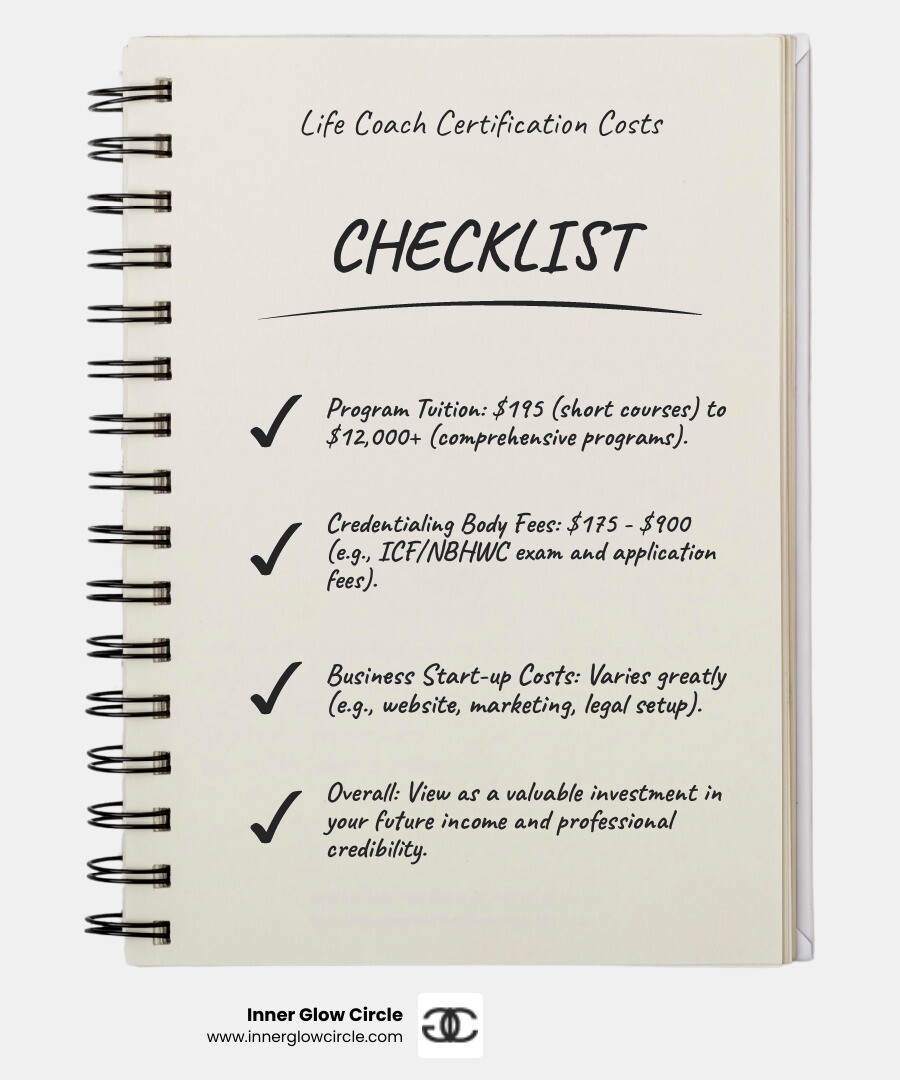
One program might cost a few hundred dollars. Another might cost several thousand. Comprehensive professional coach training can cost $20,000 or more.
So what does life coach certification actually cost, and what are you paying for?
The answer depends heavily on the type of training you’re comparing.
A self-paced online certificate and a live, ICF-accredited coach education program aren’t simply two versions of the same product at different prices. The curriculum, training hours, coaching practice, feedback, mentorship, accreditation and professional preparation can be significantly different.
Before comparing tuition, you need to compare what the tuition actually includes.
How Much Does Life Coach Certification Cost?
There is no universal price for becoming a certified life coach.
You’ll find programs ranging from inexpensive self-paced courses to comprehensive professional education programs costing $20,000 or more.
Instead of asking only:
“What’s the cheapest certification?”
A more useful question is:
“What education, practice, mentorship and professional preparation am I receiving for this investment?”
Two programs can both use the phrase “life coach certification” while offering dramatically different training experiences.
Why Do Life Coach Certification Programs Cost So Much Differently?
There is no single governing body that determines what every coach training provider must charge or include.
That means the phrase “life coach certification” alone doesn’t tell you very much about the education behind it.
When comparing prices, look at factors such as:
- Whether the program is accredited by the International Coaching Federation (ICF)
- Total coach-specific education hours
- Live instruction versus primarily self-paced content
- Opportunities to actually practice coaching
- Observation and feedback on your coaching
- Mentor coaching
- Faculty qualifications
- Final evaluations or assessments
- Business and career education
- Community and professional development
- Access to training after graduation
- Support pursuing an individual ICF credential
These differences can explain why one program costs substantially more than another.
What Does ICF-Accredited Coach Training Include?
If you’re considering professional coaching as a career, you’ll probably encounter ICF Level 1 and Level 2 accredited education.
The International Coaching Federation establishes requirements for accredited coach education programs.
As of 2026, ICF Level 1 programs provide 60–124 hours of coach-specific education and create an education pathway toward the Associate Certified Coach (ACC) credential.
ICF Level 2 programs provide 125–175 hours of coach-specific education and create an education pathway toward the Professional Certified Coach (PCC) credential.
Accredited programs also include requirements related to coaching practice, observation and feedback, mentor coaching and performance evaluation.
That is a very different educational experience from purchasing a collection of prerecorded videos and receiving a certificate after watching them.
Level 1 vs. Level 2: How Does That Affect Cost?
Generally, more comprehensive training requires a larger investment.
That makes sense when you consider the difference in education hours alone.
Level 1 programs provide at least 60 hours of coach-specific education.
Level 2 programs provide at least 125 hours.
Level 2 therefore involves significantly more education and is designed to support the education pathway toward the PCC credential.
That doesn’t automatically mean everyone should choose Level 2.
Someone who wants foundational coaching skills or an ACC education pathway may decide Level 1 is sufficient for their goals.
Someone who already knows they want coaching to become a significant part of their career or business may decide it makes more sense to complete Level 2 from the beginning.
If you’re unsure about the distinction, read our complete guide to ICF Level 1 vs. Level 2 coach training.
Does More Expensive Mean Better?
No.
Price alone is not evidence of training quality.
A $12,000 program isn’t automatically excellent because it’s expensive, just as an inexpensive program isn’t automatically poor quality.
This is why prospective students should look beyond tuition.
Ask what you’re actually getting.
How much training is live?
Who teaches it?
How often will you practice coaching?
Will anyone observe your coaching and give you feedback?
Is mentor coaching included?
What happens after you graduate?
Does the program prepare you only to coach, or does it also help you understand how to build a career using that skill?
And importantly:
Can you independently verify the accreditation and credentials the school claims to have?
If a program claims ICF accreditation, you can verify the education provider through ICF’s official directory.
Watch for Costs Beyond Tuition
The advertised tuition price isn’t always the entire financial picture.
Before enrolling, ask whether tuition includes:
- Required books or materials
- Mentor coaching
- Observed coaching and feedback
- Performance evaluations
- Practicum or coaching labs
- Business training
- Community or membership fees
- Continuing professional development
- Certification fees
- Payment-plan fees
- Access to curriculum after graduation
Also ask whether pursuing an individual ICF credential will require additional fees.
This is important because graduating from a coach training program and earning an individual ICF credential are two different things.
Certification and an ICF Credential Are Not the Same Expense
This distinction is worth understanding before you calculate your total investment.
A coach training school can award its own certification when you successfully complete its program.
The International Coaching Federation separately awards individual credentials, including ACC, PCC and MCC.
Completing ICF-accredited education can satisfy important education, mentor coaching and evaluation components of the credentialing process, depending on the pathway. However, graduates must still satisfy ICF’s applicable experience and application requirements.
ICF also charges credential application fees separately from tuition charged by coach education providers.
So if your long-term goal includes an ICF credential, factor that into your overall plan rather than assuming your school’s tuition includes an ICF credential itself.
What Does IGC Coaching School Cost in 2026?
For a real-world example, IGC Coaching School offers both ICF Level 1 and Level 2 accredited coach education.
IGC Coaching Foundations / Level 1
Total tuition: $5,995
Pay-in-full tuition: $5,495
The program currently includes:
- 4 months of weekly live training
- 60 hours of ICF-accredited coach education
- 12 hours of coaching practicum
- 5 observed coaching sessions
- Access to professional development through the Six Figure Circle
- Business and ROI education
IGC Level 2 Coach Training
Total tuition: $11,495
Pay-in-full tuition: $10,495
The program currently includes:
- 8 months of weekly live training
- 125 hours of ICF-accredited coach education
- 24 hours of coaching practicum
- 10 ICF mentor coaching hours
- Live coaching practice, observation and feedback
- Additional professional development workshops
- Lifetime access to the Six Figure Circle
- Lifetime access to the Six Figure Certified™ Business Suite
- Niche-specific business resources and mentorship
IGC also offers an accelerated Level 2 training track for students who want to complete the education on a faster schedule.
Current payment options and enrollment incentives may vary, so prospective students should review current tuition information or speak with Admissions rather than relying on an older article or promotion.
Don’t Compare Tuition Without Comparing What’s Included

Imagine comparing two colleges solely by tuition without looking at the degree, number of courses, faculty, support or program length.
Coach training deserves the same level of scrutiny.
When comparing programs, create a simple checklist:
Accreditation: Is the program ICF accredited? At what level?
Education: How many coach-specific training hours are included?
Delivery: Are classes live, prerecorded or a combination?
Practice: How much actual coaching will you do?
Feedback: Will qualified instructors observe your coaching?
Mentorship: Is mentor coaching included?
Career preparation: Does the program teach you what to do with the skill after graduation?
Support: What happens when class ends?
Total cost: What will you actually pay after required extras?
Now you’re comparing value rather than simply comparing price tags.
What About $99 or $500 Life Coach Certifications?
Inexpensive online courses can provide an introduction to coaching concepts.
That doesn’t necessarily make them useless.
But prospective coaches should understand what they’re purchasing.
A low-cost certificate course generally should not be assumed to provide the same depth of education, supervised practice, mentor coaching, assessment or professional pathway as comprehensive ICF-accredited training.
The question comes back to your goal.
If you’re simply curious about coaching, a short introductory course may be enough.
If you’re investing in coaching as a professional skill, career or business, evaluate the education accordingly.
Is Life Coach Certification Worth the Investment?
That’s ultimately a personal and financial decision.
But don’t evaluate the return only by asking:
“How quickly can I earn my tuition back?”
Professional education can create value in several ways.
A graduate might build a private coaching practice.
Another might use coaching inside an existing leadership or executive role.
Someone else might combine coaching with consulting, speaking, training, HR, wellness or another professional discipline.
That means the potential return depends significantly on what you intend to do with the education.
Before enrolling, define the outcome you’re actually investing toward.
Calculate the Potential ROI Before You Enroll
If your goal is to build a coaching business, you can make the investment more concrete by working backward from your potential offer.
For example:
If a coaching package eventually sells for $3,000, how many clients would represent $12,000 in revenue?
Four.
That doesn’t mean you’ll automatically sign four clients, nor does it guarantee any particular financial result.
It simply gives you a more useful way to think about an educational investment than looking at tuition in isolation.
Consider:
- What type of coaching do you want to provide?
- What might your services eventually cost?
- How many clients would you realistically have capacity to serve?
- Will coaching supplement existing income or become your primary career?
- What other business expenses will you need to plan for?
- How much time can you realistically devote to building the business?
A realistic ROI calculation can help you make a much more informed decision. You can calculate your ROI here.
Questions to Ask Before Paying for a Coach Certification
Before enrolling anywhere, ask:
- Is this program independently accredited?
- What level of accreditation does it hold?
- How many coach-specific education hours are included?
- How much of the program is live?
- How much coaching will I actually practice?
- Who will observe my coaching and provide feedback?
- Is mentor coaching included?
- Are there required expenses beyond advertised tuition?
- What certification will I receive from the school?
- Does graduation automatically give me an ICF credential? If someone says yes, ask them to explain exactly how.
- What career or business education is included?
- What support will I have after completing the program?
- Can I speak with graduates or review documented student experiences?
- Can I independently verify the school’s accreditation?
Those questions will tell you considerably more than tuition alone.
How to Decide What You Should Spend
Don’t begin with:
“What’s the cheapest way to get certified?”
Begin with:
“What do I want to be qualified and prepared to do when I’m finished?”
Then work backward.
If you want foundational coaching education, evaluate programs designed for that purpose.
If you want a comprehensive professional pathway, evaluate programs that provide it.
If you want to build a business, examine whether the program teaches business.
If you want to pursue an ICF credential, understand the education and experience requirements before choosing your school.
The goal isn’t to spend the most money.
It’s to understand exactly what you’re buying and choose education that matches what you intend to do with it.
Ready to Compare Your Options?
If you’re researching coach training, start with our free 2026 Professional Coaching Career Briefing. It walks through professional coach training, credentials, career paths and what to consider before choosing a program.
If you’re already considering IGC and want to understand Level 1 versus Level 2, tuition, payment options and which path fits your goals, book an Admissions interview with our team.
You can also continue your research with:
- ICF Level 1 vs. Level 2 Coach Training: What’s the Difference?
- How to Choose an ICF-Accredited Coach Training Program
- How to Become a Certified Life Coach in 2026
- IGC Coaching School: Accreditation, Programs & Tuition


