

Why Leadership Mentoring and Coaching Matter for Your Growth
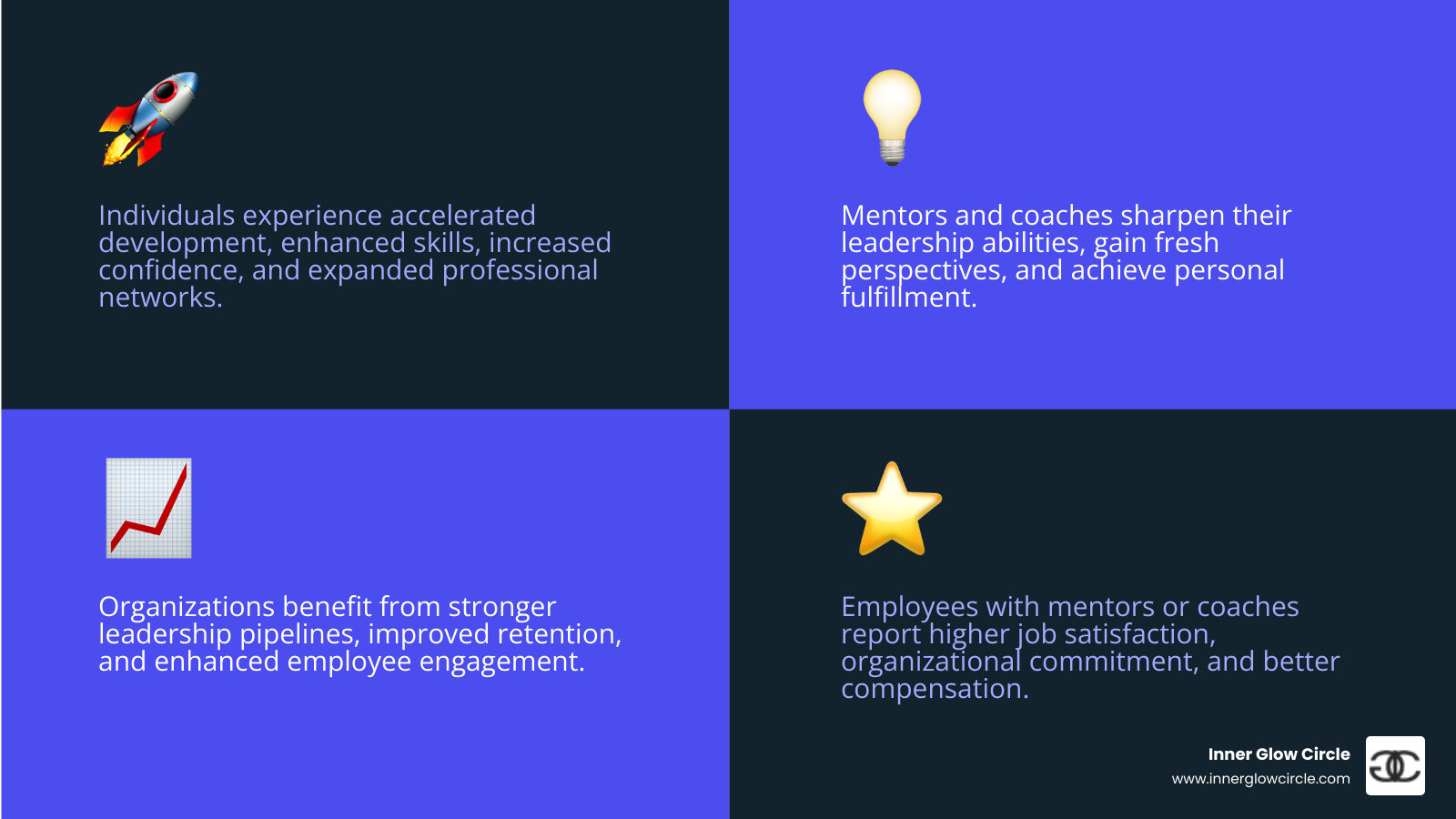
Leadership mentoring and coaching are powerful development approaches that help leaders improve their capabilities and drive success. While mentoring focuses on long-term career development and wisdom sharing, coaching targets specific performance goals and skill development. Both are critical, as employees with mentors or coaches report higher job satisfaction and organizational commitment, while companies benefit from stronger leadership pipelines and improved retention.
The workplace has changed. Traditional, authority-based leadership no longer works. Today’s leaders must excel at building trust, navigating uncertainty, and helping others reach their full potential. Yet many new leaders struggle with this transition without adequate support.
That’s where mentoring and coaching come in. These relationship-based methods create lasting behavior change far more effectively than training alone. A well-executed program builds confidence, strengthens skills, and creates positive organizational change.
In this guide, you’ll learn the difference between mentoring and coaching, when to use each, how to build effective programs, and how to measure success. Whether you’re an aspiring leader or an HR professional, this article provides practical strategies to leverage both tools for maximum impact.
Leadership mentoring and coaching terms at a glance:
Mentoring vs. Coaching: Two Paths to Leadership Excellence
While leadership mentoring and coaching both involve experienced individuals helping others grow, they follow different paths. Understanding this distinction is key to your development.
Think of mentoring as having a wise guide for your career journey, while coaching is like having a personal trainer for specific skills. The core difference is that mentoring builds relationships over time, while coaching focuses on achieving specific goals. A mentor might share career stories over coffee, while a coach works with you intensively on a concrete task, like preparing for a high-stakes presentation.
Here’s how they compare:
| Aspect | Leadership Mentoring | Leadership Coaching |
|---|---|---|
| Focus | Holistic development, career path, personal growth | Specific performance, skill improvement, goal achievement |
| Timeline | Long-term, ongoing relationship | Short-term, project-based engagement |
| Agenda | Mentee-driven, broad and flexible | Co-created with specific, measurable outcomes |
| Role | Trusted advisor, guide, wisdom sharer, role model | Facilitator, accountability partner, skill developer |
| Expertise | Shares personal experience and knowledge | Guides coachee to find their own solutions |
| Relationship | Informal, less structured | Structured, formal meetings |

Successful leaders often use both at different career stages. When deciding which you need, consider what people professionals should consider when choosing an executive coach to make an informed decision.
What is Leadership Mentoring?
Leadership mentoring is a relationship where an experienced leader shares their hard-won wisdom. This trusted advisor cares about your entire career trajectory and personal growth. A great mentor helps you steer organizational culture, builds your professional network, and helps you develop your unique leadership identity. The relationship is flexible, with the mentee driving the agenda based on their current needs—whether it’s a career crossroads or a difficult work relationship. This developmental relationship is central to supporting professional growth through mentoring and coaching.
What is Leadership Coaching?
Leadership coaching helps you find your own answers through powerful questions and structured reflection. It’s a focused, performance-driven partnership aimed at specific, measurable goals, like improving feedback delivery or time management. A key benefit is increased self-awareness, as coaches help you recognize your strengths and blind spots. The relationship is structured with regular meetings and a focus on accountability, ensuring you act on your development goals. Coaching is about open uping your potential and is for capable leaders who want to become even better. Our leadership coaching for women helps them excel while staying true to themselves. Understanding when to seek out leadership mentoring and coaching can accelerate your growth in unimaginable ways.
The Mentoring Advantage: Cultivating Wisdom and Growth

Investing in leadership mentoring and coaching creates ripples across your organization. Mentoring, in particular, cultivates wisdom that can’t be taught in a classroom.
What Mentoring Programs Accomplish
Strategic mentoring programs improve succession planning, talent retention, and knowledge transfer, preserving institutional wisdom. They also foster your organizational culture by teaching new leaders how to lead in alignment with company values.
How Mentees and Mentors Benefit
For mentees, development accelerates. They gain skills, confidence, and career advancement opportunities through their mentor’s guidance and network. This builds deep loyalty to the organization. Mentors also benefit by sharpening their own leadership skills, gaining fresh perspectives, and finding fulfillment in giving back.
The Organizational Payoff
Organizations build a stronger leadership pipeline and see employee engagement rise. The culture shifts toward continuous learning and collaboration, creating a positive environment that attracts and retains top talent. This provides a substantial return on investment through reduced turnover and increased innovation.
Key Elements of a Powerful Mentoring Relationship
A successful mentoring relationship is built on:
- Trust and confidentiality: Psychological safety is essential for mentees to share their real struggles.
- Open communication: Both parties must practice active listening and be receptive to feedback.
- Shared accountability: Both mentor and mentee commit to making the relationship work.
An effective mentor has relevant experience, empathy, and a generous spirit. They are exceptional listeners who provide constructive guidance.
Navigating Ethical Considerations
To manage power dynamics, mentors and mentees should not have a direct reporting relationship. Clear confidentiality boundaries must be set from the start, and mentors must be mindful of potential conflicts of interest.
Types of Leadership Mentoring Programs
- One-on-one mentoring: The classic pairing for deep, personalized guidance.
- Group mentoring: An efficient model where one mentor guides a small group, enabling peer learning.
- Peer mentoring: A group of peers supports each other without a designated senior mentor.
- Reverse mentoring: A junior employee mentors a senior leader on topics like technology or social media.
- Virtual mentoring: Uses technology to connect mentors and mentees regardless of location.
Understanding your own leadership style and profile helps you find the right mentoring fit, whether you’re seeking guidance or offering it.
The Coaching Catalyst: Opening up Peak Leadership Performance

While mentoring is a long walk with a guide, leadership coaching is like scaling a specific mountain with a skilled partner. Its focused, intentional, and designed to help you conquer your current challenge by creating measurable change in how you lead.
What Leadership Coaching Actually Does
At its heart, leadership coaching helps you perform at your best. A coach improves your self-awareness, helping you see your blind spots and untapped strengths. It also provides a structured path to solve specific problems, whether you’re struggling to delegate or need to develop a more strategic mindset. You get individualized support that meets you exactly where you are.
When Coaching Makes the Biggest Difference
Coaching is highly effective during key transitions, such as a promotion to a first-time leadership role. It also accelerates the development of high-potential leaders preparing for senior positions. If you have specific performance gaps or are leading a major change initiative, a coach can provide targeted support and act as a thinking partner.
Exploring Different Leadership Coaching Formats
Leadership coaching comes in various formats to match different needs:
- Executive coaching: A personalized approach for senior leaders navigating high-level strategic challenges.
- Integrated coaching: Combines coaching with other tools like 360-degree feedback for a comprehensive development picture.
- Team coaching: Brings a leadership team together to improve collaboration and problem-solving as a unit.
- Virtual coaching: Uses video calls and online platforms to connect you with the perfect coach, regardless of geography.
For those considering this path, our ICF Accredited Coach Training Program offers comprehensive preparation.
The Role of the Coach in Leadership Development
A coach is not a consultant who gives answers, but a facilitator of your own thinking. They ask powerful questions that challenge your assumptions and help you access your own wisdom. A coach also serves as a confidential sounding board and an accountability partner, helping you commit to action and follow through.
Coaches often use frameworks like the GROW or COACH models to structure conversations and help you build resilience.
The Sacred Trust of Confidentiality
Even when your organization pays for coaching, the conversations are confidential. This creates the psychological safety needed for honest reflection. Professional coaches follow strict ethical guidelines, like those from the International Coaching Federation (ICF), to protect your privacy. This confidential relationship is what makes coaching so transformative, giving you a safe space to grow into the leader you’re capable of being. For a neutral overview of the profession and its standards, see the International Coaching Federation.
Designing Your High-Impact Leadership Mentoring and Coaching Program

Creating a successful leadership mentoring and coaching program requires thoughtful planning and commitment. Think of it as building a garden: you need a clear structure, well-matched participants, and consistent support to see growth.
Building Your Foundation
Every program needs clear goals. Are you building a leadership pipeline or improving retention? A structured framework defining roles, meeting frequency, and timelines provides clarity and safety. Crucially, training for participants on communication, listening, and feedback transforms good intentions into real results. Finally, an evaluation process helps you track progress and continuously improve.
The Power of Leadership Buy-In
Your program will struggle without strong support from senior leadership. When executives champion the program by participating, they send a powerful message. Securing resources—time, budget, and tools—is also vital. Most importantly, leaders must foster a supportive culture where learning is valued and asking for help is seen as a strength.
Navigating the Challenges
Implementing these programs has challenges. Lack of time is a common complaint, so integrate development into existing workflows. Mismatched pairs can cause frustration, so invest in a robust matching process. Measuring impact on soft skills can be tricky; use a mix of quantitative data (retention rates) and qualitative stories (testimonials). To gain buy-in, connect the program to business results like reduced turnover and stronger team performance.
Effective Selection and Matching for Leadership Mentoring and Coaching
The right match can transform a career. The matching process should consider personality and goals, not just experience. Chemistry meetings allow potential pairs to assess their fit before committing. Modern technology platforms can suggest optimal pairings and simplify program administration. Giving participants choice in their match increases their investment in the relationship.
When selecting mentors, look for empathetic leaders who are skilled listeners and willing to share their experiences. When vetting external coaches, check for credentials, track records, and value alignment. If training internal coaches, provide comprehensive preparation on coaching methodologies and ethics.
This support is especially critical for first-time managers, as a good match can set them up for long-term success.
Measuring the Success and ROI of Leadership Mentoring and Coaching
To prove your program is working, you must measure its impact. Start with quantitative metrics like retention and promotion rates. 360-degree feedback can show pre- and post-program improvements in leadership competencies. Employee engagement surveys can reveal if participants feel more committed.
But numbers don’t tell the whole story. Gather anecdotal evidence and participant testimonials to show the human impact. Observe improved team morale and ask for feedback from managers and peers. The most compelling measurement links program outcomes directly to business goals, like innovation or customer satisfaction. By combining hard data with compelling stories, you create an undeniable picture of ROI.
If these results inspire you, consider taking the next step to become a coach.
Frequently Asked Questions about Leadership Development
We hear these questions all the time when people are exploring leadership mentoring and coaching. Let’s clear up some common confusion.
What’s the difference between a mentor and a manager?
Your manager is responsible for your performance and has formal authority over you. Their relationship is evaluative, focused on ensuring you meet job objectives. A mentor, on the other hand, has no formal authority. They are a trusted advisor focused on your long-term career development and personal growth, offering guidance based on their own experience.
How do I find a leadership mentor?
Be proactive. Start by looking within your own organization for formal programs or senior leaders you admire. Industry events and professional organizations are also great places to network. Don’t forget your alumni networks or the power of asking for introductions from your current contacts. Before you approach anyone, be clear about what you need and what kind of guidance would be most valuable. For more detailed guidance, check out our 10 Tips for Finding a Mentor.
Can coaching fix a poor performer?
This is a critical distinction: leadership coaching is for development, not remediation. It’s designed to help good performers become great, not to fix someone who is failing to meet basic job requirements. A consistent failure to meet expectations is a performance management issue for a manager to address.
However, coaching can support a performance improvement plan (PIP). If a leader is struggling with a specific skill identified in their PIP, targeted coaching can help them develop it. But for coaching to be effective, the individual must be motivated and ready to change. We see coaching as a strategic investment in high-potential individuals who are ready to grow.
Conclusion: Lead with Confidence and Vision
Throughout this guide, we’ve seen how leadership mentoring and coaching are two complementary pathways to excellence. Mentoring provides long-term wisdom from a trusted guide, while coaching offers laser-focused skill development and accountability for immediate goals.
Today’s leaders need both. The modern workplace demands that we build trust, lead with emotional intelligence, and empower others. These developmental approaches are precisely what enable us to meet those demands.
When you invest in leadership mentoring and coaching, you are strengthening your leadership pipeline and creating a culture of continuous improvement. You build a legacy of confident, capable leaders ready to face any challenge. We’ve seen this translate into real business outcomes: better retention, stronger succession planning, and higher engagement.
At Inner Glow Circle, we’re committed to empowering women to lead authentically through transformative coaching. By mastering both mentoring and coaching, you don’t just improve your own journey—you create ripples that uplift everyone around you.
The question isn’t whether to invest in leadership development, but how quickly you can start. The time to begin is now.
Ready to become a mentor or find one? Explore our Mentor Coaching program and take that next step toward leading with confidence and vision. Your leadership legacy starts today.


