

Your Journey to Becoming a Coach Begins Here
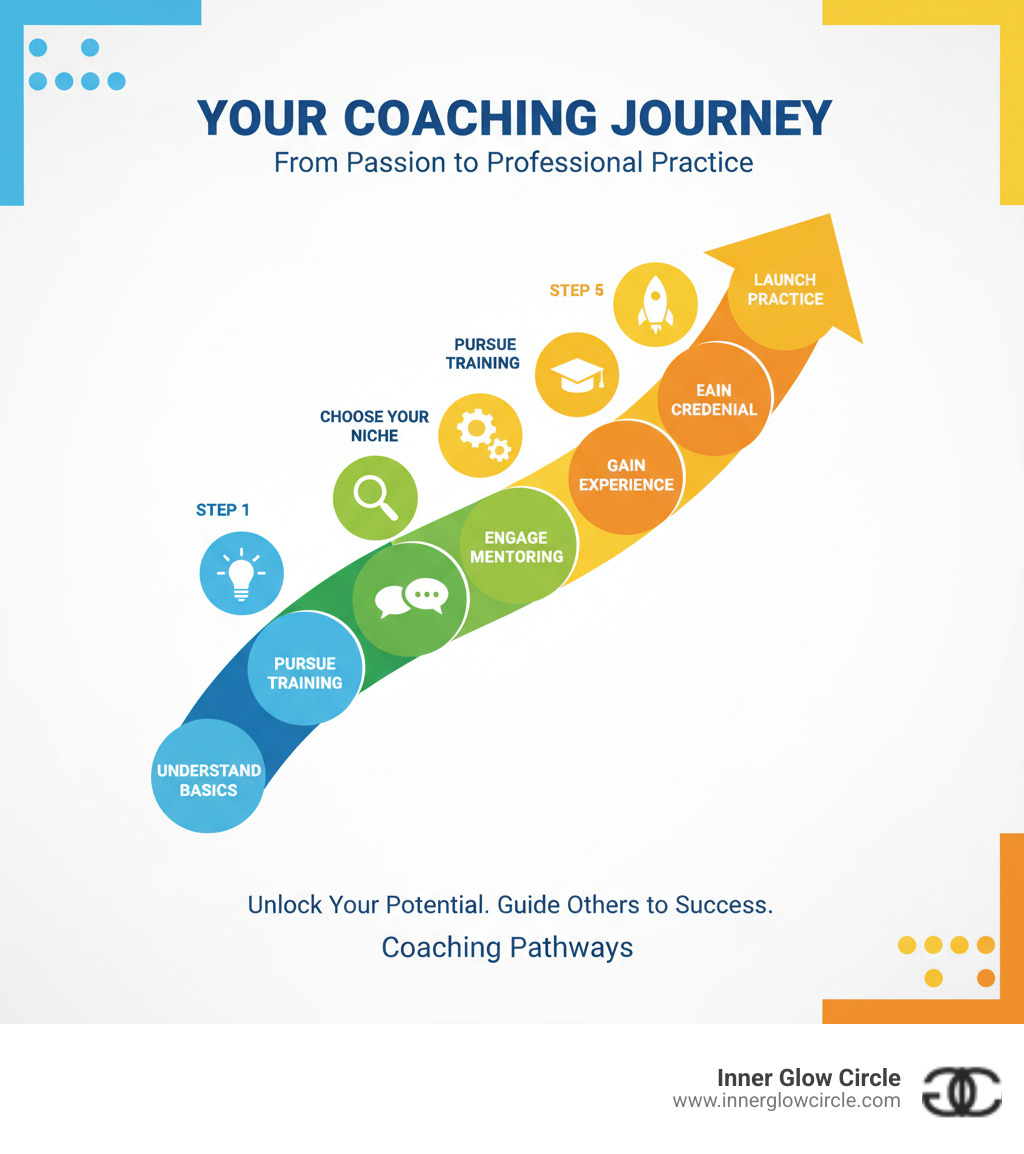
If you’re wondering how to become coach, you’re in the right place. Here’s the straightforward path:
Quick Answer: The 4-Step Journey to Becoming a Coach
- Get Trained – Complete an accredited coach training program (60-200 hours).
- Gain Experience – Log coaching hours with real clients (100-2,500 hours).
- Get Mentored – Work with an experienced coach for skill refinement.
- Get Credentialed – Earn a professional coaching credential like ICF’s ACC, PCC, or MCC.
If you feel a pull to guide others, you’re not just indulging a hobby—you’re answering a calling. But passion alone doesn’t build a career. You need a structured approach to turn that desire into a profession.
Coaching is a collaborative partnership. The International Coaching Federation defines it as “partnering with clients in a thought-provoking and creative process that inspires them to maximize their personal and professional potential.” Unlike therapy or consulting, coaching empowers clients to find their own solutions.
The industry is booming, with projected employment growth of 9% from 2023 to 2033. Clients are also becoming more discerning: 80% of coaches report that their clients expect them to be certified or credentialed. Fortunately, there’s a clear path to meet that expectation and build a successful practice.
Laying the Groundwork: Understanding the World of Coaching
Before exploring the practical steps of how to become coach, it’s crucial to understand what coaching is—and what it isn’t. The distinctions between coaching, therapy, and consulting are key to serving your clients effectively.
At its heart, coaching is about open uping potential. It’s a forward-looking partnership where you help clients clarify goals, identify obstacles, and create strategies to move forward. While a therapist might explore the past to heal wounds, a coach focuses on the future. While a consultant provides answers and expertise, a coach asks powerful questions to help clients find their own solutions. We believe the client is the expert on their own life; our role is to facilitate their findy.

Modern coaching is also deeply influenced by positive psychology, which shifts the focus from fixing what’s wrong to building on what’s right. Instead of dwelling on weaknesses, we help clients identify and leverage their strengths to foster resilience, cultivate positive emotions, and achieve optimal performance.
Choosing Your Niche: Finding Your Focus
Choosing a niche allows you to become an expert for a specific audience. You don’t have to decide right away, but it helps to know the possibilities:
- Life coaching: A broad category focusing on personal goals, relationships, well-being, and life transitions.
- Executive coaching: Develops leaders within organizations, focusing on leadership skills, strategic thinking, and team dynamics.
- Career coaching: Helps clients steer career transitions, develop professional skills, and find their ideal career path.
- Health and wellness coaching: One of the fastest-growing areas, partnering with clients on goals like stress reduction, fitness, and nutrition. The World Health Organization highlights how coaches promote well-being. You can read more about health coaching from WHO.
Other niches include financial coaching and business coaching. Your passion will often guide you to the right focus.
Core Skills Every Successful Coach Needs
Great coaching is built on a foundation of core skills that are developed through training and practice:
- Active listening: Fully concentrating on what is said and unsaid, understanding the emotion and meaning behind the words.
- Powerful questioning: Asking open-ended, thought-provoking questions that challenge assumptions and spark new insights.
- Empathy: Genuinely understanding and sharing a client’s feelings to create a safe, supportive space.
- Building trust and rapport: The bedrock of coaching, built through consistency, reliability, and confidentiality.
- Clear communication: Articulating thoughts and setting clear expectations for the coaching relationship.
- Business acumen: Understanding marketing, sales, and finance is essential for running your own practice.
The Essential Guide on How to Become a Coach
This is where your dream becomes a reality. Following a structured, proven path is what transforms you from someone who wants to help into a professional who knows how to create lasting change. While the coaching industry is largely unregulated, your future clients are savvy. 80% of coaches report that clients expect them to be certified, and 92% of clients with credentialed coaches were satisfied with their experience.
Formal training provides credibility, confidence, and an ethical framework. It’s what sets you apart in a crowded market and shows you’ve invested in the skills to truly serve your clients.

The most recognized accrediting body is the International Coach Federation (ICF), which sets the global gold standard for training programs and credentials. Choosing an ICF-accredited program ensures your education will be respected worldwide.
Step 1: Pursue Accredited Coach Training and Education
Your journey begins by enrolling in an ICF-accredited program. These programs teach the ICF Core Competencies and are offered at three levels:
- Level 1 Education (60+ hours): Designed for beginners, this provides the foundational skills needed to start coaching and aligns with the Associate Certified Coach (ACC) credential.
- Level 2 Education (125+ hours): For coaches seeking to deepen their mastery, this path aligns with the Professional Certified Coach (PCC) credential.
- Level 3 Education (200+ hours): The most intensive option, for experienced coaches pursuing the Master Certified Coach (MCC) credential.
Most new coaches start with Level 1, which offers a comprehensive and manageable entry into the profession.
Step 2: Gain Practical Coaching Experience
Theory is important, but real-world practice is essential. You must log actual coaching hours with clients. The requirement depends on your credential goal: 100+ hours for ACC, 500+ hours for PCC, and 2,500+ hours for MCC.
To get started, offer free or low-cost (pro-bono) sessions to friends, family, or community members. This builds your skills, confidence, and a portfolio of testimonials. Peer coaching with fellow students in your training program is another excellent way to practice in a safe environment. Keep a detailed log of every session, as this documentation is required for your credential application.
Step 3: Engage in Mentor Coaching
Mentor coaching is like having a personal trainer for your coaching skills. An experienced, credentialed coach reviews your sessions and provides detailed, constructive feedback on your application of the ICF Core Competencies. This objective insight is invaluable for refining your technique.
For an ICF credential, you must complete 10 hours of mentor coaching, which can be a mix of individual and group sessions. This process accelerates your growth and ensures you meet professional standards.
Step 4: Earn Your Professional Credential
After training, coaching, and mentoring, it’s time to earn your professional credential. This is your public declaration of commitment to the highest standards of coaching.
The ICF offers three main credential levels:
- Associate Certified Coach (ACC): The entry-level credential, requiring 60+ training hours and 100+ coaching hours. It signals you have a solid professional foundation.
- Professional Certified Coach (PCC): The next level, demonstrating advanced mastery with 125+ training hours and 500+ coaching hours.
- Master Certified Coach (MCC): The highest credential, for elite coaches with 200+ training hours and 2,500+ coaching hours.
The credentialing process involves submitting your application with logged hours, passing a performance evaluation (a reviewed coaching session), and passing the Coach Knowledge Assessment exam. Credentials require renewal every three years with continuing education, ensuring you stay current in the evolving field of coaching.
Launching and Growing Your Coaching Career
You’ve done the work. You’ve completed your training, logged your hours, earned your credential. Now comes the part that feels both thrilling and terrifying: actually building a coaching career that sustains you—financially and emotionally.
This is where how to become coach shifts from learning the skills to using them in the real world. And here’s what nobody tells you at the start: becoming a great coach and building a successful coaching business are two different skill sets. You need both.

How to become a coach with a successful practice
Running your own practice offers freedom but requires wearing many hats. A solid business plan is your roadmap. Get clear on your ideal client—not just their demographics, but their hopes and fears. When you know who you’re serving, your marketing becomes much easier.
- Create coaching packages: Offer 3- or 6-month programs for deeper client change and more predictable income.
- Set your prices: Research your niche, but price based on the value and results you provide. Don’t undercharge; you’re facilitating life-changing results.
- Market your services: A professional website is your home base. Use social media platforms where your ideal clients gather, like LinkedIn for career coaching or Instagram for life coaching. Share valuable content and engage authentically.
- Network: Attend conferences and join professional groups. Referrals from other professionals are a powerful source of clients.
Ethical and Legal Considerations for Coaches
As a coach, you hold a sacred trust. The ICF Code of Ethics is your guide for everything from confidentiality to professional conduct. Always use clear client agreements to set boundaries and expectations regarding payment, cancellation, and the scope of work. For your business, handle the legal basics: business registration, tax compliance, and liability insurance. Consulting a lawyer and accountant is a wise investment.
How to become a coach within an organization
Not everyone wants to be an entrepreneur. Many coaches thrive in internal coaching roles, helping employees grow within a company. This offers the stability of a regular paycheck and a steady stream of clients. Furthermore, coaching as a leadership skill is changing management. Leaders who use coaching approaches create more engaged and innovative teams, and many organizations are actively building corporate coaching cultures.
Career Outlook and Earning Potential
Let’s talk numbers. The Bureau of Labor Statistics projects that employment for coaches will grow 9 percent from 2023 to 2033, much faster than average, with about 41,800 openings each year.
The median annual wage was $45,920 in May 2024, but this figure includes sports coaches. Professional coaches in niches like executive or business coaching often earn significantly more. Your income potential depends on your specialization, experience, credentials, and business model. While it takes time to build, a rewarding and financially sustainable coaching career is absolutely achievable.
Frequently Asked Questions about Becoming a Coach
We’ve covered the path of how to become coach, but you might still have some practical questions. Here are answers to the most common concerns.
How long does it take to become a certified coach?
This depends on the program and your pace. A 60+ hour program for the Associate Certified Coach (ACC) credential typically takes about six months to complete the coursework. A more intensive 125+ hour program for the Professional Certified Coach (PCC) level often takes about a year. This is just the training; you will also need additional time to log the required practical coaching hours and complete mentor coaching before you can apply for your full credential.
Is it necessary to be certified to be a coach?
Technically, no. The industry is unregulated. However, certification is what sets serious professionals apart. The data is clear: 80% of coaches report that their clients expect them to be certified, and 92% of clients with credentialed coaches are satisfied with their experience. Certification builds credibility in a crowded market, gives you confidence in your skills, and shows your commitment to ethical standards. While you could skip it, you would be starting your career at a significant disadvantage.
What are the main costs involved in becoming a coach?
Becoming a professional coach is an investment in your future. The primary costs include:
- Training Program Fees: A quality, ICF-accredited 60+ hour program typically costs around £2,900 plus VAT (or your currency’s equivalent). More extensive programs cost more.
- Credential Application Fees: The ICF charges a fee to apply for your credential (ACC, PCC, or MCC).
- Mentor Coaching: You’ll need to budget for 10 hours of mentor coaching if it’s not included in your training program.
- Business Startup Costs: If you launch your own practice, factor in costs for a website, marketing, business registration, and liability insurance.
This is an investment not just in a credential, but in a career that offers financial stability and deep personal fulfillment.
Conclusion: Start Your Changeal Journey Today
You’ve seen the path of how to become coach—from understanding the fundamentals to earning your credentials and launching a career. It’s a journey that requires dedication, but the reward is profound: the ability to facilitate real change in people’s lives.
This isn’t just a career; it’s a path of continuous growth for your clients and for you. Every coaching conversation expands your understanding of human potential. If you’ve felt the pull to guide others professionally and are hungry for a career that feeds your soul, this is your moment.
At Inner Glow Circle, we’ve built our coaching certification program specifically for women who crave a supportive community and transformative training. We don’t just teach you how to become coach; we walk beside you as you become the coach you’re meant to be.
Your future clients are waiting. Are you ready to take the first step?
Let’s begin this journey together.
Start your journey with our career and personal development resources


