

Why Emotional Intelligence is Your Most Powerful Professional Asset
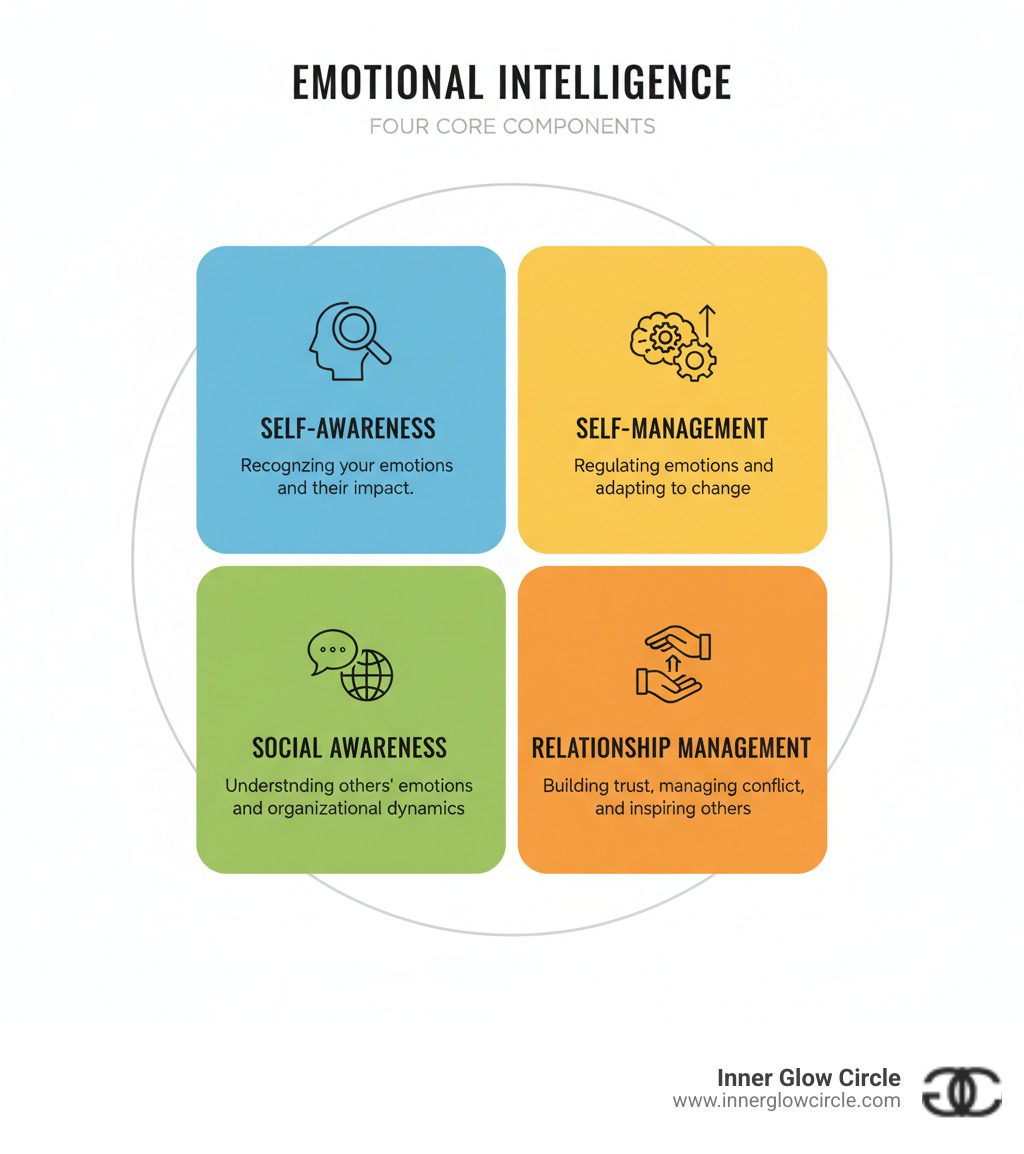
Emotional intelligence coaching is a specialized form of personal development that helps you recognize, understand, and manage your emotions while navigating the emotions of others. This coaching focuses on developing four core competencies: self-awareness, self-management, social awareness, and relationship management.
Imagine walking into a high-stakes meeting. Your heart races, but instead of panicking, you respond with clarity. You understand what you’re feeling, regulate your emotions, read the room, and connect authentically. That’s the power of emotional intelligence (EQ).
The science backs this up. Studies show that 90% of top performers have high emotional intelligence and earn higher incomes than their peers. The World Economic Forum lists EQ as a Top 10 professional skill, essential for our AI-powered future.
Emotional intelligence isn’t just about what you do; it’s about how you show up, handle setbacks, and build genuine connections. EQ coaching bridges the gap between knowing these skills matter and developing them in a lasting way. Through structured assessment and targeted practice, it transforms how you relate to yourself, your clients, and your goals.
Emotional intelligence coaching terms you need:
What is Emotional Intelligence and Why Does It Matter More Than Ever?
Picture yourself in a high-stakes meeting where your project is criticized. Your face flushes. What you do next—lash out or pause to understand—reveals your emotional intelligence in action.
In the mid-90s, psychologist Daniel Goleman‘s book, Emotional Intelligence: Why It Can Matter More Than IQ, revolutionized our understanding of success. Before Goleman, IQ was seen as the primary predictor. His research showed that your ability to understand and manage emotions (your EQ) often matters far more.

Today, this is more critical than ever. As AI handles routine tasks, uniquely human skills like empathy, creativity, and relationship-building become our greatest assets. Leaders consistently name emotional intelligence as a top skill for the future, essential for workplace success and leadership effectiveness. In our world, EQ is also a powerful tool for stress management. If you’re wondering how this connects to broader personal growth, check out more info about what life coaching is.
The Core Components of Emotional Intelligence
Emotional intelligence coaching focuses on four interconnected areas:
Self-Awareness: This is the foundation. It’s your ability to recognize your emotions as they happen and understand how they affect your thoughts and behavior. It means knowing your triggers, strengths, and blind spots.
Self-Management: This is awareness in action. It’s your capacity to manage disruptive emotions, stay composed under pressure, and adapt to change. It involves impulse control and channeling your feelings constructively.
Social Awareness: This shifts the focus outward. It’s your ability to pick up on others’ emotions, primarily through empathy—understanding someone else’s perspective. It also includes organizational awareness, or the ability to read group dynamics.
Relationship Management: This brings it all together. It’s using your emotional understanding to build strong connections, manage conflict, communicate clearly, influence and inspire others, and foster teamwork.
These pillars build on each other; you can’t manage relationships without social awareness, which in turn requires self-awareness. Research from Harvard Business School, including the idea that emotional intelligence has 12 elements, shows how these competencies create lasting impact.
The Undeniable Link Between EQ and Success
The research is compelling: 90% of top performers have high emotional intelligence. They don’t just perform better; they also earn significantly higher income than their lower-EQ peers.
Dr. Daniel Goleman calls emotional intelligence the largest predictor of success in the workplace—more so than your degree or technical skills. It’s what separates a brilliant idea from a brilliant idea that gets executed and acceptd by a team.
Think of the technically brilliant manager who can’t retain staff, or the executive whose career advancement stalls due to poor social skills. The difference-maker is emotional intelligence. When you develop your EQ, teams want to work with you, clients trust you, and opportunities find you. Your ability to steer difficult conversations and connect with others becomes your competitive advantage, especially for coaches whose clients depend on compassionate guidance.
If you’re ready to leverage EQ for your professional growth, explore more info about career development coaching to see how these skills can accelerate your journey.
The Practice of Emotional Intelligence Coaching
Knowing what emotional intelligence is and why it’s vital is the first step. Developing it is the next. This is where emotional intelligence coaching comes in—a personalized, guided partnership that creates lasting behavioral change.
Coaching is a forward-looking process focused on helping you get from where you are to where you want to be. It’s about maximizing potential. This differs from counseling, which often explores the past to heal psychological issues. An EQ coach focuses on development, not therapy, and will refer clients who need therapeutic support to a qualified professional.
How Does Emotional Intelligence Coaching Differ from Other Coaching?
While all coaching open ups potential, emotional intelligence coaching is unique. It treats emotions not as obstacles, but as valuable data. An EQ coach helps you explore feelings and triggers to understand underlying patterns and build new, productive responses.
This approach directly targets the emotional drivers behind behavior, leading to more authentic and sustainable change. It also centers on interpersonal dynamics—improving the quality of your interactions, not just the outcomes. For leaders, this is transformative, helping them connect with and motivate their teams on a human level. To understand its broader context, you can explore More info about personal development coaching services.
Here’s a quick comparison of how emotional intelligence coaching fits into the broader coaching landscape:
| Feature | Emotional Intelligence Coaching | Life Coaching | Executive Coaching |
|---|---|---|---|
| Primary Focus | Recognizing, understanding, and managing emotions (self & others) to improve personal effectiveness and relationships. | Achieving personal goals, improving overall well-being, finding purpose, balancing life areas. | Enhancing leadership skills, improving professional performance, achieving organizational objectives. |
| Key Differentiator | Explicitly targets emotional competencies as the foundation for all other growth. | Holistic approach to personal growth across various life domains. | Focused on career advancement, organizational impact, and leadership effectiveness within a corporate context. |
| Core Methodologies | EQ assessments, self-reflection, emotional regulation techniques, empathy building, communication strategies. | Goal setting (SMART), visioning, values clarification, habit formation, accountability. | 360-degree feedback, leadership assessments, strategic planning, team dynamics, stakeholder engagement. |
| Typical Client | Individuals seeking to improve relationships, communication, stress management, leaders, professionals. | Anyone wanting to make significant personal changes, find direction, improve satisfaction. | Senior leaders, managers, high-potentials, entrepreneurs looking to improve their leadership and business acumen. |
| Benefits | Improved self-awareness, improved relationships, effective communication, greater resilience, inspiring leadership. | Increased clarity, motivation, personal fulfillment, improved decision-making, work-life balance. | Better decision-making, stronger team performance, improved communication, strategic thinking, career growth. |
Key Skills and Methodologies for an EQ Coach
An effective emotional intelligence coach uses a specific set of skills to guide clients toward their own insights.
- Active Listening & Powerful Questioning: Coaches listen for what’s said and unsaid, using powerful questions to spark self-findy and challenge assumptions. The goal isn’t to provide answers but to help clients find their own.
- Empathy and Trust: A coach models empathy to create a safe, supportive space where clients feel understood. This trust is essential for the vulnerability that real change requires.
- Facilitating Self-Findy: The coach partners with clients to explore their behaviors, beliefs, and emotions, facilitating insight through reflection and feedback.
- Accountability and Goal Setting: Coaches help clients set clear goals using frameworks like SMART goals and provide accountability to ensure they follow through on their action plans.
To jump-start this process, coaches often use assessment tools like the EQ-i 2.0, 360-Degree Assessment, and the DISC Profile. These tools provide objective data, offering a clear roadmap for both coach and client. The process often uses a strengths-based approach, amplifying what’s already working rather than just fixing weaknesses, which positive psychology shows leads to greater happiness and engagement.
The Four Pillars of EQ in a Coaching Context
The four pillars of emotional intelligence—self-awareness, self-management, social awareness, and relationship management—are the practical tools used in emotional intelligence coaching to transform how you show up in the world.

Strengthening these pillars is a journey of self-findy that touches every aspect of your life. This deep exploration is what makes coaching for self-improvement so powerful.
Pillar 1 & 2: Self-Awareness and Self-Management
These internal pillars work together: you can’t manage what you don’t recognize. Coaching helps you slow down to recognize emotions and understand your triggers—the situations or people that set off specific reactions. This awareness is the first step toward emotional regulation. Instead of reacting on autopilot, you learn to pause and choose your response. This builds impulse control and adaptability, helping you stay flexible when plans change. As Harvard Business School notes, acknowledging areas for growth builds trust and transparency.
Pillar 3 & 4: Social Awareness and Relationship Management
These pillars focus on how you interact with others. Empathy, the foundation of social awareness, is the ability to understand what someone else is experiencing. Coaching develops this through active listening and perspective-taking exercises. This extends to organizational awareness, or the ability to read group dynamics and unspoken rules. With these skills, you can approach conflict management as an opportunity for growth, not a threat. You learn to influence others by inspiring them toward shared goals and foster teamwork by creating a cooperative atmosphere. This all contributes to building rapport and trust, making you someone others want to connect with and support.
By strengthening these four pillars through emotional intelligence coaching, you don’t just understand emotions better—you become more confident, connected, and capable of creating the life you want.
The Transformative Impact of Developing Your EQ
When you commit to developing your emotional intelligence, the change creates ripples that touch everything—your leadership, your teams, and your entire organization.

Organizations that invest in emotional intelligence coaching see measurable results: productivity increases, employee engagement soars, and turnover drops. When people feel understood and respected, they contribute more deeply. The World Economic Forum identifies EQ as a Top 10 professional skill because it’s a massive predictor of workplace success, especially as automation increases.
Benefits for Leaders and Professionals
For leaders, developing EQ is essential. It leads to better decision-making, as you learn to separate feelings from facts and recognize personal biases. Your communication becomes more inspiring, as you learn to articulate ideas with clarity and listen with empathy. You build resilience, bouncing back from setbacks more quickly and managing stress effectively. Most importantly, you learn to inspire others and build trust—the most valuable currency in leadership. When your team trusts you, collaboration accelerates, loyalty deepens, and innovation flourishes. For entrepreneurs, these skills are even more critical for navigating the emotional rollercoaster of building a business. If you’re curious about how EQ specifically empowers women in business, explore More info on empowering female entrepreneurs.
Long-Term Impact and Sustainability of Emotional Intelligence Coaching
Unlike a one-day workshop, the effects of emotional intelligence coaching last. This is thanks to neuroplasticity—your brain’s ability to adapt and form new neural pathways. With consistent practice and coaching support, you can literally rewire your brain to make emotionally intelligent responses automatic.
Research confirms this. Studies tracking participants after emotional intelligence training show that improvements don’t just stick; they often continue to grow months later. The Scientific research on EI training effectiveness validates that these skills become integrated into who you are. When leaders develop their EQ, they become catalysts for change, creating a coaching culture where emotional intelligence is woven into the organizational DNA. This investment creates sustained behavioral change and long-term performance improvement.
Frequently Asked Questions about Emotional Intelligence Coaching
Considering emotional intelligence coaching? Here are straight answers to some common questions.
How can I assess my own emotional intelligence?
You can’t improve what you don’t measure. A great starting point is self-reflection. Regularly ask yourself honest questions about your emotional reactions. Why did that comment frustrate you? What were you feeling in that meeting? Next, try seeking feedback from trusted colleagues, friends, or a manager about how you handle emotions and relationships.
For a more structured approach, formal assessments provide scientifically validated data on your EQ. Common tools include:
- EQ-i 2.0 (Emotional Quotient Inventory): Measures 15 specific emotional competencies.
- MSCEIT (Mayer-Salovey-Caruso Emotional Intelligence Test): An ability-based test of EQ skills.
- TEIQue (Trait Emotional Intelligence Questionnaire): Focuses on emotional self-perceptions.
- DISC Profile: Reveals behavioral preferences and communication styles linked to EQ.
The most comprehensive approach is working with a coach. A coach helps you interpret assessment results, provides objective observations, and guides you in turning that data into actionable wisdom.
What does a typical emotional intelligence coaching program look like?
Emotional intelligence coaching is a practical, forward-focused partnership. A typical program follows a clear structure:
- Initial Assessment: The process usually begins with a formal assessment (like the EQ-i 2.0) and in-depth conversations to establish a baseline and understand your unique emotional landscape.
- Goal Setting: You’ll work with your coach to set specific, measurable, and meaningful goals, such as managing reactions in high-pressure meetings or building stronger team connections.
- Regular Sessions: In weekly or bi-weekly one-on-one sessions, you’ll explore, reflect, and grow in a confidential space. Your coach uses powerful questions and proven methodologies to help you access your own insights.
- Action Planning & Accountability: Between sessions, you’ll work on targeted assignments to practice your new skills in real-life situations. Your coach provides support and accountability to help you stay on track and turn good intentions into lasting change.
Most programs last 3 to 6 months, providing enough time to rewire old habits and establish new, emotionally intelligent responses.
Can emotional intelligence really be learned and improved?
Yes, absolutely. For years, many believed EQ was a fixed trait, but neuroscience has proven otherwise. Thanks to neuroplasticity, your brain can form new neural connections throughout your life. The emotional patterns that feel ingrained are just well-worn pathways; with intentional effort and consistent practice, you can create new ones.
Every time you pause before reacting or choose empathy over judgment, you are strengthening your EQ. Coaching interventions accelerate this process by providing a structured environment, personalized feedback, and accountability.
The research is clear: studies show significant improvement in people who complete EI training, and these gains are sustained long-term. For more details, you can explore the Scientific research on EI training effectiveness. Whether you feel like a beginner with emotions or are looking to refine advanced skills, your emotional intelligence can grow.
Open up Your Potential with EQ Coaching
From Daniel Goleman’s insights to modern neuroscience, one truth is clear: emotional intelligence coaching isn’t about fixing a flaw. It’s about open uping the potential that’s already within you.
Imagine approaching a challenge with quiet confidence, not because you’ve become someone else, but because you’ve learned to understand yourself. The power of self-awareness is transformative. When you understand your emotions, you can manage them. When you understand others, you can connect with them. These are not mysterious talents; they are skills for the future that you can learn, practice, and master.
Emotional intelligence coaching provides a partner for this journey. A skilled guide asks the right questions and walks alongside you as you find your own answers. Through personalized assessments and consistent support, you develop the competencies that lead to greater success and deeper satisfaction.
In a world shaped by AI, our human capacity for empathy, collaboration, and authentic leadership is our greatest professional asset. At Inner Glow Circle, we’ve seen this change countless times in our coaching programs designed for women ready to step into their full potential.
You don’t have to figure this out alone. The path to becoming a more effective leader and person starts with the decision to invest in your emotional growth.
Become a more effective leader and person with mentor coaching.
Your potential is waiting. Let’s open it up together.


