

Why Growing Your Coaching Practice Matters More Than Ever
Grow coaching practice isn’t just about adding more clients—it’s about building a sustainable business that creates real impact while honoring your energy and values. Whether you’re just starting out or looking to expand beyond one-on-one sessions, understanding proven growth strategies can help you move from scattered efforts to intentional expansion.
Quick Answer: How to Grow Your Coaching Practice
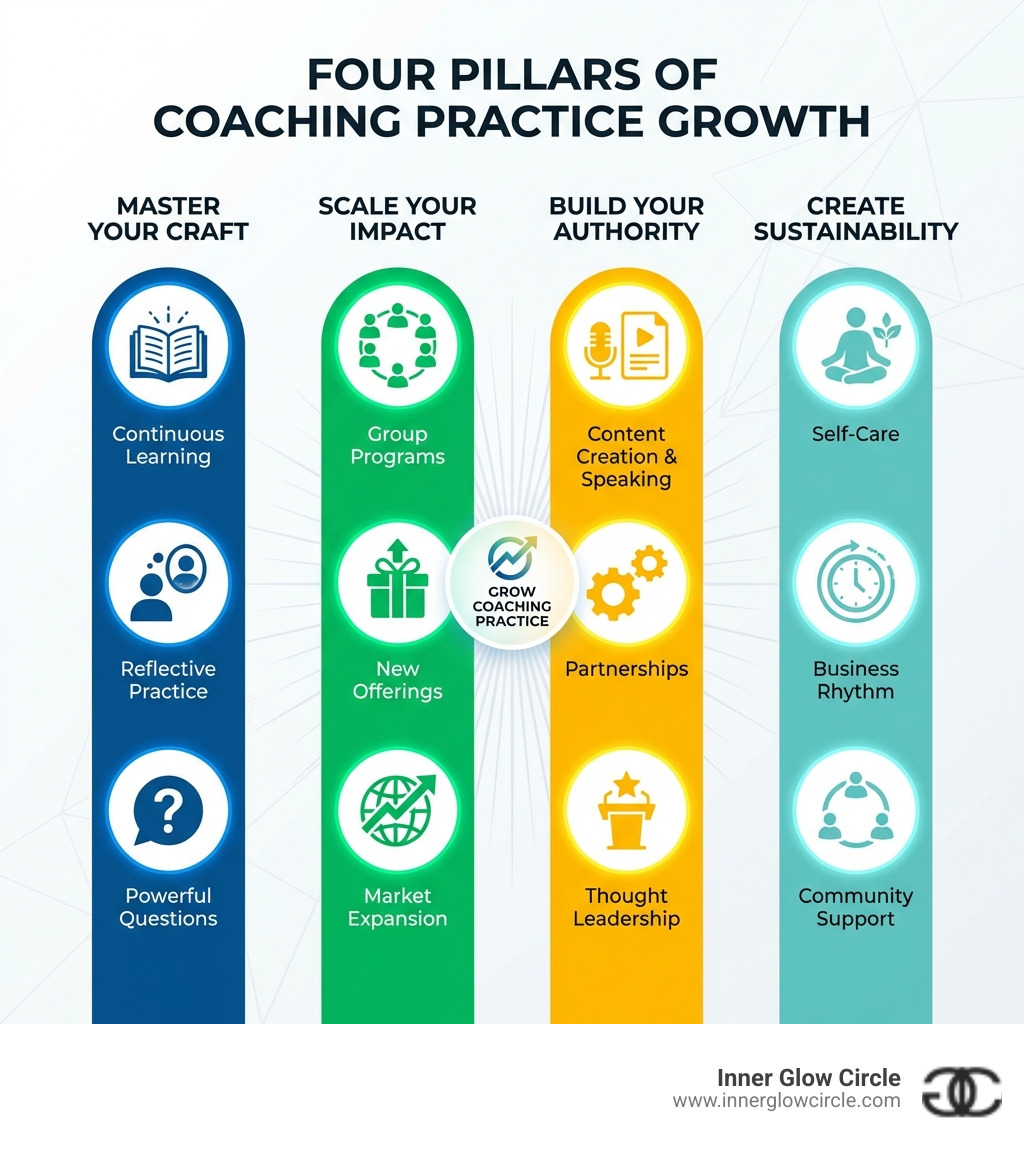
- Master Your Craft – Deepen your skills through continuous learning, powerful questioning techniques, and reflective practice
- Scale Your Impact – Move beyond 1-on-1 sessions with group programs, new offerings for existing clients, and expansion into adjacent markets
- Build Your Authority – Share your expertise through content, speaking, podcasts, and strategic partnerships
- Leverage Proven Frameworks – Use structured models like GROW (Goal, Reality, Options, Will) to guide effective coaching conversations
- Prioritize Sustainability – Build in breaks, avoid overbooking, and design a rhythm that protects your presence and energy
Here’s the truth that most new coaches don’t realize: building a successful coaching practice requires both inner work and outer strategy. Research shows that the most effective coaches don’t just master techniques—they cultivate presence, practice self-reflection, and build businesses that align with their values.
The coaching industry is evolving rapidly. Managers are moving away from command-and-control leadership toward coaching-based approaches. Clients want more than advice—they want support in finding their own answers. And successful coaches are finding that growth doesn’t mean working harder; it means working smarter.
If you’re feeling overwhelmed by all the advice out there, you’re not alone. Sarah, like many aspiring coaches, struggled with self-doubt and uncertainty about how to build a sustainable practice. The good news? There’s a clear path forward, backed by research and proven frameworks used by successful coaches worldwide.
Simple grow coaching practice glossary:
Master Your Craft: Foundational Strategies to Grow Your Coaching Practice

Before we can effectively expand our reach, we must first ensure our foundation is rock-solid. This means continuously honing our coaching skills, embracing lifelong learning, and prioritizing our own well-being through reflective practice and self-care. After all, a burnt-out coach is not a glowing coach! Professional sustainability isn’t just a buzzword; it’s the bedrock of a thriving coaching practice.
Deepen Your Coaching Skills for Greater Client Impact
At the heart of every successful coaching practice is a highly skilled coach. Our commitment to ongoing education is paramount, helping us stay informed about new developments in psychology, business, technology, and coaching itself. As Forbes points out, becoming a lifelong learner ensures we offer the most innovative solutions to our clients.
One of the most powerful and globally recognized frameworks we can master is the GROW Coaching Model. Created by executive coaching thought leader Sir John Whitmore in the 1980s, the GROW model is a structured approach designed for solving problems, setting goals, and improving individual and team performance. Its simplicity and effectiveness have made it the most commonly used coaching model by managers and a favorite among professional coaches worldwide. Wikipedia notes its development in England in the mid-1980s, primarily for corporate coaching with executives, and its first publication in Whitmore’s seminal 1992 book, Coaching for Performance.
So, what does GROW stand for?
- G – Goal: What does the client want to achieve? This isn’t just about setting goals, but making them SMART (Specific, Measurable, Achievable, Realistic, Time-bound).
- R – Reality: What is the current situation? Where are they now in relation to their goal? This stage explores facts, feelings, and what’s truly happening.
- O – Options: What possibilities or alternative actions could the client take? This is a brainstorming phase, encouraging creative thinking without immediate judgment.
- W – Will (or Way Forward): What will the client commit to doing? This is the action plan, ensuring commitment and accountability.
The GROW model works because it’s a results-oriented framework, always ending with the client choosing concrete actions. It’s easy to remember and follow, ensuring that key elements of a coaching session are covered. Its relevance endures because it provides a clear structure for navigating ambiguity, empowering individuals, and fostering continuous improvement. Herminia Ibarra and Anne Scoular in The Leader as Coach noted how companies are shifting from command-and-control to models where managers provide support and guidance—a perfect fit for GROW.
The GROW Coaching Model contributes significantly to employee development, engagement, and performance. By guiding individuals to identify their own solutions and commit to action, it fosters a sense of ownership and intrinsic motivation, aligning beautifully with principles of self-determination theory. As Sir John Whitmore emphasized, the model focuses on awareness and accountability to drive business outcomes. It greatly simplifies and optimizes the performance management process, helping engage and motivate employees across all industry verticals.
The ‘W’ for ‘Will’ (or ‘Way Forward’) is perhaps the most crucial pillar. Sir John Whitmore was unequivocal: ‘W’ stands for having the will to commit. It’s not just about identifying what to do, but cultivating the internal drive and commitment to actually do it. Without this, even the best goals and options remain just ideas.
Powerful Questions to Guide Your Coaching Sessions
The magic of the GROW model lies in the questions we ask. Here are some powerful coaching questions to guide each stage, helping clients open up their own insights and drive their progress:
G – Goal: What do you want to achieve?
- What would success look like for you?
- How will you know when you have achieved this goal?
- What would it mean to you personally to achieve this?
- How much personal control do you have over this goal?
- What specific, measurable, achievable, relevant, and time-bound outcomes are you aiming for?
R – Reality: Where are you now?
- What is happening at the moment in relation to your goal?
- What have you already tried, and what were the results?
- What evidence or examples do you have to support this?
- Who else is involved, and what are their perceptions?
- What is holding you back? What’s getting in the way?
- What is the impact of the current situation?
O – Options: What could you do?
- What are all the possible ways you could move forward? (Encourage brainstorming, no judgment!)
- What steps have worked for you in similar situations?
- If you had unlimited resources, what would you do?
- What might someone else in your shoes do?
- What could you stop doing, do less of, do more of, or start doing?
- What are the benefits and costs of each option?
W – Will (Way Forward): What will you do?
- Which option(s) are you most committed to?
- What is your very first step? When will you take it?
- On a scale of 1 to 10, how committed are you to taking this action? What would make it a 10?
- What potential obstacles might arise, and how will you overcome them?
- What support do you need, and from whom?
- How will you hold yourself accountable?
These questions, used skillfully, can reveal profound insights and propel clients toward their objectives, even in short conversations of just five minutes.
Accept Reflective Practice and Self-Care
To truly master our craft and sustain our energy, we must accept reflective practice and self-care. It’s easy to preach mindfulness to clients while running ourselves ragged. But as coaches, embodying presence and self-care is fundamental to ICF Competency 2: Embodies a Coaching Mindset.
Reflective practice is a deliberate process of thinking about our experiences to gain insights and apply them. It’s an iterative, creative journey that helps us grow personally and professionally. As Michelle Lucas reminds us, reflection isn’t just about taking time; it’s about “knowing what to bring into that time” to gain valuable insights.
A critical aspect of self-care for coaches is allowing space between client sessions. Microsoft’s Work Trend Index (2021) showed that back-to-back meetings increase stress and reduce focus, while even short breaks reset neural activity and restore cognitive clarity. We need these “brain breaks” to show up fully present for our next client.
Practices like scheduled pauses, journaling, seeking supervision, engaging in peer coaching, and spending time in nature are vital. Integrating wellness, mindfulness, or holistic health techniques into our own lives—and, by extension, our practice—can differentiate our services and prevent burnout. As Jordan Friedman, The Stress Coach, suggests, helping clients with mindfulness and stress reduction makes coaching more impactful. This holistic approach ensures we not only help others flourish but also sustain our own joy and energy in the process.
Scale Your Impact: Strategies for Business Expansion

Once we’ve mastered our craft, the next step in our journey to grow coaching practice is to strategically scale our impact. This means moving beyond the traditional one-to-one model to reach more people, increase our revenue, and create thriving client communities.
Develop Group Coaching and Community Programs
One of the most effective ways to scale our practice is by embracing the one-to-many model through group coaching and community programs. Group coaching can significantly scale our practice, foster a sense of community among clients, and facilitate powerful peer learning. Imagine the impact of guiding a cohort of ambitious women, all supporting each other toward their goals! This approach allows us to serve more clients without proportionally increasing our time commitment, creating leverage that boosts both our impact and income. It also builds a supportive network for our clients, enhancing their experience and results.
Create New Offerings for Existing Clients
Our existing clients are a goldmine for growth. They already know, like, and trust us, making it much easier to offer them additional services. We can leverage our intellectual property and valuable thought leadership to develop new products. This might include:
- Online workshops or masterclasses: Focused on specific skills or challenges.
- Retreats: Immersive experiences for deeper change.
- Digital resources: E-books, templates, or self-study courses.
- Higher-tier programs: More intensive, longer-term coaching options.
By creating new offerings, we deepen our relationships with clients, increase their lifetime value, and provide them with continuous opportunities for growth. Remember to help them set and achieve SMART goals within these new offerings, just as we would in one-on-one coaching.
Expand Into New Markets to Grow Your Coaching Practice
Thinking beyond our current client base can open up significant growth. We can expand into new markets by identifying adjacent niches or entirely new audiences that could benefit from our existing coaching services. For example, if we currently coach female entrepreneurs, we might explore coaching women in leadership roles in corporations, or women transitioning careers.
The key is to:
- Define the new audience: Who are they? What are their unique needs and challenges?
- Understand their needs: Immerse ourselves in their world to truly grasp how our coaching can serve them.
- Tailor our offerings: While our core methodology remains, we might need to adjust our messaging, examples, and even delivery methods to resonate with this new group.
This strategic expansion can involve evolving our business structure, perhaps by creating specialized programs or hiring additional coaches to serve the new market. It’s about smart growth, not just busywork.
Build Your Authority and Brand
To truly grow coaching practice, we need to establish ourselves as thought leaders and build a brand that attracts our ideal clients. This means stepping into our power, sharing our unique wisdom, and creating a visible presence in the market.
Share Your Expertise Through Content and Speaking
Clarifying our unique methodology and sharing it widely is a powerful way to establish expertise. Authoring a book, for instance, not only improves credibility and widens our audience but also reinforces our brand and helps clarify our intellectual property. Imagine the impact of having our coaching philosophy articulated in a published work! This can open doors to new revenue streams and significantly extend our influence through writing, speaking engagements, or teaching opportunities. Whether it’s blog posts, articles, or keynote speeches, consistently sharing our insights positions us as an authority in our niche.
Host a Podcast, Web Series, or Live Events
Launching a podcast or web series is an excellent strategy to boost visibility and establish thought leadership. As Forbes Advisor suggests, a podcast allows us to discuss industry challenges, offer solutions, interview other leaders, and build a loyal audience. This not only expands our network but also provides a platform to share our unique insights and connect with potential clients on a deeper level. Similarly, hosting live or virtual events—from webinars to workshops—creates direct engagement opportunities and positions us as accessible experts.
Leverage Social Proof and Form Strategic Alliances
Nothing speaks louder than results. Leveraging social proof through testimonials, case studies, and client success stories demonstrates the changeal impact of our coaching. When clients share their positive experiences, it attracts potential clients and fosters a deeper connection to our brand. We should actively collect and showcase these stories, using them to build trust and credibility.
Furthermore, forming strategic alliances with complementary professionals can lead to offering comprehensive, holistic packages that benefit clients and expand our reach. For example, a career coach might partner with a financial advisor or a wellness expert to provide a more integrated service. This community engagement, both with our clients and with other professionals, strengthens our brand and creates a powerful referral network.
Frequently Asked Questions about Growing a Coaching Practice
How do different coaching models support client growth?
The GROW Coaching Model is renowned for its simplicity, effectiveness, and results-oriented approach, making it the most commonly used coaching model by managers. However, it’s not the only game in town. Other powerful coaching models exist, such as T-GROW (which adds ‘Topic’ before ‘Goal’ to help clients clarify their focus), OSKAR (Outcome, Scale, Know-how, Affirm & Action, Review), and CLEAR (Contracting, Listening, Exploring, Action, Review).
These models all provide structured frameworks to guide coaching conversations, helping clients move from their current state to their desired outcome. They offer different entry points and emphases, allowing skilled coaches to draw on various frameworks depending on the client’s needs and the specific situation. For example, T-GROW can be particularly useful when a client is scattered or unclear at the start of a session, helping them define their ‘Topic’ before diving into their ‘Goal.’ The flexibility of the GROW model allows for movement between its components, not always a strict adherence to sequence, adapting to the natural flow of a conversation. Even in short conversations, structured questioning can produce valuable insight, highlighting the adaptability of these models.
What are the potential limitations of coaching models?
While incredibly powerful, coaching models like GROW are tools, not magic wands. Their effectiveness hinges on the coach’s skill and presence. One potential limitation of the GROW model, as noted by some experts, is that it is primarily a “coaching session model” rather than an entire coaching process. This means it doesn’t explicitly include a mechanism for ongoing accountability or reviewing actions agreed upon in previous sessions within its core framework. While a coach would naturally integrate this, it’s not explicitly part of the G-R-O-W acronym itself.
Another consideration is the risk of rigidity if the model is misused. A coach might fall into the trap of robotically asking questions without genuinely listening or adapting to the client’s unique needs. There’s also a danger in the ‘Will’ stage that clients might propose actions they think they should do, rather than what truly aligns with their talents and behavior. The GROW model is not to be employed in isolation but in conjunction with active listening, intuition, and the broader coaching skills that allow us to “dance in the moment” with our clients. The model is a guide; the coach’s ability to connect, challenge, and empower remains paramount.
How can managers use coaching skills to develop their teams?
The GROW model is not just for professional coaches; it’s an invaluable tool for managers looking to foster a culture of continuous improvement and empower their teams. In fact, it’s the most commonly used coaching model by managers to coach their employees.
Managers can implement the GROW model to:
- Facilitate problem-solving and decision-making: By guiding team members through Goal, Reality, Options, and Will, managers can help them take ownership of challenges and find their own solutions.
- Improve employee development and performance: The model simplifies and optimizes the performance management process, helping managers engage and motivate employees to develop new skills and reach their career goals.
- Foster a culture of accountability: The ‘Will’ stage, with its emphasis on commitment and action planning, naturally builds accountability within teams.
- Promote productivity and self-satisfaction: When individuals feel supported in setting their own goals and finding their own paths, it leads to greater job satisfaction and improved output.
The GROW model is actionable and adaptable, providing a clear structure for navigating ambiguity and empowering employees, which is crucial in a time of constant change. Managers can introduce the model to their direct reports, practice it with fellow managers, and consistently use its principles in one-on-one meetings, performance discussions, and leadership development programs. This shift from giving instructions to providing support and guidance, as highlighted in The Leader as Coach, is a key implication for leadership development. It helps create clarity, builds accountability, and supports personal development at every level of the organization.
Conclusion: Your Coaching Empire Awaits
We’ve explored a powerful roadmap to grow coaching practice, moving from mastering foundational skills to scaling our impact and building undeniable authority. We’ve seen how deepening our craft through models like GROW, embracing reflective practice, and caring for our well-being are non-negotiables. We’ve also uncovered strategies for business expansion, from group programs to new markets, and learned how to amplify our voice through content, speaking, and strategic alliances.
The journey of building a thriving coaching empire is one of continuous growth—both inner and outer. It’s about serving more people, making a bigger difference, and doing it all with joy and integrity. At Inner Glow Circle, we believe in empowering women like you to achieve confidence and success, building practices that truly align with your values.
The time is now to cultivate your unique coaching empire.
Ready to build your profitable coaching practice? Join our class to get started.


