

Introduction: What Is Inner Strength and Why Does It Matter?
To cultivate inner strength, focus on building resilience through consistent practices like mindfulness and self-compassion, developing self-awareness to understand your limits and values, and taking small daily actions that reinforce your sense of agency and control. Inner strength grows when you intentionally process positive experiences, challenge negative thought patterns, and create supportive environments that nurture your growth.
Quick ways to start building inner strength today:
- Practice mindfulness meditation for 5-10 minutes daily to strengthen attention and calm
- Write about challenging experiences for 15-20 minutes to process emotions and heal
- Set one small, achievable goal each day and follow through to build self-trust
- Identify your core values to make decisions aligned with your authentic self
- Spend time in silence away from distractions to hear your inner voice
- Connect with supportive people who encourage your growth and well-being
Life throws challenges at all of us. Some days you wake up ready to conquer the world. Other days, even a small setback feels overwhelming.
Inner strength is the reservoir of psychological and emotional resources within you that allows you to face life’s challenges with resilience, grace, and determination. It’s not about never experiencing doubt or fear. It’s about having the tools to steer those feelings and move forward anyway.
Think of inner strength like supplies in a backpack for life’s journey. These supplies include capabilities like mindfulness and emotional intelligence, positive emotions like gratitude and self-compassion, and attitudes like confidence and determination.
Here’s the wonderful news: inner strength isn’t something you’re born with. Research shows that about two-thirds of a person’s strengths are developed over time through intentional practice. The other third comes from your natural temperament and personality.
Inner strength enables you to maintain composure under pressure, bounce back from setbacks with renewed determination, pursue your goals with unwavering focus, and adapt to change with flexibility and openness.
For Sarah, our aspiring life coach struggling with self-doubt, cultivating inner strength could mean the difference between letting fear hold her back and confidently launching her coaching business. The same is true for anyone facing their own “one thing” that’s been holding them back from living their fullest life.
The key components of inner strength include resilience (your ability to bounce back from adversity), self-compassion (treating yourself with kindness during difficult times), and agency (recognizing your power to make choices and take action).
This guide will show you exactly how to build these qualities through practical, proven techniques. You’ll find how your brain’s neuroplasticity allows you to rewire old patterns, how small daily practices create lasting change, and how your environment and relationships either support or undermine your inner strength.
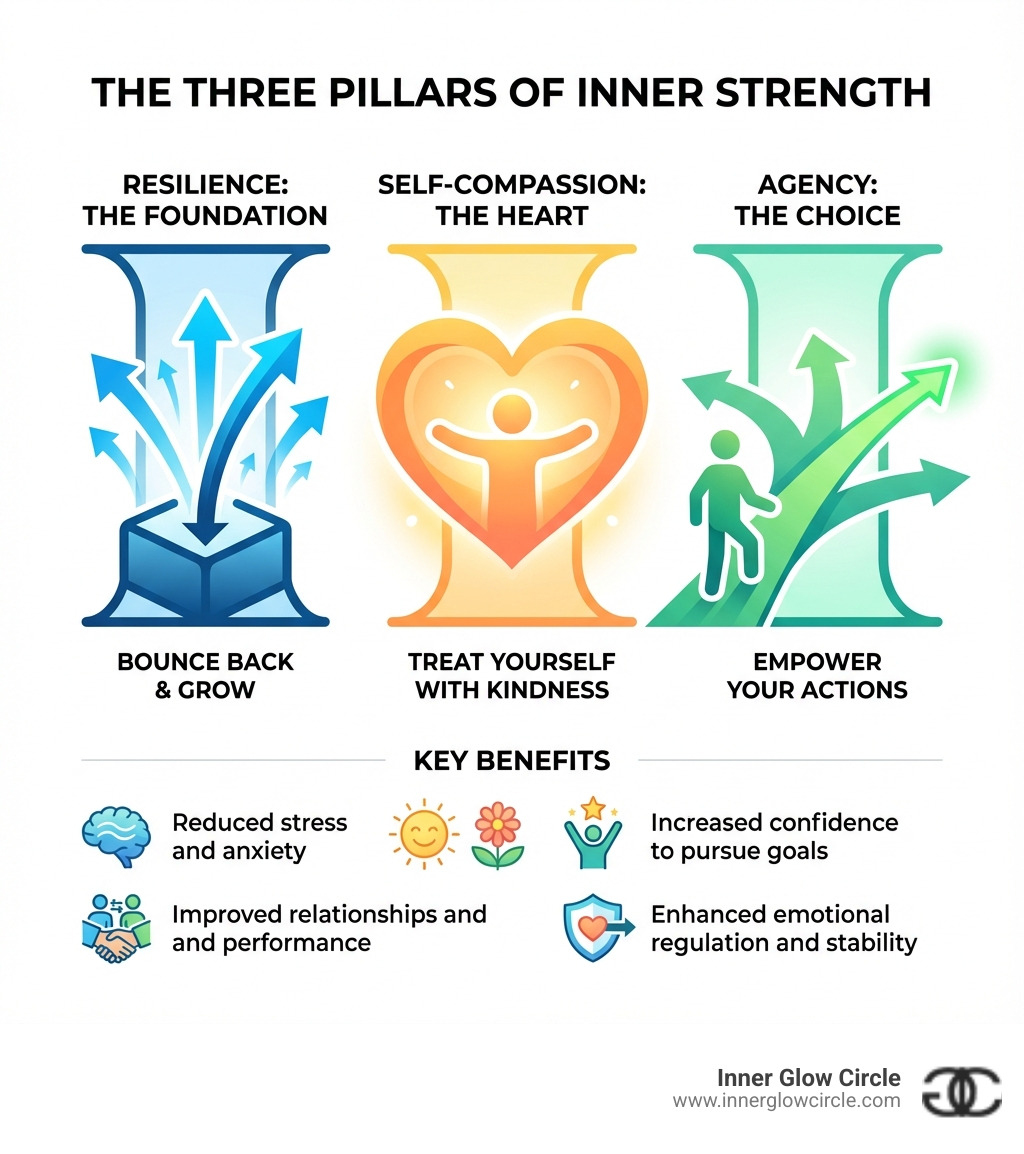
Cultivate inner strength terms explained:
Foundational Mindset Shifts for Building Inner Strength

Before we dive into specific practices, let’s talk about the powerful mindset shifts that lay the groundwork for building inner strength. We’re talking about understanding how our brains work, knowing ourselves deeply, and reframing our personal stories. These shifts help us overcome common obstacles like self-doubt, fear of failure, and even past traumas.
Harness Your Brain’s Power: Neuroplasticity and the Negativity Bias
Did you know your brain is an incredible, ever-changing organ? This amazing ability is called neuroplasticity, meaning your brain can actually rewire itself based on your experiences and focus. This is fantastic news for anyone looking to cultivate inner strength, because it means we aren’t stuck with old patterns or inherent weaknesses. Through intentional practices, we can literally reshape our brains to be more resilient and resourceful, no matter what our past experiences have been.
However, our brains also come with a built-in challenge: the negativity bias. This is our brain’s natural tendency to focus on negative experiences more strongly than positive ones. It’s an evolutionary survival mechanism, designed to keep us safe by making us highly aware of threats. But in modern life, it can leave us feeling overwhelmed by stress and setbacks.
The good news is we can leverage neuroplasticity to steer this bias. Dr. Rick Hanson, a renowned psychologist, offers expert strategies for turning positive experiences into lasting inner strengths. His HEAL method (Have, Enrich, Absorb, Link) is a simple yet powerful way to do this:
- Have a positive experience.
- Enrich it by savoring it for 15-30 seconds, letting it fill your senses and body.
- Absorb it by feeling it sink into you, becoming a part of your inner landscape.
- Link it to something negative you want to overcome, allowing the positive to soothe and replace the negative.
By deliberately prolonging and creating positive experiences, we’re actively shaping our neural networks for greater strength and resilience. This isn’t just wishful thinking; it’s grounded in neuroscience. On average, only about a third of our strengths are innate; the other two-thirds are developed over time. So, let’s get developing! For more on these powerful brain-shaping techniques, check out these expert strategies for building resilience.
How Self-Awareness Helps You Cultivate Inner Strength
“Know Thyself” – this ancient Greek maxim, inscribed in the Temple of Apollo, is a foundational principle for building inner strength. It sounds simple, but truly understanding ourselves is a continuous journey. To cultivate inner strength, we must first know our limits, boundaries, motivations, and desires.
When we understand our limits, we can avoid burnout and set realistic expectations. Knowing our motivations helps us align our actions with our deepest values, giving us a sense of purpose and direction. And understanding our desires allows us to pursue what genuinely brings us fulfillment.
A crucial part of self-awareness is setting healthy boundaries. This means learning to say “no” to things that drain our energy, compromise our well-being, or don’t align with our goals. Setting boundaries isn’t selfish; it’s a powerful act of self-care that protects our psychological and emotional resources. It communicates our worth and teaches others how to treat us. As we learn to set boundaries, we strengthen our sense of agency and self-respect.
Furthermore, self-compassion is a key component of inner strength. It’s about treating ourselves with the same kindness and understanding we would offer a dear friend. When we face setbacks or make mistakes, self-compassion allows us to acknowledge our pain without harsh self-criticism. This gentle approach helps us learn from challenges rather than being paralyzed by them, fostering resilience. It’s not about suppressing emotions; it’s about navigating them with wisdom and kindness. This deep self-understanding is vital for mental toughness and overall well-being. Find more about how to build mental strength by fostering these internal qualities.
Reframe Your Narrative with Expressive Writing
Life throws us curveballs, and sometimes those experiences leave deep emotional wounds. Learning to process these can be a monumental step in cultivating inner strength. This is where expressive writing, often called “story-editing,” comes in. It’s a powerful, low-cost, and highly effective tool for emotional healing and building resilience.
Expressive writing involves writing continuously about your most upsetting or challenging life experiences for 15-20 minutes a day, typically for three or four days. The key is to write without worrying about grammar, spelling, or judgment, just letting your thoughts and feelings flow onto the page.
Why does it work? Psychologists like James W. Pennebaker, who championed expressive writing, have shown that this practice helps us organize our thoughts and feelings, find meaning in difficult events, and gain new perspectives. It allows us to externalize our internal struggles, making them less overwhelming and more manageable. By putting our story down, we can observe it, challenge negative thought patterns, and even begin to reframe our narrative. This process is like being the editor of our own life story, allowing us to rewrite parts of it, not by denying reality, but by changing our interpretation and emotional response to it.
The benefits are extensive, ranging from reducing anxiety and easing depression to improving concentration and even boosting immune function. It helps us process past traumas and build a stronger, more coherent sense of self. It truly is a “steroid for the soul,” but entirely natural and without side effects! To dig deeper into this transformative practice, you can learn more about Expressive Writing.
Daily Practices to Cultivate Inner Strength
Now that we’ve explored some foundational mindset shifts, let’s get practical. Building inner strength isn’t about grand gestures; it’s about consistent, actionable strategies woven into our daily lives. Think of it as a daily routine for your emotional and psychological muscles. These practices help us foster a mind-body connection, set meaningful goals, and build a powerful sense of self-efficacy.
Using Mindfulness and Meditation to Cultivate Inner Strength
In our world, finding moments of quiet can feel like a luxury. Yet, spending time in silence and practicing mindfulness and meditation are incredibly significant for building inner calm and strength. These practices are not just ancient wisdom; they are increasingly backed by scientific research.
Mindfulness is the practice of being fully present in the moment, observing our thoughts and feelings without judgment. Meditation is a formal practice that trains our attention and awareness. Together, they help us develop a deeper connection to ourselves, fostering self-awareness and emotional regulation.
When we intentionally set aside time for silence, even just a few minutes, we create space to hear our inner voice, free from external distractions. This introspection helps us understand what’s truly going on inside, rather than being swept away by external demands.
The benefits are profound: meditation has been shown to effectively reduce anxiety, improve concentration, ease depression, and increase body satisfaction. It helps us respond to situations rather than react impulsively, which is a hallmark of true inner strength. By regularly returning to our breath and the present moment, we build a stable inner anchor, making us less susceptible to the storms of life.
To start, simply find a comfortable position, close your eyes, and focus on your breath. Observe its rhythm without trying to change it. If your mind wanders (and it will!), gently guide it back to your breath. Even 5-10 minutes a day can make a remarkable difference in your journey to cultivate inner strength. For more on the scientific backing of these practices, explore scientific research on meditation.

Connect Mind and Body with Movement and Affirmations
The connection between our mind and body is powerful, and leveraging it is a fantastic way to cultivate inner strength. Practices like yoga, Tai Chi, and Qi Gong aren’t just physical exercises; they are mindful movements that build discipline, focus, and fortitude.
Consider yoga, for example. The focus required to hold a pose, the deep breathing, and the balance involved all work together to create a therapeutic and enlightening experience. It strengthens not just our physical body, but also our mental and emotional resilience. When we push past discomfort in a yoga pose, we’re building a mental muscle that helps us tolerate discomfort in life’s challenges.
We can boost these practices by combining them with positive affirmations. Affirmations are positive statements that, when repeated regularly, can help rewire our thought patterns and beliefs. When you pair a specific yoga pose with a corresponding affirmation, you create a powerful synergy that boosts your energy and reinforces your inner resolve.
Here are a few examples of how we can combine movement and affirmations:
- Mountain Pose (Tadasana): Stand tall, feet together, arms relaxed. Breathe deeply for 30 seconds. Affirm: “I understand and tolerate discomfort, and I accept my feelings without being controlled by them.” This builds a sense of stability and emotional acceptance.
- Warrior I (Virabhadrasana I): Step one foot forward, bend the knee into a lunge, keep the back leg straight. Bring arms overhead, arching slightly. Hold for 30 seconds. Affirm: “I take calculated, not random risks.” This pose embodies courage and focused intention.
- Warrior II (Virabhadrasana II): From Mountain Pose, step one leg out 3-4 feet, turn the foot 90 degrees, stretch arms parallel to shoulders. Bend the front knee over the ankle, sinking the hip. Hold for 10 seconds. Affirm: “I invest my energy in the present moment.” This pose grounds us in the here and now, fostering presence.
- Peaceful Warrior (Viparita Virabhadrasana): From Warrior II, turn palms upward, lean back, slide one hand down the back leg, and curl the other arm overhead. Look up. Affirm: “I experience a sense of peace and love with every breath I take.” This pose cultivates grace and inner calm amidst effort.
These practices, whether it’s the gentle flow of Qi Gong or the strength of yoga, are excellent ways to foster the mind-body connection and build lasting inner fortitude. Explore the discipline of Qi Gong to find a movement practice that resonates with you.
Build Momentum with Small, Consistent Actions
Sometimes the idea of building inner strength can feel overwhelming, like a massive mountain to climb. But just like a journey of a thousand miles begins with a single step, cultivating inner strength is best achieved through small, consistent actions. This is where techniques like the “Walk Around the Block” come in.
The “Walk Around the Block” technique, attributed to Richard Rose and echoed in modern psychology as “mini-habits” or “micro-habits,” is incredibly simple yet profoundly effective. The premise is this: make a decision to do one tiny, achievable task, and then do it.
Let’s say you want to be more disciplined. Instead of resolving to clean your entire house, decide you will walk around the block. That’s it. No matter how you feel, just do that one small thing. Once you’ve done it, you’ve proven to yourself that you can make a decision and carry it out. This builds self-control and a sense of agency.
The power lies in consistency and the success-momentum it creates. If you consistently achieve small goals, you build confidence and character. You are strengthening the link between your internal decision and your external action. If you find yourself struggling with a task, make it even smaller. Can’t walk around the block? Decide to just walk to the mailbox and back. The goal is to ensure success, no matter how tiny, to build that crucial internal trust.
This approach helps us overcome procrastination and the fear of failure. By setting small, achievable goals, we reduce the perceived risk and build a track record of accomplishment. Over time, these consistent, tiny victories accumulate, leading to significant shifts in our sense of self-efficacy and overall inner strength. It teaches us that we are the captains of our own ship, capable of steering our course through deliberate action, one small step at a time.
Nurturing Your Environment and Relationships
Our journey to cultivate inner strength isn’t just an internal process; it’s deeply intertwined with our external world. The environments we inhabit and the relationships we nurture play a critical role in supporting or undermining our emotional and psychological well-being.
Create a Supportive Physical and Social Environment
Our surroundings have a profound impact on our inner state. A cluttered, chaotic living space can often lead to a cluttered, chaotic mind. Conversely, a peaceful and organized environment can foster a sense of calm and clarity, which are essential for building inner strength.
Think about the principles of decluttering, popularized by experts like Marie Kondo. Her method isn’t just about tidiness; it’s about creating a home that sparks joy and supports your well-being. By intentionally curating our physical space, we reduce external stressors and create a sanctuary where our minds can rest and recharge. Even if we can’t overhaul our entire home, choosing one room or even one corner to organize and beautify can make a significant difference.
Equally important are our social environments. Nurturing supportive relationships is not a luxury; it’s a necessity for our overall health and inner strength. Studies show that people who are part of a healthy community have better overall markers of good health. These connections provide emotional support, validation, and a sense of belonging, which are crucial when navigating life’s challenges.
We need people who uplift us, challenge us constructively, and celebrate our successes. These relationships act as a buffer against stress and loneliness, helping us feel seen and valued. When we feel supported, we have more capacity to tap into our inner resources and face adversity.
Strengthen Your Support System
Building on the idea of a supportive environment, actively strengthening your support system is a deliberate strategy for cultivating inner strength. This involves consciously connecting with loved ones, seeking help when needed, and leveraging the power of community.
It’s easy to feel like we need to handle everything ourselves, but true strength often lies in knowing when and how to ask for support. Whether it’s a friend, family member, mentor, or professional counselor, having people we can turn to provides invaluable emotional support and practical advice. These connections remind us that we are not alone in our struggles and that shared burdens often feel lighter.
The role of community in resilience cannot be overstated. When we are part of a group that shares our values or understands our experiences, we gain a sense of belonging and collective strength. This could be a local club, an online forum, a spiritual community, or even a mastermind group. These connections provide different perspectives, encouragement, and sometimes, just a listening ear.
Maintaining strong connections with your loved ones is vital for mental strength. These relationships provide comfort, emotional support, and companionship. Spending quality time and engaging in shared activities with those who care about us nourishes our souls and replenishes our emotional reserves. As the Calm blog emphasizes, the importance of strong connections is a cornerstone of resilience. So, reach out, connect, and allow yourself to receive the strength that comes from true belonging.
Frequently Asked Questions about Building Inner Strength
We often get asked common questions about cultivating inner strength. Let’s address some of them head-on.
Can anyone develop inner strength, regardless of their past?
Absolutely, yes! This is one of the most empowering truths about inner strength. It is not something you are born with; it is a skill that is cultivated over time. Thanks to the incredible power of neuroplasticity, our brains can change and adapt throughout our lives. This means that past experiences, even challenging ones, do not define our capacity for future strength.
In fact, past challenges can be reframed as powerful learning opportunities. Every time we’ve overcome an obstacle, big or small, we’ve engaged our inner strength. By intentionally practicing mindfulness, gratitude, and strategies like Dr. Rick Hanson’s HEAL method, we can literally rewire our brains to become more resilient and resourceful, regardless of what we’ve faced in the past. It’s about taking intentional steps, starting from where you are, and building from there.
What’s the difference between inner strength and just “being tough”?
This is an excellent question! While “being tough” might conjure images of stoicism or suppressing emotions, inner strength is a much more nuanced and holistic concept.
“Toughness” can sometimes imply pushing through pain without acknowledging it, or even hiding vulnerabilities. True inner strength, however, accepts qualities like self-compassion, emotional intelligence, and adaptability. It means we don’t suppress our emotions; instead, we learn to steer them with wisdom and control. We acknowledge our feelings, understand their origins, and choose how to respond rather than reacting impulsively.
Someone with inner strength can be vulnerable, ask for help, and express their feelings, all while maintaining their composure and resolve. It’s about resilience (bouncing back), not rigidity (never bending). It’s the ability to find calm amidst chaos, not to pretend the chaos doesn’t exist. So, while “toughness” might be a component, inner strength is a broader, more compassionate, and ultimately more sustainable way to steer life.
How long does it take to see results from these practices?
The timeline for seeing results from practices aimed at cultivating inner strength varies greatly from person to person. Just like physical fitness, consistency is key, and individual progress is unique.
Some practices, like a short mindfulness meditation session or a positive affirmation, can yield immediate feelings of calm, clarity, or well-being. These small shifts are important because they reinforce the practice and build motivation.
However, developing lasting inner strength – the kind that fundamentally changes how you respond to challenges and perceive yourself – typically requires consistent practice over weeks or months. For example, rewiring your brain through neuroplasticity takes time and repetition. Building resilience, self-compassion, or a strong sense of agency are not one-time achievements but ongoing processes.
Think of it as a daily journey rather than a destination. Each small step, each moment of conscious practice, contributes to your overall growth. Be patient with yourself, celebrate the small victories, and trust that with consistent effort, you are building an unshakeable foundation of inner strength.
Conclusion: Your Journey to Unshakeable Inner Strength
We’ve explored a wide array of techniques and mindset shifts, from using your brain’s incredible neuroplasticity and fostering deep self-awareness to incorporating daily practices like mindfulness, movement, and small, consistent actions. We’ve also highlighted the vital role of nurturing supportive environments and relationships.
What we hope you’ve finded is that cultivating inner strength is not a mystical gift reserved for a select few. It’s a learnable, developable skill set, accessible to all of us. It’s a continuous journey of self-findy, growth, and intentional practice, empowering us to face life’s inevitable challenges with grace, resilience, and determination.
Every small, consistent step you take contributes to building that unshakeable foundation within you. Your journey to a more empowered, resilient self starts now.
Ready to take the next step in open uping your full potential and truly cultivate inner strength? We’re here to guide and support you every step of the way.
Begin your empowerment journey with coaching


