

Why Developing a Personal Development Plan is Your First Step to Change
Developing a personal development plan is a powerful step to transform your aspirations into reality. Whether you feel stuck, lack direction, or are simply ready to grow, a PDP provides the structured roadmap you need.
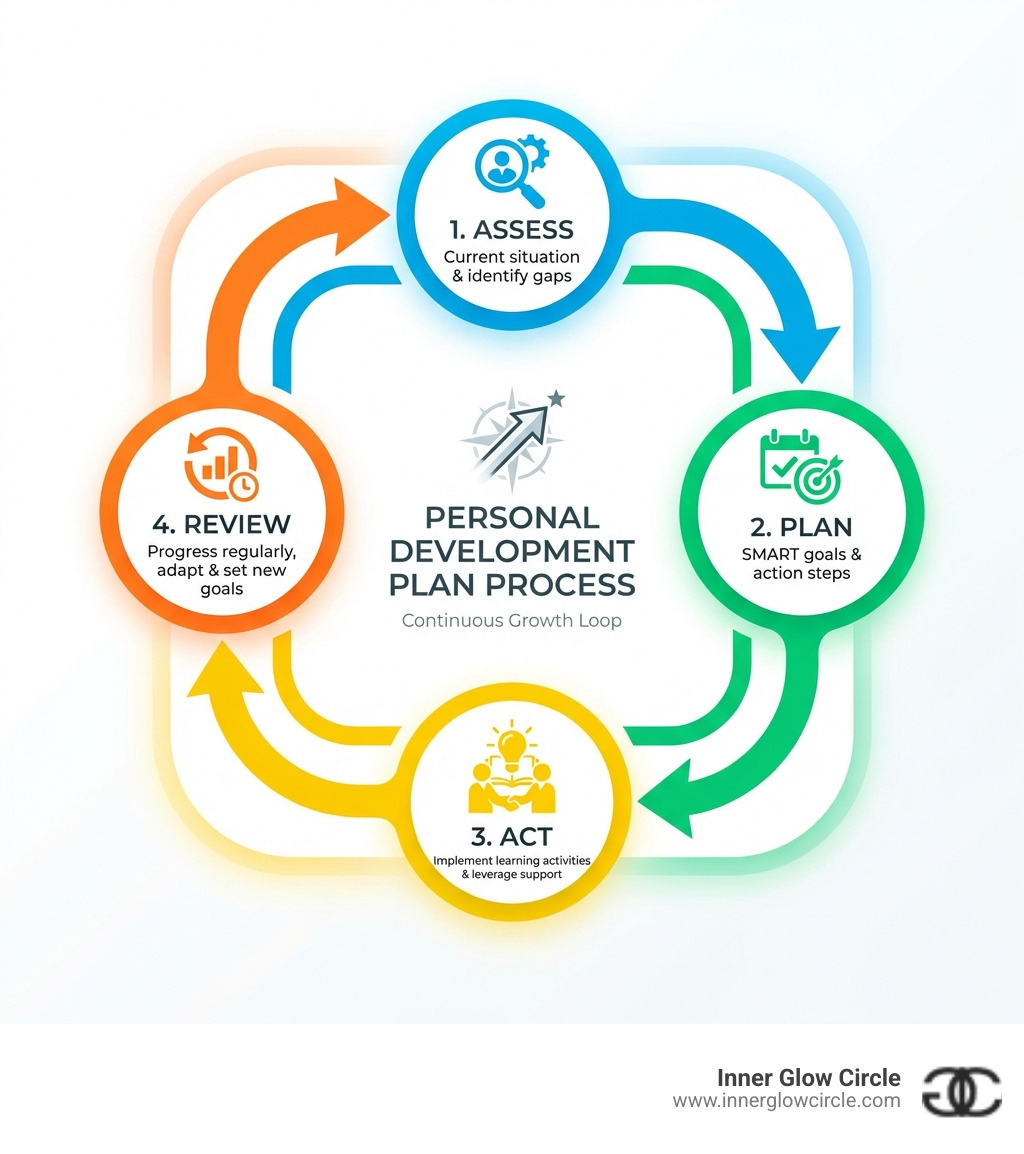
Quick Answer: To develop a personal development plan:
- Assess where you are now (strengths, weaknesses, opportunities, threats)
- Plan by setting SMART goals and defining action steps
- Act by pursuing learning activities and leveraging support
- Review your progress regularly and adapt as needed
Are you feeling stagnant in your career or sitting on a dream like launching a coaching business? Workplace fulfillment is key. Gallup research shows that 68% of employees who left their jobs in 2024 did so for reasons like engagement, culture, and work-life balance, not just compensation.
A Personal Development Plan (PDP) is your answer to the yearning for meaningful work and personal fulfillment. It’s a dynamic tool that helps you identify where you want to go, map out how to get there, and track your wins.
Think of your PDP as a personal GPS. It shows you where you are, helps you plot your destination, and guides you through your career development journey. The best part? You’re in the driver’s seat.
In this guide, you’ll learn to conduct a self-assessment, set goals that stick, choose development activities, and build a support network. You’ll also find how to overcome common obstacles and use your PDP for career advancement.
Ready to take control of your future? Let’s get started.
Essential developing a personal development plan terms:
The Foundation: Understanding and Preparing for Your PDP
Before we dive into developing a personal development plan, let’s lay the groundwork. Understanding what a PDP is and why it’s so powerful will fuel your motivation.
What is a Personal Development Plan (PDP) and Why is it Your Ultimate Power Tool?
A Personal Development Plan (PDP) is your personalized blueprint for growth. It’s a structured approach to identifying your aspirations, assessing your current reality, and charting a course for continuous improvement. Think of it as a living document that evolves with you, guiding your personal and professional journey.
A PDP is important because it provides focus, direction, and purpose. It helps answer the question, “What Should I Do With My Life?” by changing vague desires into concrete actions.
Here’s why developing a personal development plan is your ultimate power tool:
- Increased Focus and Clarity: A PDP forces you to articulate your goals, making them tangible and helping you concentrate on what truly matters.
- Boosted Motivation: Seeing your path clearly laid out with achievable steps boosts motivation. Celebrating small wins keeps you energized.
- Improved Well-being and Satisfaction: Directing your energy toward meaningful growth fosters a sense of accomplishment. Gallup research confirms that growth opportunities and meaningful work boost retention. When employees can use their best skills and have work-life balance, their well-being and satisfaction improve.
- Meaningful Work: A PDP aligns your daily tasks with your long-term vision, making work more impactful and helping you find your true purpose.
- Proactive Growth: Instead of reacting to circumstances, a PDP empowers you to proactively shape your future.
A PDP is about making your growth journey intentional, fulfilling, and empowering.
Conducting a Personal SWOT Analysis
Before you can chart your course, you need to know your starting point. A Personal SWOT Analysis (Strengths, Weaknesses, Opportunities, Threats) is a self-assessment tool that gives you a clear picture of your internal and external landscapes.

Here’s how to conduct your own:
- Strengths: What are you good at? Identify your unique skills, talents, and qualities. Consider what others praise you for or what comes naturally.
- Weaknesses: Where do you need to improve? Be honest. This isn’t self-criticism, but a way to identify growth areas, like overcoming procrastination or learning a new technical skill.
- Opportunities: What external factors can you leverage? Look for networking events, industry trends, training programs, or mentorship opportunities that can help you.
- Threats: What external factors could hinder your progress? Consider economic shifts, competition, or changing technology. Identifying threats helps you plan for them.
To make your SWOT analysis insightful, seek feedback from trusted mentors, colleagues, or friends. This process also helps you identify your “transferable skills”—abilities that can be applied to different areas.
Integrating Personal and Professional Aspirations
For a truly impactful PDP, accept holistic growth. Your personal and professional aspirations are not separate; they feed into each other.
For example, improving your self-confidence (personal) can lead you to take on leadership roles (professional). Mastering a new skill at work (professional) can boost your personal sense of accomplishment.
Integrating these two fields means:
- Recognizing Interconnectedness: Understand that personal growth in areas like communication or resilience directly fuels professional success. A LinkedIn analysis shows that while technical skills get attention, soft skills often secure the job offer.
- Prioritizing Work-Life Balance: Your PDP should include strategies for maintaining well-being, which is critical for sustained performance.
- Leveraging Personal Strengths Professionally: Apply your natural personal strengths in your professional context.
- Using Professional Development for Personal Fulfillment: Learning a new skill for your job might ignite a personal passion.
By weaving personal growth goals into your professional PDP, you create a powerful, synergistic plan. Our Personal and Professional Growth Coach can help you make these connections.
Crafting Your Action Plan: A Step-by-Step Guide to Developing a Personal Development Plan
Now that you understand the “what” and “why” of a PDP, let’s get to the “how.” This section is about crafting the actionable steps to turn your aspirations into achievements.
Step 1: Setting Powerful and Effective SMART Goals
The backbone of any successful PDP is well-defined goals. Vague aspirations like “I want to be better” won’t get you far. Use SMART goals: Specific, Measurable, Achievable, Relevant, and Time-bound.

Let’s break down what each means:
- Specific: Your goal should be clear and precise. Instead of “improve leadership skills,” try “complete a leadership certification course.”
- Measurable: How will you track progress? “Complete a leadership certification course within six months” is measurable.
- Achievable: Is your goal realistic? It should be challenging but attainable to avoid setting yourself up for failure.
- Relevant: Does this goal align with your overall vision and contribute to your growth?
- Time-bound: Every goal needs a deadline. This creates urgency and accountability. As noted in the Harvard Business Review, deadlines require strategic planning to be effective; without a firm timeframe, goals can drift indefinitely.
Break down large goals into smaller, manageable milestones. For example, if your goal is to “launch a coaching business within 12 months,” milestones might include “complete coaching certification by month 3” and “secure first three clients by month 9.”
Your goals are your compass. Head over to our page on Goals for more insights on effective goal setting.
Step 2: Creating Your Action Steps and Milestones
Once your SMART goals are set, map out the journey by breaking each goal into concrete action steps and milestones.
Here are the key components of a robust action plan:
- Specific Tasks: List the exact actions for each goal. For “complete leadership certification,” tasks would include researching programs, enrolling, and dedicating weekly study time.
- Resources Needed: Identify necessary resources: time, money, software, books, or mentorship.
- Timelines: Assign start and end dates to each task to stay on track.
- Defining What Success Looks Like: Clearly define what successful completion looks like for each milestone and goal.
- Creating Milestones to Track Progress: Milestones are mini-goals that help you track progress and stay motivated by providing opportunities to celebrate wins.
Think of it like building a house. The goal is the finished house, the action steps are laying the foundation and framing the walls, and the milestones are completing each major stage.
Step 3: Choosing Your Development Activities
How will you acquire the knowledge and skills you need? A well-rounded PDP often includes a mix of different activities.
- Formal Development: This includes structured learning like:
- Online courses and certifications (e.g., leadership, project management).
- Workshops and seminars.
- Degree programs.
- Online platforms like Khan Academy offer resources such as the Hour of Code to sharpen skills.
- Social Development: Learning through interaction with others is powerful:
- Mentorship: Find a mentor for invaluable guidance.
- Networking: Connect with professionals to open doors to opportunities.
- Peer Learning: Join professional associations or discussion groups for shared experiences and support.
- Industry Associations: Organizations like the Small Business Administration (SBA) or the American Nurses Association (ANA) are excellent for connecting with peers.
- Experiential Development: Learning by doing is often the most impactful:
- On-the-job training: Take on new responsibilities or lead a challenging project.
- Shadowing: Observe someone in a role you aspire to.
- Volunteering: Gain new skills in a different context.
- “Stretch” assignments: Projects that push you beyond your comfort zone.
Balance hard skills (technical abilities) with soft skills (communication, leadership). While hard skills get you noticed, LinkedIn analysis shows soft skills often secure the job offer.
Implementation and Evolution: Bringing Your PDP to Life
A plan is just words on paper until it’s put into action. This section is about activating your PDP, building a support system, and understanding that your plan must evolve.
Leveraging Your Support Network for Maximum Growth
You don’t have to go on your growth journey alone. A strong support network can significantly boost your progress and motivation.
Your support network can include:
- Mentors: Experienced guides who offer knowledge and help you see pitfalls and opportunities.
- Managers/Supervisors: A key ally for aligning your goals with company objectives and accessing resources.
- Colleagues: Peers can offer practical advice and shared experiences.
- Accountability Partners: A friend, colleague, or coach who checks in on your progress can keep you committed.
- Professional Associations: Groups like the SBA or the ANA connect you with a broader community for networking and resources.
The power of community is immense. For women seeking to amplify their impact, our Empowerment Life Coach Guide 2025 offers more insights on building support systems.
The Power of Coaching in Developing a Personal Development Plan
Sometimes we need a dedicated partner to help us gain clarity and stay accountable. This is where coaching shines. A coach is a trained professional who helps you identify your desires, overcome limiting beliefs, and create actionable strategies.
How does coaching boost your PDP?
- Gaining Clarity: A coach asks powerful questions to help you clarify your vision, define meaningful goals, and increase self-awareness.
- Building Self-Efficacy: Coaches help you recognize your strengths and past successes, building your belief in your ability to achieve new goals.
- Challenging Limiting Beliefs: A coach helps you identify and reframe internal narratives that hold you back, opening up new possibilities.
- Accountability: A coach serves as an accountability partner, ensuring you stay committed to your action steps.
- Positive Psychology: Coaching generates positive emotions, which, according to the “Broaden-and-Build Theory,” improves well-being and performance. A coach’s “unconditional positive regard” creates a safe space for you to thrive.
At Inner Glow Circle, we believe in the transformative power of coaching. It’s about open uping your full potential. To learn more, explore Unlock Your Potential: Understanding Life Coaching.
Tracking Progress and Adapting Your Plan Over Time
Developing a personal development plan is an ongoing cycle of action and reflection. Your PDP is a living document that should be reviewed and adapted as you grow.
Here’s how to keep your PDP effective:
- Regular Reviews:
- Weekly/Monthly Check-ins: Use short, regular check-ins to review tasks and make small adjustments.
- Quarterly Reviews: Every three months, take a broader look to assess progress on larger goals and reprioritize if needed.
- Annual Reassessment: Once a year, conduct a comprehensive review. Revisit your SWOT analysis, assess your growth, and set new long-term goals.
- Journaling: Keeping a journal is a powerful tool for tracking progress and gaining self-awareness.
- Celebrating Milestones: Acknowledge and celebrate your achievements to reinforce positive behavior and boost motivation.
- Embracing Flexibility: Life happens. Be willing to pivot, adjust timelines, or redefine goals if they no longer serve your ultimate vision.
- Knowing When to Pivot: Be courageous enough to let go of what no longer serves you and accept new aspirations. Continuous self-assessment is key to an effective PDP.
By consistently tracking progress and adapting your plan, you ensure your PDP remains relevant and motivating.
Navigating Your Career with a PDP
A well-crafted PDP is a strategic asset for your career, helping you overcome challenges and advance professionally.
Navigating Common Obstacles on Your Development Journey
Even with the best intentions, we all face obstacles. Here are common challenges and how to overcome them:
- Lack of Time: “I’m too busy” is a common refrain.
- Overcome it: Schedule development time in your calendar. Even 15-30 minutes daily helps. Break large goals into micro-tasks.
- Loss of Motivation: The initial enthusiasm can fade.
- Overcome it: Reconnect with your “why.” Remind yourself of the purpose behind your goals. Celebrate small wins and use an accountability partner to stay engaged.
- Limited Resources: “I can’t afford that course.”
- Overcome it: Get creative. Look for free or low-cost alternatives like online courses, libraries, or webinars. Volunteer for projects to gain experience.
- Resistance to Change: Stepping out of our comfort zone is uncomfortable.
- Overcome it: Accept discomfort as a sign of growth. Seek support from your network or a coach to stay committed as you push past your limits.
How Your PDP Fuels Performance Reviews and Career Advancement
Your PDP is a powerful tool for professional success that can impact performance reviews and accelerate your career.
- Aligning with Organizational Objectives: Align your PDP with company goals to show initiative and strategic thinking about your role.
- Facilitating Proactive Conversations with Managers: Use your PDP to start proactive conversations with your manager about your growth and aspirations, demonstrating leadership potential.
- Demonstrating Initiative: A clear, actionable PDP showcases your drive for continuous improvement, which is highly valued by employers.
- Job Crafting: Use your PDP to actively shape your role to better align with your strengths and passions, leading to increased engagement.
- Using Your PDP to Prepare for Reviews: Your PDP provides a clear record of your goals and achievements, making it easier to prepare for performance reviews and discuss future growth.
- Career Advancement: A well-executed PDP is your roadmap to promotions or a career transition. By systematically developing the needed skills, you position yourself for success.
Our Career Development Coaching can provide personalized guidance on leveraging your PDP for maximum career impact.
Frequently Asked Questions about Personal Development Plans
We often get asked common questions when individuals are starting their journey of developing a personal development plan. Here are some of the most frequent ones:
How often should I review my personal development plan?
Think of your PDP as a living document. We recommend a multi-tiered review approach:
- Weekly/Bi-weekly Check-ins: Quick touchpoints to track tasks and make minor adjustments.
- Monthly Reviews: A slightly deeper dive to assess progress on milestones and identify challenges.
- Quarterly Reviews: A substantial review to evaluate progress against larger goals and reassess priorities.
- Annual Reassessment: A comprehensive overhaul to revisit your SWOT analysis, evaluate growth, and set new long-term goals. Be prepared to adapt your plan whenever major life or career changes occur.
Can I have both personal and professional goals in the same PDP?
Absolutely, and we highly encourage it! A holistic PDP is most effective. Personal growth (like confidence) fuels professional success (like leadership), and vice versa. Recognizing this synergy creates a more balanced and sustainable path to success.
What’s the difference between a PDP and a to-do list?
This is a great question. While both involve listing tasks, their purpose is very different:
- A To-Do List is tactical, managing daily tasks for today or this week. It’s about getting things done.
- A Personal Development Plan (PDP) is a strategic, long-term roadmap for your growth. It’s about who you want to become and aligns your actions with your overarching vision.
A to-do list focuses on efficiency; a PDP focuses on growth and impact.
Conclusion: Your Future is in Your Hands
Developing a personal development plan is more than just a productive exercise; it’s an act of self-empowerment. It’s about taking the reins of your life, designing your future with intention, and moving from passive hope to active creation.
Throughout this guide, we’ve explored how a PDP provides clarity, boosts motivation, and offers a structured path for both personal and professional growth. We’ve seen how a personal SWOT analysis helps you understand your starting point, how SMART goals keep you focused, and how a diverse range of development activities propels you forward. Most importantly, we’ve emphasized the power of community, mentorship, and coaching in supporting your journey, changing obstacles into opportunities for deeper growth.
The benefits are clear: increased focus, profound satisfaction, and the undeniable sense that you are actively shaping your destiny. At Inner Glow Circle, we are deeply committed to empowering women like you to achieve this clarity and purpose. We believe that with the right tools, support, and intentional action, you can open up your fullest potential and create a life that truly glows.
Your future isn’t just something that happens to you; it’s something you design. Ready to take that powerful next step?
Explore our career and personal development resources and let us help you craft the extraordinary future you deserve.


