

Why Understanding Development Approaches Matters for Your Growth Journey
Coaching, teaching, and mentoring are three distinct approaches to development, but they’re often used interchangeably. This confusion can cost you time, money, and progress on your growth journey.
Here’s the quick breakdown:
| Approach | What It Does | Who Leads | Best For |
|---|---|---|---|
| Teaching | Transfers knowledge and skills | Teacher (expert) | Learning new information or foundational skills |
| Mentoring | Shares wisdom and guidance | Mentor (experienced person) | Navigating career paths and life transitions |
| Coaching | Open ups your own potential | You (with coach support) | Achieving specific goals and improving performance |
If you’ve ever felt stuck choosing between a course, a mentor, or a coach, you’re not alone. Many people invest in programs that don’t match their needs—taking teaching-focused courses when they need coaching for self-doubt, or seeking mentorship when they need structured training.
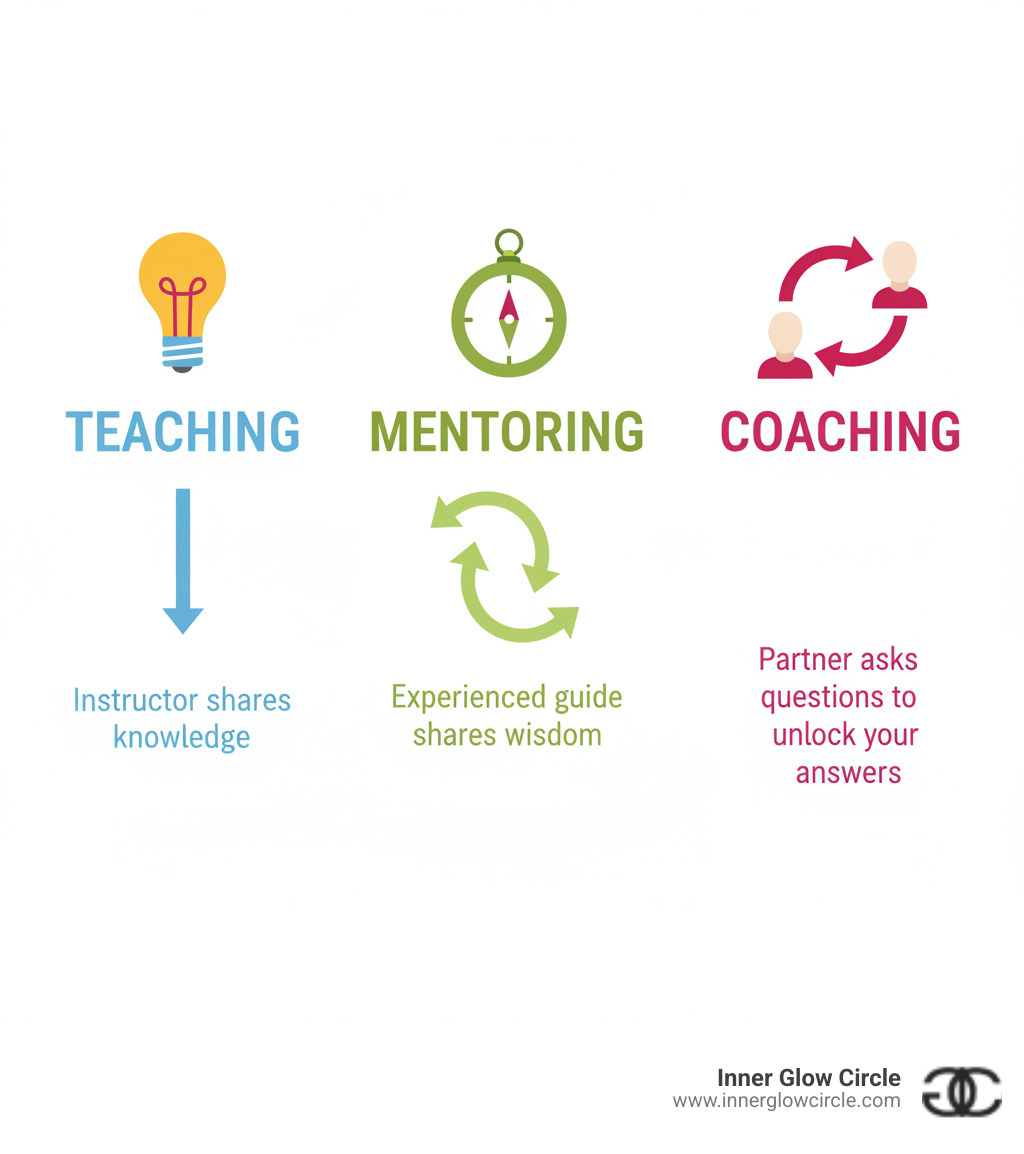
The truth is simple: Teaching gives you information. Mentoring gives you guidance. Coaching helps you find your own answers.
While teaching provides a knowledge base, coaching creates lasting change by building your core capabilities. Understanding these differences allows you to choose the right support for your specific needs.
This guide will help you decode these buzzwords and choose the path that truly serves your journey toward becoming a confident coach and leader.
Relevant articles related to coaching teaching mentoring:
The Three Pillars of Development: Core Definitions and Objectives
Think of personal growth as a journey with three different types of travel companions. Each one—coaching, teaching, and mentoring—brings something unique to your path. Understanding who does what can save you from wandering in circles.
Let’s shine a light on what makes each approach special, so you can choose the right support at the right time.

Teaching: Building the Foundation of Knowledge
Teaching is where learning begins. It’s the structured way we gain new knowledge from an expert. Think of a classroom, workshop, or online course.
Teaching is typically a one-to-many relationship. A teacher designs lessons and delivers content to transfer information. In the professional world, this could be a certification program or a leadership course designed to build foundational knowledge.
However, our brains struggle to retain new information. According to the “forgetting curve,” we can lose up to 90% of what we learn within a week. This isn’t a personal failing; it’s how our brains work. Teaching provides the foundation, but it needs reinforcement to create lasting change, which is why it’s an essential first step but rarely transformative on its own.
Mentoring: Guiding with Wisdom and Experience
Mentoring is a long-term relationship where an experienced individual shares their wisdom to guide your journey. Unlike the formal structure of teaching, mentoring is organic and personal. A mentor shares insights from their lived experience—the wins, the mistakes, and the lessons learned.
Mentoring shines in career development. A mentor can help you steer office politics, make strategic decisions, and build your professional network. They see your potential and invest their time to help you grow, often sharing stories, making introductions, or acting as a sounding board. This personalized guidance is invaluable when charting an unfamiliar course. If you’re seeking direction, exploring how to find your purpose can complement a mentor’s wisdom.
Coaching: Open uping Potential and Driving Performance
Coaching flips the script. Instead of giving advice, a coach asks powerful questions to help you find your own answers. It’s a future-focused partnership designed to help you achieve specific goals.
The International Coaching Federation defines coaching as a partnership in a thought-provoking process that inspires clients to maximize their potential. You collaborate with a coach who believes the answers are already inside you.
Coaching is goal-oriented and action-focused. It provides structure and accountability for goals like launching a business or earning a promotion. A coach creates space for you to explore your actions and align them with your true desires. This process of self-findy is powerful because you own the solutions you create. The change happens because you do the work, with the coach acting as a facilitator.
Many who experience great coaching are inspired to become a life coach themselves. They want to help others open up their own potential.
Coaching, teaching, and mentoring each serve a distinct purpose. Teaching builds knowledge, mentoring provides guidance, and coaching open ups the potential that’s been inside you all along.
Approach and Application: How Coaching, Teaching, and Mentoring Differ in Practice
Understanding the definitions of coaching, teaching, and mentoring is just the beginning. To truly leverage these tools, we need to grasp how they differ in practice. This will help you choose the most effective path for your growth.

The “How”: Comparing Methodologies and Relationships
The practical differences between coaching, teaching, and mentoring come down to their methodologies and relationships.
- Teaching is directive. The teacher is the expert, and the relationship is hierarchical. Communication is mostly one-way, with the teacher providing structured content for the student to absorb.
- Mentoring is advisory. The relationship is conversational and built on trust, but the mentor holds more experience. They share personal stories and offer advice based on their own journey.
- Coaching is facilitative. The relationship is a non-hierarchical partnership. The coach believes you are the expert and asks powerful questions to help you find your own insights. You drive the agenda and uncover your own solutions.
Real-World Scenarios: Seeing the Differences in Action
Let’s make this concrete. Imagine you want to improve your public speaking skills. How would each approach help?
| Aspect | Teaching | Mentoring | Coaching |
|---|---|---|---|
| Focus | Knowledge transfer, foundational skills | Wisdom, career guidance, long-term development | Goal achievement, performance, self-findy |
| Timeframe | Short-to-medium term (course, workshop) | Long-term, ongoing relationship | Short-to-medium term (specific goal completion) |
| Example: Public Speaking | A structured class on speech writing, delivery techniques, body language, and using visual aids. You learn the “rules” and best practices. | A seasoned public speaker shares their personal journey, tips for managing stage fright, networking strategies, and how to build confidence over time. | Sessions focused on identifying your specific fears, practicing delivery with targeted feedback, setting measurable goals for your next presentation, and developing strategies to overcome mental blocks. |
In the teaching scenario, you’d attend a class on the fundamentals: speech structure, voice projection, and creating slides. You’re building a knowledge foundation.
With a mentor, a seasoned speaker would share personal stories, offer advice on handling nerves, and connect you with speaking opportunities.
In coaching, you’d work one-on-one to tackle your specific challenges, like freezing up or rushing. Your coach would ask questions to help you understand the root cause, create personalized strategies, and hold you accountable as you practice and improve.
When to Choose Each Approach for Your Growth
Knowing when to use each approach saves time, money, and frustration.
- Choose teaching when you need foundational knowledge or new skills, like learning a new software or theory. Remember the forgetting curve; knowledge alone may not stick without application.
- Choose mentoring for long-term career planning and navigating professional landscapes. A mentor, an experienced individual sharing wisdom, can provide perspective, open doors, and help you avoid common pitfalls.
- Choose coaching when you have specific goals, want to improve performance, or need to drive behavioral change. It’s ideal for launching a business or improving leadership presence. Coaching helps you tap into your inner resources and personal empowerment coaching capabilities to find answers that fit you.
The Power of Synergy in Coaching, Teaching, and Mentoring
I’ve learned from working with hundreds of women that coaching, teaching, and mentoring aren’t meant to compete. They’re designed to work together, each bringing something different to the table.

A Holistic Approach to Personal and Professional Growth
Think of your development as building a house; you need different tools for different tasks. The same is true for growth.
Consider Maya, who dreamed of launching a wellness business. Her journey shows how these three approaches work together.
- Teaching: Maya took business courses to learn fundamentals like business plans and legal requirements. This gave her the essential building blocks.
- Mentoring: She connected with an experienced entrepreneur who became her mentor. The mentor shared industry insights, made valuable introductions, and offered encouragement during moments of doubt.
- Coaching: Maya worked with a coach to turn knowledge into action. Coaching helped her identify fears, set launch goals, and develop strategies aligned with her values. The coach asked powerful questions that helped Maya find her own path.
This integrated approach was transformative. Each method filled a gap the others couldn’t. Our team of coaches understands this synergy and has seen countless women flourish with the right combination of support.
Applying Coaching, Teaching, and Mentoring in Modern Leadership
For leaders, blending coaching, teaching, and mentoring is a superpower. Great leaders shift between these roles based on their team’s needs.
- As a teacher, you share knowledge and set clear expectations, like when training on a new system or skill.
- As a mentor, you guide based on your experience, sharing your career journey to help a rising star steer their path.
- As a coach, you empower others to find their own solutions by asking powerful questions (“What are the options here?” “What’s holding you back?”). This builds confidence and long-term problem-solving skills.
Knowing which hat to wear is key. A new employee may need teaching, then mentoring, and later coaching. When leaders coach more than they direct, teams become more innovative and self-sufficient. This holistic perspective is at the core of our female leadership coaching programs, where we help women thrive by mastering these roles.
The Distinct Value of Coaching for Intentional Success
While teaching and mentoring are indispensable, coaching holds a unique position for achieving intentional success and lasting change.

Why Coaching Stands Out: Fostering Self-Sufficiency
The magic of coaching is that it transforms who we become. While teaching fills our knowledge bank and mentoring lights our path, coaching builds our inner compass.
As coaching pioneer Timothy Gallwey said, coaching is “not about telling people what to do; it’s giving them a chance to examine what they are doing in the light of their intentions.”
Coaching develops core capabilities that stick. We don’t just solve one problem; we learn how to solve problems. This “action, reflection, learning” cycle leads to lasting behavioral change. Research shows that adding coaching to training can increase behavioral change from 20% to 88%.
Building self-sufficiency has a ripple effect. When we are coached, we become better at coaching others. This is a core reason we are passionate about women empowering women through coaching—empowered women empower others.
Frameworks and Ethics in Coaching
Effective professional coaching requires structure and integrity, which are provided by frameworks and ethical guidelines.
A trusted framework is the GROW model:
- Goal: What do you want to achieve?
- Reality: What is happening now?
- Options: What possibilities exist?
- Will (or Way Forward): What actions will you take?
This model provides a map for the conversation, giving it structure while allowing for a creative, organic process.
Ethics are also crucial. Professional coaches adhere to strict codes of conduct, with confidentiality, professional boundaries, and trust as foundational principles. The International Coaching Federation (ICF) provides comprehensive ethical guidelines to ensure coaching is a safe and transformative space. This commitment to ethics is a cornerstone of our ICF accredited coach training program, as we believe great coaches need both skill and integrity.
Frequently Asked Questions about Development Approaches
We often hear questions that highlight the confusion around coaching, teaching, and mentoring. Let’s address the most common ones.
Can one person be a teacher, mentor, and coach?
Yes, one person can be all three, and great leaders often are. A manager might teach a new process, mentor a junior employee, and coach a team member in the same day.
The key is clarity. It’s crucial to communicate which role you’re in to avoid confusion. For example, a leader could say, “For this conversation, I’m putting on my mentoring hat,” or “Let’s switch to coaching mode for this problem.” This intentional communication ensures the support is effective.
What’s the difference between coaching and consulting?
These roles are often confused, but the main difference is who holds the answers.
- A consultant is an expert hired to provide answers, diagnose problems, and implement solutions based on their specific knowledge.
- A coach believes you are the expert of your own life. They don’t give answers but help you find your own through powerful questions and reflection. As noted earlier, coaching is not about telling people what to do.
In short, a consultant tells you what to do; a coach helps you figure out what you want to do.
How do I know which one I need right now?
To decide what you need, assess your current goal:
- Need information or foundational knowledge? Seek a teacher. A course or workshop is perfect for learning a new skill or concept.
- Need wisdom, guidance, or a long-term roadmap? Find a mentor. A mentor is ideal for navigating career transitions and getting advice from someone with lived experience.
- Need to achieve a specific goal or improve performance? Hire a coach. Coaching is most effective when you’re ready to take action, overcome a challenge, or drive behavioral change. A coach helps you create an actionable plan that you own.
Choosing the right approach for your current needs leads to more targeted and impactful growth.
Conclusion: Choose Your Path to Intentional Growth
We’ve explored the three powerful approaches to development: coaching, teaching, and mentoring. Teaching builds knowledge, mentoring provides guidance, and coaching empowers you to find your own answers.
Understanding these differences allows you to take ownership of your growth. By knowing whether you need information, guidance, or accountability, you can make intentional choices that move you forward. These approaches also work beautifully together, creating a holistic path to lasting change.
Your development journey is unique. The key is choosing the right support at the right time. At Inner Glow Circle, we are passionate about empowering women to become confident leaders and coaches by understanding these principles.
If you’re drawn to coaching and want to experience its transformative power, we’re here to support you. We invite you to explore our approach to mentor coaching and see how we can help you on your journey to intentional success.
The path is yours to choose. Choose intentionally. Choose with confidence. Choose growth.


