

Why Your Organization Needs a Strategic Approach to Coaching and Mentoring
A coaching and mentoring program is a structured workplace initiative that helps employees develop skills, steer career paths, and reach their full potential. Here’s what you need to know:
Quick Answer: Key Elements of Effective Coaching and Mentoring Programs
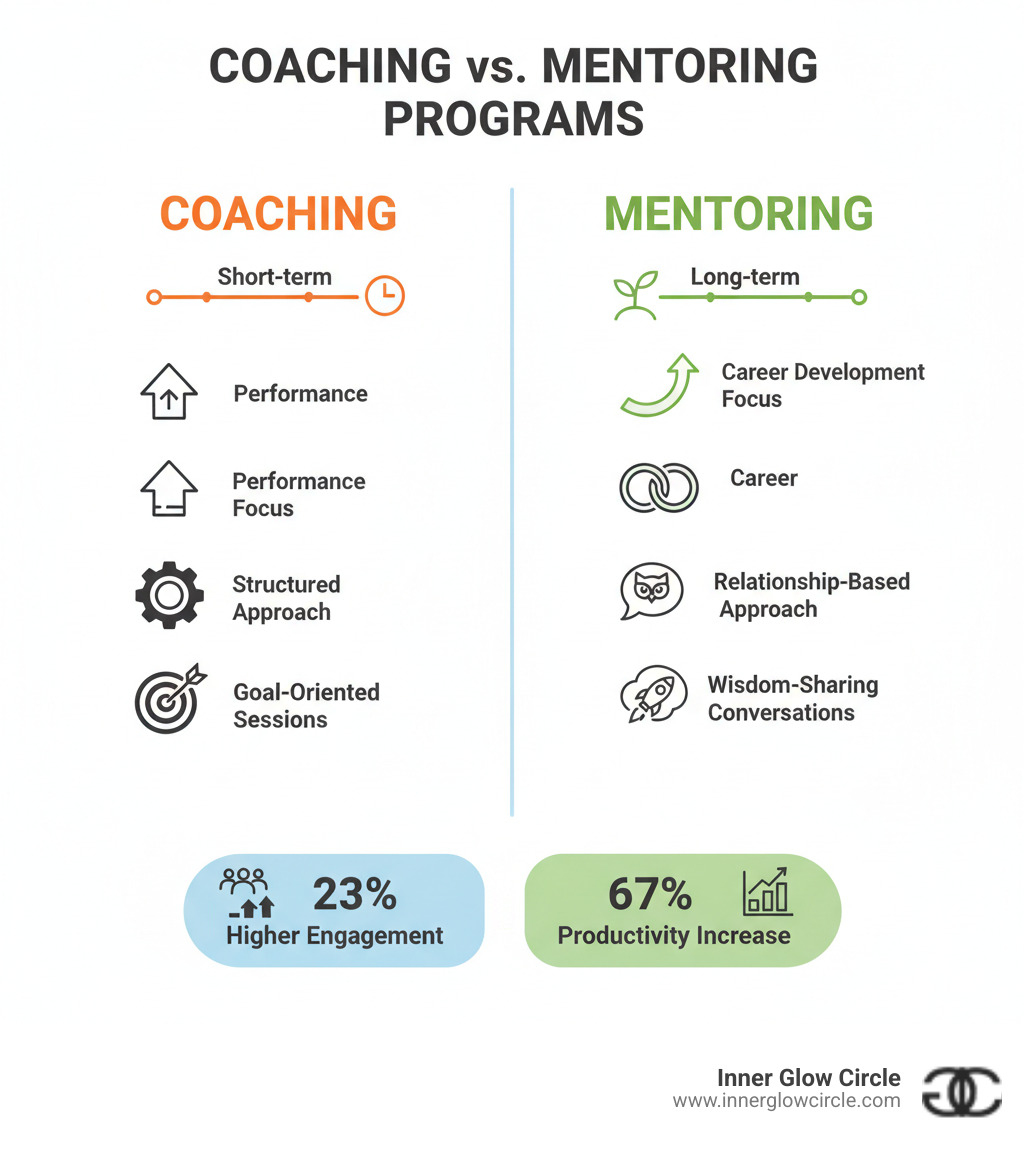
- Coaching focuses on current job performance and specific skill development through structured, short-term relationships (typically ≤ 6 months)
- Mentoring focuses on future career development and guidance through long-term relationships (typically ≥ 1 year)
- Structured programs drive measurable results: 23% higher employee engagement and 67% increased productivity
- Essential components include clear goals, intentional pairing, trained participants, feedback mechanisms, and success metrics
Just as athletes rely on coaches, professionals need structured guidance to sharpen their abilities and advance their careers. Yet, many organizations launch programs without a clear purpose, proper training, or ways to measure impact. The difference between a struggling program and a thriving one is intentional design.
The business case is compelling. Departments with structured coaching and mentoring score 23% higher on employee engagement, and two-thirds of businesses report higher productivity. Employees who receive this support are also significantly more likely to stay with their employer.
Success doesn’t happen by accident. It requires understanding the differences between coaching and mentoring, selecting the right approach, and implementing best practices. Whether you’re launching your first program or improving an existing one, this guide will walk you through every step to create lasting impact for your people and your organization.
Essential coaching and mentoring program terms:
Understanding the Foundation: Coaching vs. Mentoring
While often used interchangeably, coaching and mentoring are distinct approaches to development. Understanding these differences is the foundation of an effective coaching and mentoring program.
Coaching is a reflective process that uses powerful, open-ended questions to help individuals find their own solutions. A coach doesn’t provide answers but creates space for reflection and skill-building. The relationship is structured, goal-oriented, and focused on current performance or specific skills.
Mentoring is a supportive learning relationship where a more experienced person shares their wisdom and insights. Mentors offer guidance on long-term career paths, help steer organizational culture, and share practical advice. These relationships are typically long-term and focus on future growth.
Here’s how coaching and mentoring stack up side by side:
| Feature | Coaching | Mentoring |
|---|---|---|
| Focus | Enhancing current job performance, developing specific skills, resolving here-and-now challenges, and opening potential. | Long-term career trajectory, future development, sharing wisdom and experience, and navigating organizational culture. |
| Duration | Typically short-term, usually 3-6 months. | Long-term, often a year or more, sometimes ongoing indefinitely. |
| Relationship | Equal partnership where the coach facilitates self-findy. The coach is an expert in the process of coaching. | Hierarchical or peer-based, with the mentor sharing expertise. The mentor is an expert in the subject matter or career path. |
| Agenda | Set by the coachee, with the coach helping clarify goals and uncover solutions. | Often a blend of mentee-driven goals and mentor-initiated guidance based on their experience. |
| Source | Can be internal (trained employees) or external (professional coaches hired by the organization). | Usually internal (experienced employees within the organization), but can be external for specific industry insights. |
| Goal Orientation | Highly goal-oriented, often using frameworks like the GROW model to achieve specific, measurable outcomes. | Broader developmental goals, including personal growth, network expansion, and long-term career planning. |
| Performance Focus | Direct impact on immediate performance and skill refinement. | Indirect impact on performance through broader development, confidence building, and strategic career moves. |
| Career Development | Can support career advancement by improving skills necessary for the next step, but typically not focused on the overall career trajectory. | Central to career development, offering guidance on career paths, promotions, and navigating organizational dynamics. |
When to Choose Coaching
Coaching is ideal for focused, actionable support. Choose coaching to:
- Develop specific skills: Help a new manager improve delegation or a team member improve their communication style.
- Improve performance: Address a specific challenge or work toward a concrete performance metric.
- Support leadership transitions: Provide personalized support to new leaders adjusting to unfamiliar responsibilities.
- Overcome obstacles: Create space for breakthroughs when an employee feels stuck or is facing a significant hurdle.
- Gain clarity and support: Offer an objective perspective during career shifts or major decisions.
The magic of coaching is that it empowers people to find their own answers, fostering self-awareness and accountability. To explore how coaching can open up potential, check out Unlock Your Potential: The Power of Life Coaching.
When to Choose Mentoring
Mentoring is best for long-term career development. Choose mentoring for:
- Career path guidance: Allow employees to learn from someone who has walked a similar path and can share strategic insights.
- Network expansion: Help mentees build connections by introducing them to key contacts.
- Navigating company culture: Provide insider knowledge on organizational dynamics and unwritten rules.
- Succession planning: Ensure the transfer of institutional knowledge and prepare high-potential employees for future leadership roles.
- Gaining wisdom from experience: Share lessons learned and practical shortcuts to help mentees avoid common pitfalls and accelerate their growth.
At its heart, mentoring is an intentional, developmental relationship that can significantly impact a person’s long-term career trajectory.
Designing Your High-Impact Coaching and Mentoring Program
Designing a coaching and mentoring program is like creating a strategic roadmap for your organization. A well-designed program develops future leaders, boosts retention, and ensures institutional wisdom is passed on.

For example, new leaders often struggle to transition from individual contributor to manager. A thoughtfully designed program gives them the support they need to succeed. These programs are most effective when they reflect your workforce’s diversity. Diversity in Coaching isn’t just a checkbox—it’s what makes programs truly effective.
Step 1: Define Your Purpose and Goals
First, ask: Why are we doing this? Without a clear purpose, programs drift. Connect your program to key organizational goals, such as strengthening leadership, improving employee retention, or enhancing succession planning.
Next, identify your target audience. Are you focusing on new hires, high-potential employees, or emerging leaders? Each group has unique needs.
Then, set SMART goals (Specific, Measurable, Achievable, Relevant, Time-bound). Instead of a vague goal like “improve leadership skills,” aim for something concrete: “Increase leadership effectiveness scores by 15% within 12 months for program participants.”
Finally, determine your program scope. Will it be formal or informal? Mandatory or voluntary? What time, budget, and people can you realistically commit? These decisions shape everything that follows. If you’re exploring how coaching fits into your own journey, see how others Find Your Purpose: Consult, Coach Organizations & Executives.
Step 2: Choose the Right Approach and Structure
Design a program structure that fits your organization’s unique needs.
- One-on-one coaching: The gold standard for individualized attention, especially for executive coaching.
- Group coaching: Brings people with shared goals together to learn from a coach and each other.
- Peer mentoring: Pairs employees at similar career stages to share experiences and build connections.
- Mentoring circles: Small groups of mentees meet with one or two mentors, enriching the conversation with diverse viewpoints.
- Reverse mentoring: A junior employee mentors a senior one on topics like technology or generational perspectives, breaking down hierarchies.
- E-mentoring: Uses technology to connect people regardless of location, making mentoring accessible in remote and hybrid environments.
For program duration, coaching is typically shorter (3-6 months), while mentoring relationships last a year or more. The matching process is also critical. Intentional pairing based on skills, experience, and personality is far more effective than random assignments.
Step 3: Establish Best Practices for a Successful Coaching and Mentoring Program
Great design requires great execution. These practices are essential for success.
- Intentional pairing: Take time to understand what each participant needs and who can best provide it. A poor match can undermine the entire program.
- Clear guidelines and expectations: Define roles, success metrics, and boundaries upfront to prevent confusion. Clarify meeting frequency and appropriate topics.
- Confidentiality rules: Create the psychological safety needed for participants to share challenges and vulnerabilities without fear.
- Feedback mechanisms: Use surveys or check-ins to gather input on what’s working and what isn’t, allowing you to continuously improve the program.
- Strong program kick-off: Launch with an event that explains the program’s purpose and benefits. Provide orientation to get everyone on the same page.
- Ongoing support and resources: Show your commitment with continued training for coaches and mentors, peer learning opportunities, and a dedicated program manager.
The People Power: Selecting and Training Effective Participants
Your coaching and mentoring program is only as strong as its participants. Investing in their development is investing in your program’s success.
When leaders actively participate in coaching and mentoring, they send a powerful message that development is a priority. This commitment creates psychological safety, an environment where people feel comfortable asking for help and taking risks. When a senior leader openly discusses their own mentor, it normalizes the experience for everyone, changing your program into a competitive advantage.
Essential Skills for Effective Coaches
Great coaches don’t give answers; they ask questions that spark new perspectives. This requires a specific skill set that can be learned and refined.
- Active listening: Listen deeply to the words, emotions, and values being expressed, without judgment or a personal agenda.
- Powerful questioning: Ask open-ended “what” and “how” questions that invite exploration and help people tap into their own wisdom.
- Empathy: Build trust by connecting with the human experience behind the words, allowing for genuine change.
- The GROW model: Use this framework (Goal, Reality, Options, Will) to keep conversations focused and productive.
- Providing constructive feedback: Deliver feedback that is timely, specific, balanced, and focused on future growth.
- Maintaining objectivity: Challenge assumptions and help people see their blind spots without being attached to a specific outcome.
At Inner Glow Circle, we’re passionate about developing these skills. Our training cultivates the presence and confidence that make coaching truly changeal. Become a Certified Life Coach with Inner Glow Circle
Essential Qualities for Effective Mentors
While coaches facilitate self-findy, mentors draw on their own journey to light the path for others. Effective mentors possess qualities beyond technical expertise.
- Relevant experience: Credibility comes from having faced similar challenges. Sharing failures and lessons learned is often more valuable than only showcasing successes.
- Willingness to share: Great mentors are generous with their knowledge, frameworks, and insider insights.
- A strong network: Mentors accelerate career growth by making introductions and opening doors to new opportunities.
- Advocacy and sponsorship: Effective mentors actively champion their mentees, recommending them for stretch assignments and using their influence to create opportunities.
- Role modeling: Mentees learn by observing how their mentors handle pressure, communicate, and maintain their values.
- Providing guidance and advice: Unlike coaches, mentors are expected to share opinions and offer direct recommendations based on their experience.
Our team at Inner Glow Circle embodies these qualities, supporting women as they become confident, skilled coaches. Meet Our Team of Coaches
Launching and Measuring Your Program for Lasting Success
A successful launch is about creating genuine excitement and building momentum. The ongoing measurement of your coaching and mentoring program is what sustains it for years to come.

How to Successfully Launch Your Initiative
Think of your launch as the opening night of a performance. Every detail matters.
- Secure leadership buy-in: When executives participate as coaches or mentors, they signal that development is a core value.
- Communicate benefits clearly: Focus on what’s in it for the individual. Will they develop new skills, build relationships, or gain confidence? Make the benefits personal and tangible.
- Provide resources and toolkits: Equip participants with conversation guides, goal-setting templates, and other tools to help them feel supported from day one.
- Celebrate early wins: Share success stories (with permission) to make the program’s impact feel real and achievable. Data matters, but stories stick.
- Start with a pilot program: For larger organizations, a pilot allows you to gather lessons, refine your approach, and build a case for scaling up.
Leaders who champion these initiatives build a culture where growth is expected and celebrated. Leaders Rising at Inner Glow Circle embodies this approach, supporting leaders as they help others rise.
How to Measure the Impact of Your Coaching and Mentoring Program
If you can’t measure your program’s impact, you can’t prove its value. Focus on the Key Performance Indicators (KPIs) that matter most to your organization.
- Employee engagement scores: Compare scores between participants and non-participants. Structured programs have been shown to boost engagement by 23%.
- Retention and promotion rates: Track how many participants stay with the company and advance into leadership roles. Employees with mentors are more likely to stay.
- Skill assessments: Use 360-degree feedback or other tools to measure skill development before and after the program.
- Productivity data: Look for improvements in team performance, project completion rates, or other business outcomes. 67% of businesses report higher productivity from mentoring.
- Return on Investment (ROI): Estimate the financial impact by linking program costs to benefits like reduced turnover and increased productivity.
- Feedback surveys and testimonials: Collect qualitative data to understand the human side of your impact. Numbers tell you what happened; stories tell you why it matters.
Use this data to continuously improve your coaching and mentoring program. Each measurement cycle provides new insights to make your program even stronger.
Frequently Asked Questions about Coaching and Mentoring
Here are answers to common questions about the real-world impact of a coaching and mentoring program.
What are the key benefits of coaching and mentoring in the workplace?
These programs deliver measurable, meaningful changes that affect your bottom line and your people’s lives.
- Increased productivity: 67% of businesses report higher productivity from mentoring, as individuals learn to focus and overcome blockers.
- Higher employee engagement: When people feel invested in, they engage more deeply. Structured programs can increase engagement scores by 23%.
- Improved retention rates: Employees who receive coaching or mentoring are significantly more likely to stay, reducing costly turnover.
- A stronger leadership pipeline: These programs prepare high-potential employees for advanced roles, ensuring smooth succession planning.
- An improved company culture: Fosters open communication, normalizes feedback, and creates a learning-oriented environment.
- Knowledge transfer: Mentoring captures and passes on the wisdom of experienced employees before it walks out the door.
How do coaching and mentoring support career growth?
Coaching and mentoring support career growth in several complementary ways.
- Skill acquisition and refinement: Coaching helps individuals quickly develop the specific skills needed for their current and future roles.
- Increased self-awareness: Through reflection and feedback, individuals gain a clearer understanding of their strengths, values, and motivations.
- Expanded professional networks: Mentors open doors by introducing mentees to their established connections, leading to new opportunities.
- Preparation for future roles: Mentors help map out a path for advancement, while coaches help build the competencies needed to succeed.
- Building confidence: Both practices empower individuals to overcome self-doubt and step boldly into new challenges.
Finding your purpose is a journey often supported by coaches and mentors. Find Your Purpose: Become an Author & Speaker with Inner Glow Circle
What is the difference between a coach, a mentor, and a manager?
While all three roles support development, their focus and approach are fundamentally different.
A manager focuses on team performance and results. They assign tasks, evaluate performance, and ensure business objectives are met. The relationship is hierarchical, and the agenda is driven by business needs. A manager asks, “How do we hit our targets?”
A coach focuses on individual performance and skill development. They facilitate self-findy through powerful questioning, helping individuals find their own answers. The relationship is often short-term and goal-oriented. A coach is an expert in the process of development. They ask, “What do you think is possible?”
A mentor focuses on long-term career and personal development. They share wisdom, experience, and their network to guide a mentee’s career trajectory. The relationship is long-term and built on trust. A mentor is an expert in the subject matter or career path. They say, “Here’s what I learned when I was where you are.”
Conclusion
You have a blueprint for building a coaching and mentoring program that works. This isn’t just another HR initiative; it’s an investment in your organization’s most valuable asset—your people.
We’ve covered the differences between coaching and mentoring, the steps for designing a program, the qualities of effective participants, and the metrics that prove your impact. The numbers speak for themselves: 23% higher engagement, 67% increased productivity, and significantly improved retention. Beyond the data is the human change that occurs when people feel supported in their growth.
When you create space for coaching and mentoring, you build a culture where people feel valued, wisdom is shared, and everyone has the opportunity to reach their potential. You empower employees to find their own answers and step confidently into their future.
The journey requires commitment, intentional design, and a willingness to measure and adapt. But the rewards—for both individuals and your organization—are immense.
At Inner Glow Circle, we’ve witnessed how these programs transform lives. We’ve seen women find their voices, step into leadership, and then turn around to lift others up. That’s the ripple effect we’re passionate about creating.
Whether you’re designing a program for your organization or feeling called to become a coach yourself, we’re here to support you. We believe in the power of connection and the profound impact of one person believing in another’s potential.
Ready to take the next step? Book a Call with us to explore how we can help you build a program that creates lasting change.
Or, if you feel the spark to guide others, we’d love to welcome you to our community. Become a mentor or coach with us and join a movement of women lighting up the world, one conversation at a time.


