

Navigating Your Career Crossroads
Career test for adults are online or offline assessments designed to help you understand your personality, interests, skills, and values—then match those insights to potential career paths. Whether you’re feeling stuck, considering a career change, or simply seeking greater job satisfaction, these tests offer a structured way to explore your options.
Quick Answer: Best Career Tests for Adults
- Free Options: O*NET Interest Profiler (60 questions, government-backed), Princeton Review Career Quiz (24 questions), various quick quizzes (5-10 minutes)
- Paid Options: In-depth profilers (10-25 minutes, often based on Big Five + Holland Codes), detailed vocational analyses
- What They Measure: Personality traits, work interests, transferable skills, and core values
- Typical Duration: 5-30 minutes depending on depth
- Best For: Career changers, mid-career professionals, recent graduates, or anyone seeking clarity
Many of us spend half our waking lives at work, often making career decisions based on gut instinct or advice from others, which can lead to unfulfillment. Career tests offer a more scientific approach. They help you identify hidden talents, understand what truly motivates you, and find careers you might never have considered. You’ll get personalized recommendations based on validated psychological models like the Big Five personality traits and Holland Codes.
Why adults take career assessments:
- Feeling stuck or dissatisfied in their current role
- Exploring a career change later in life
- Seeking alignment between passion and profession
- Wanting confidence before making major education or job decisions
- Finding transferable skills for a new industry
The best tests examine four key areas to give you a complete picture of your ideal career path.
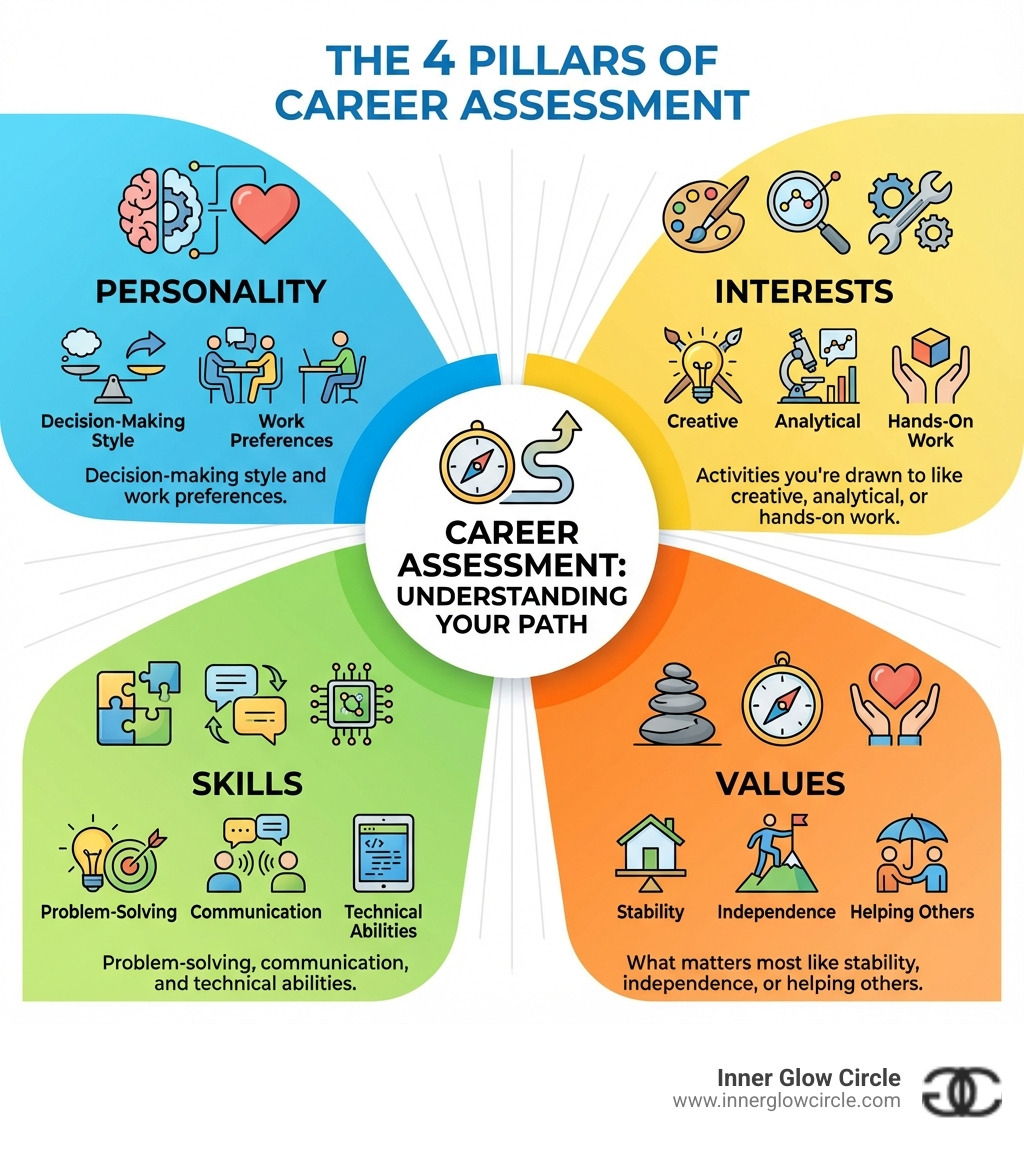
Simple guide to career test for adults:
Why Adults Turn to Career Tests for Clarity and Confidence
Let’s be honest, we spend a significant portion of our adult lives working. If that time isn’t spent doing something fulfilling, it can lead to a pervasive sense of dissatisfaction. Many adults turn to a career test for adults because they’re feeling stuck, unmotivated, or simply wondering, “Is this all there is?”
We often hear from clients who are experiencing job dissatisfaction, which can manifest as burnout, lack of engagement, or a nagging feeling that they’re meant for something more. This is where career tests shine. They provide a structured way to gain clarity and boost confidence in our career decisions. Instead of relying on anecdotal advice or just “going with the flow,” these assessments offer data-driven insights into our unique strengths, interests, and values.
For students, a career test for adults can be invaluable for making crucial decisions about their futures. Understanding personal interests, ambitions, and values early on can guide educational choices and set them on a fulfilling path. For mid-career professionals, these tests offer a fresh perspective, helping them identify transferable skills and explore new industries they might never have considered.
The power of a good career test for adults lies in its ability to help us align our passions with our professions. It can uncover hidden talents we might not recognize in ourselves, leading to a profound sense of self-findy. When we understand what truly motivates us, what kind of work environment we thrive in, and what skills we naturally possess, we can make informed decisions that lead to greater job satisfaction and long-term success. It’s not just about finding a job; it’s about finding your job—the one that lights you up and leverages your unique potential. The high completion rates for many online assessments speak volumes about the intrinsic motivation people have to seek this kind of clarity.
Understanding Your Work Personality for Job Satisfaction
When we talk about personality in the context of careers, we’re often looking specifically at “work personality.” This isn’t necessarily the same as your general personality traits. Work personality focuses on how you make decisions, interact with others, and handle pressure in a professional setting. Some tests focus specifically on who you are in professional settings to provide better career matching.
Consider the classic distinction between introverts and extroverts. An extrovert might thrive in dynamic, people-oriented roles like sales or management, where constant engagement is key. Conversely, an introvert might find satisfaction in roles that require concentration and analytical thinking, such as research or data analytics. These preferences directly influence the ideal work environment.
Beyond introversion and extroversion, other traits play a significant role. Frameworks like the Myers-Briggs Type Indicator (MBTI) offer useful language for these traits:
- Sensing vs. Intuition: A “senser” might prefer roles focused on facts and existing skills, like copy editing. An “intuitive” might lean towards big-picture thinking and novelty, finding fulfillment in psychology or publishing.
- Feeling vs. Thinking: “Feelers” are often drawn to work that aligns with their values, such as healthcare. “Thinkers” excel in roles requiring rationality, like computer programming.
- Judging vs. Perceiving: “Judgers” prefer setting goals and organization, fitting well into business administration. “Perceivers” thrive in adaptable environments, solving open-ended challenges, often seen in counseling or creative direction.
These traits impact everything from how you collaborate with a team to your preference for independence. Understanding your work personality allows you to seek out environments and roles where you can naturally excel and feel energized, rather than drained.
What to Expect from a Career Test for Adults
Taking a career test for adults can feel like stepping into the unknown, but knowing what to expect can ease any apprehension. While each test is unique, there are common elements you’ll encounter.
Most tests are designed to be completed in a reasonable timeframe, from quick 5-10 minute quizzes to more comprehensive assessments that take 20-30 minutes. The format of questions varies, but you might encounter:
- Multiple-choice: “Which task do you prefer?” or “Rate your agreement with this statement.”
- Agree/disagree scales: Similar to multiple-choice but often on a Likert scale.
- Situational questions: “When faced with a challenge, how do you respond?”
- Preference choices: Choosing between two work-related options.
Upon completion, you’ll typically receive immediate results. Many platforms offer a free summary of your findings, including some career recommendations. For a more in-depth analysis, comprehensive reports are often available for a fee. These detailed reports often include a breakdown of your unique profile, explaining your strengths, preferences, and how they align with various career paths.
A career test for adults aims to provide personalized career recommendations that resonate with your unique profile. It’s about understanding your innate talents, individual interests, and what truly motivates you, helping you narrow down your options and focus on paths where you’re most likely to thrive.
If you’re curious to dip your toes into self-findy, we invite you to explore our own Inner Glow Circle’s career and purpose quiz to start understanding your unique profile today.
Decoding the Different Types of Career Assessments

Just as we wouldn’t use a single tool for every task, relying on just one type of career assessment might not give us the full picture. A holistic approach to career exploration involves looking at various facets of who we are. This means combining insights from different types of tests – personality, interests, skills, and values – to build a robust understanding of our ideal career landscape. Taking multiple career aptitude tests can provide a fuller idea of the jobs in which we’d likely do well, helping us see connections and patterns that a single test might miss.
Personality-Based Tests
Personality tests dig into our inherent traits and how they influence our behavior and preferences, especially in a work context. These assessments help us understand our decision-making styles, how we handle stress, and how we interact within a team or independently.
Two prominent models often used in personality-based career tests are:
- The Big Five Model: This scientifically validated model assesses five broad dimensions of personality: Openness to experience, Conscientiousness, Extraversion, Agreeableness, and Neuroticism (often referred to as Emotional Stability). Many reputable career tests are based on this model.
- Myers-Briggs Type Indicator (MBTI): While the MBTI is a popular framework for self-reflection, it’s worth noting that it’s not as scientifically validated as other models. It categorizes preferences across four dichotomies: Extraversion (E) or Introversion (I), Sensing (S) or Intuition (N), Thinking (T) or Feeling (F), and Judging (J) or Perceiving (P). The combinations of these preferences are thought to suggest suitable work environments. For example, a “Thinker” might prefer analytical roles, while a “Feeler” might gravitate towards roles focused on human connection.
These tests don’t just give us a label; they provide vocabulary to describe our experiences and preferences. They help us understand what kind of work environment we’d thrive in—whether it’s highly structured or flexible, collaborative or independent.
Interest and Aptitude Inventories
Interest and aptitude inventories focus on the activities we genuinely enjoy and our natural talents. This is crucial because interests describe the types of activities that you are drawn to; these will need to be present in a job if you are to stay motivated.
A key framework in this area is Holland Codes, also known as the RIASEC model. Developed by psychologist John Holland, it categorizes interests into six distinct areas:
- Realistic (R): Hands-on, practical activities.
- Investigative (I): Analytical, intellectual activities.
- Artistic (A): Creative, expressive activities.
- Social (S): Helping, interacting with others.
- Enterprising (E): Leading, persuading activities.
- Conventional (C): Organized, detail-oriented activities.
The O*NET Interest Profiler, supported by the United States Department of Labor, is a prime example of an assessment based on the RIASEC model, asking users to rate 60 work activities. Many other tests also incorporate the Holland Code model.
It’s vital to understand the distinction between interest and skill. We might be interested in playing the guitar, but that doesn’t automatically mean we’re skilled at it. Interest tests identify what we’re drawn to, while aptitude tests measure our potential for success in certain areas. These tests help us connect our natural inclinations to specific job responsibilities and professions.
Skills and Values Matchers
Beyond personality and interests, understanding our skills and values is paramount for career satisfaction.
- Skills Matchers help us identify our existing competencies—both hard skills (like coding) and soft skills (like problem-solving and communication). CareerOneStop’s Skills Matcher is an excellent example, helping individuals create a description of their skills for a resume. These tests can reveal transferable skills that might not be immediately obvious, especially when considering a career change.
- Values Matchers focus on what truly matters to us in a job and workplace. Do you prioritize work-life balance, high income, social impact, or autonomy? CareerOneStop’s Work Values Matcher helps align our career pursuits with our personal and professional values. When our work aligns with our core values, we experience greater motivation, engagement, and a deeper sense of purpose. This alignment is a powerful driver of long-term job satisfaction.
By combining insights from all these types of assessments, we get a much richer, more nuanced understanding of ourselves and the career paths that will genuinely light us up.
Choosing the Right Career Test for Adults: Free vs. Paid
Deciding which career test for adults to take can feel like choosing from a buffet—so many options! The “best” test really depends on your specific needs, goals, and current stage of self-awareness. Are you just exploring, or are you making a major life decision?
Several factors should guide your choice:
- Scientific Validity: Look for tests based on scientifically validated models, like the Big Five or Holland Codes. Reliance on these models helps ensure a more reliable outcome.
- Reputation of the Provider: Tests supported by reputable organizations, like the O*NET Interest Profiler from the U.S. Department of Labor, tend to be highly regarded.
- Free Summaries vs. Comprehensive Paid Reports: Many excellent tests offer free basic results, which can be a fantastic starting point. However, if you’re serious about a career change, a comprehensive paid report might offer the depth you need.
- Data Privacy Policies: Always check how your data will be used. Reputable providers often have clear privacy policies stating they do not sell your personal data.
Features of Free Career Tests
Free career test for adults are an excellent entry point for anyone curious about career exploration without financial commitment. They serve as a quick way to gain initial insights and can often be completed rapidly.
Here are some popular types of free options:
- Government-Sponsored Tools: The O*NET Interest Profiler, supported by the U.S. Department of Labor, involves answering 60 questions to rate work activities. It provides career suggestions based on the six Holland Code interest areas and is a robust starting point.
- Quick Quizzes: Many sites, like The Princeton Review, offer short quizzes (often 20-30 questions) that ask you to choose between work-related options to generate suggestions based on your style and interests.
- Personality Sorters: Some free tests help identify your temperament and personality type within a work environment, often based on frameworks like Myers-Briggs.
While these tests are a good starting point and quick to complete (often 15 minutes or less), they typically provide basic results. Some may require an email signup to receive results, and a few might be ad-supported. They’re perfect for initial self-findy but might lack the detailed analysis needed for major career shifts.
When to Invest in a Paid Assessment
Sometimes, a free summary just isn’t enough, especially when we’re navigating a significant career crossroads or planning a substantial investment in education or training. This is when a paid career test for adults truly shines.
Paid assessments typically offer:
- In-depth Analysis: They provide a much more comprehensive understanding of your profile, detailing nuances that free tests often gloss over. Many offer full reports that can be downloaded as a PDF for easy printing and sharing.
- Multi-dimensional Reports: These reports often integrate findings across personality, interests, skills, and values, giving you a holistic view. Some use advanced algorithms to generate more nuanced, personalized career matches.
- Personalized Coaching Add-ons: Many paid platforms offer the option to connect with a career coach who can help interpret your results and guide your next steps. Inner Glow Circle also offers transformative coaching programs that can complement any assessment.
- Actionable Insights for Major Decisions: If you’re considering a career change or investing in a new degree, the detailed insights from a paid assessment can provide the confidence and clarity needed to make these big decisions. They help ensure your career recommendations are custom to who you truly are, not just where you’ve been so far.
While there’s an initial investment, it can save you significant time, money, and emotional energy down the line by helping you choose a path you’ll truly love.
Common Career Clusters Explored
Career test for adults often group recommended professions into broader categories or “clusters.” These groupings help us understand the landscape of opportunities and identify fields that align with our overall profile. Some of the common career domains explored include:
- Technical: This cluster includes roles in information technology, software development, data analytics, cybersecurity, and various engineering fields (mechanical, civil, systems, process). These often require strong analytical and problem-solving skills.
- Business: Encompassing management, finance, marketing, sales, human resources, and operations. This cluster values strategic thinking, leadership, persuasion, and organizational skills.
- Healthcare: Covering roles from clinical team leads and healthcare educators to medical research and patient care. Compassion, scientific understanding, and attention to detail are often key.
- Creative: This domain includes careers in design (UX/UI, visual), writing, arts, and media. Imagination, innovation, and expressive abilities are paramount here.
- Social & Human Services: Roles focused on helping others, counseling, community service, and education. Empathy, communication, and a desire to make a positive impact are central.
- Marketing: A blend of creative and business, including digital marketing, brand management, and public relations. It requires influencing, communication, and understanding market trends.
- Agriculture: From farm management to agricultural science and food production.
- Law, Public Safety, Corrections & Security: Careers in legal practice, law enforcement, and security services.
- Manufacturing: Involves production, quality control, and industrial processes.
- Government & Public Administration: Roles in federal, state, and local government.
These clusters provide a great starting point for exploring various fields, helping us see how our unique blend of personality, interests, skills, and values can translate into a fulfilling career.
From Results to Reality: Making Your Next Move

Getting your career test for adults results is an exciting moment, but it’s just the beginning. Think of the results not as a rigid rulebook, but as a compass pointing you in a promising direction. The goal is to glean key themes and recommendations that resonate with you, using them as a guide for further exploration. No single tool can fully assess your unique character, so your intuition and lived experience are still incredibly valuable.
How to Use a Career Test for Adults Considering a Change
For adults contemplating a career change, a career test for adults is an incredibly powerful tool. It helps us break free from the notion that our past defines our future.
- Identifying Transferable Skills: One of the biggest problems in a career change is recognizing how our current skills can apply to a new industry. Career assessments are fantastic at highlighting these transferable skills—like problem-solving, communication, or leadership—that are valuable across diverse fields.
- Exploring New Industries: The tests introduce us to career ideas we might never have considered. They can broaden our horizons beyond our immediate experience, showing us paths that align with our deeper interests and values.
- Referencing Past Job Experiences: Many assessments are designed to help adults reference past career experiences, including what they’ve liked and disliked. This reflection is crucial for planning a move that truly suits your authentic self, rather than simply replicating past dissatisfaction.
- Planning a Move That Suits Your True Self: The ultimate goal is to find a career path custom to “who you truly are, not just where you’ve been so far.” This self-awareness ensures your next chapter is one of fulfillment and genuine alignment.
Beyond the Test: Limitations and Next Steps
While a career test for adults provides invaluable insights, understand its limitations. As CareerOneStop points out, these assessments “will not guarantee that you will like a particular career, ensure that certain careers are available in your location, or account for differences within the same career.” They are a starting point, not a crystal ball.
So, what comes next?
- Research Suggested Careers: Dive deep into the careers recommended by your test. Use resources like the Occupational Outlook Handbook or O*NET OnLine to understand job duties, required education, and salary ranges.
- Conduct Informational Interviews: Talk to people actually working in those fields. Ask about their day-to-day, challenges, and what they love about their job. This real-world perspective is irreplaceable.
- Gain Relevant Experience: This might involve volunteering, taking a short course, or pursuing an internship (you can find opportunities on Internships Blog).
- Consider a Career Coach: For personalized guidance and accountability, working with a career coach can be transformative. Coaches help you interpret results, set actionable goals, and steer the complexities of career transitions. We at Inner Glow Circle offer supportive coaching programs designed to empower you through this journey.
Frequently Asked Questions about Career Assessments
How accurate are career tests?
The accuracy of a career test for adults is a common and important question. Reputable tests are often researched extensively to ensure they are valid and reliable, based on validated psychological models such as the Big Five and Holland Codes. Some claim high accuracy through advanced AI and proprietary models, with some providers having created hundreds of thousands of reports.
However, it’s crucial to remember that “no career test can perfectly predict which career will suit you.” They are best used as a tool for exploration and self-findy, providing objective insights into your strengths, interests, and preferences. They offer a strong indication of potential fits, but your personal context, evolving experiences, and external factors will always play a role. Think of them as a highly sophisticated map, not a predetermined destination.
How often should I retake a career test?
Our interests, values, and even aspects of our personality can evolve over time. Major life events, new experiences, or significant personal growth can shift our career preferences. Therefore, retaking a career test for adults is a good idea.
Many providers allow you to retake the test. It’s often recommended to revisit these assessments every few years, or particularly during significant life transitions such as:
- Considering a career change
- Entering a new life stage (e.g., becoming a parent, empty nesting)
- Feeling unfulfilled or burnt out in your current role
- After gaining substantial new skills or experiences
Retaking the test allows you to track your personal growth and see how your evolving preferences might suggest different career fits, ensuring your career path continues to align with your authentic self.
Can a career test help me find a remote job?
Yes, a career test for adults can certainly help you in your search for a remote job, albeit indirectly. The tests themselves don’t typically filter specifically for “remote” roles. Instead, they identify:
- Suitable Roles: They pinpoint job functions and industries that align with your personality, skills, and interests. Many of these roles naturally have remote or hybrid work options in today’s landscape (e.g., software development, digital marketing, writing, data analysis, counseling).
- Work Styles and Preferences: A test might indicate you thrive with autonomy, prefer focused work, or enjoy flexible schedules—all traits often associated with successful remote work. Some tests dig into your optimal work environment and decision-making style.
Once you have your test results and a list of recommended career paths, you can then integrate “remote” as a filter in your job search. For example, if your test suggests a career in “digital marketing,” you would then search for “remote digital marketing jobs.” The test helps you identify what you should be doing, and then you can layer on how and where you want to do it.
Conclusion: Your Journey to a Fulfilling Career Starts with Self-Knowledge
Navigating the complexities of our professional lives can be challenging, but a career test for adults offers a powerful guide of light. As we’ve explored, these assessments are more than just quizzes; they are scientifically-backed tools designed to foster deep self-knowledge, helping us understand our unique blend of personality traits, interests, skills, and values. They provide clarity, boost confidence, and illuminate paths to careers we might never have imagined.
The journey to a fulfilling career is an ongoing one, marked by continuous learning, adaptation, and self-reflection. Career tests serve as an excellent starting point or a valuable re-evaluation tool, whether you’re a student making initial choices, a mid-career professional seeking change, or simply someone yearning for greater job satisfaction. They empower us to move beyond gut feelings and external pressures, making informed decisions that truly align with who we are.
At Inner Glow Circle, we believe that understanding your purpose is the cornerstone of a truly fulfilling life and career. We encourage you to accept this journey of self-findy.
Ready to take the first step towards a career that truly resonates with your inner glow? Find your purpose with our quiz and explore how our coaching can support you every step of the way.


