

Why Career Advancement for Women Remains a Critical Challenge
Despite remarkable educational achievements—with women earning the majority of bachelor’s, master’s, and doctorate degrees—career advancement for women faces significant obstacles. This success hasn’t translated to equal representation in leadership roles.
Key barriers to women’s career advancement:
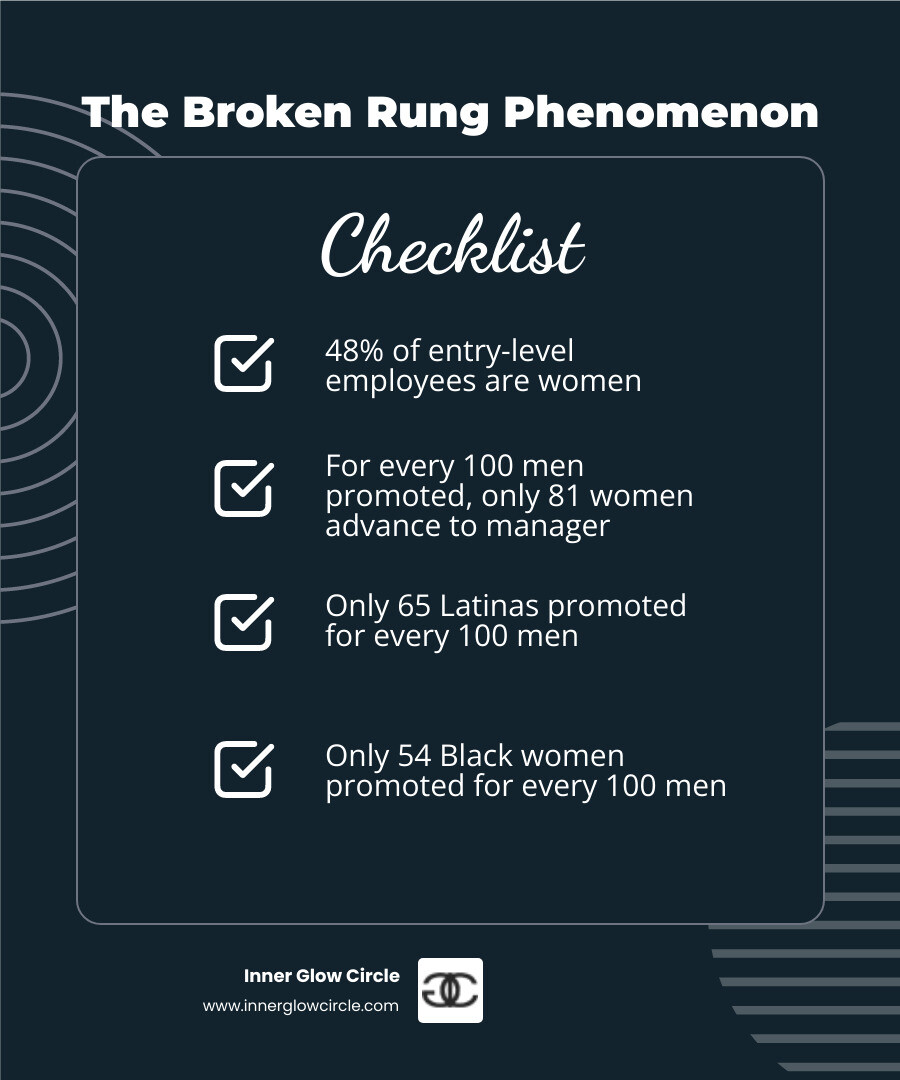
- The “broken rung”: For every 100 men promoted to management, only 81 women are.
- Reduced opportunities for women of color: Only 65 Latinas and 54 Black women are promoted for every 100 men.
- Gender bias in evaluation: Men are judged on potential, women on past performance.
- The confidence gap: Women apply for jobs only when meeting 100% of requirements vs. men at 60%.
- Lack of sponsorship: Women are “overmentored but undersponsored.”
- Motherhood penalty: 60% of women say caring responsibilities prevent job applications.
The numbers tell a clear story: women are highly educated yet face significant barriers on the career ladder. This gap starts early, compounds over time, and results in women holding only 32% of leadership roles globally. The need for strategic career development is urgent.
The solution isn’t just working harder—it’s working smarter. Success requires building “experience capital” through strategic career moves, mastering self-advocacy, building influential networks, and proving your value.
Career advancement for women terms at a glance:
Laying the Groundwork: Master Your Mindset and Brand
Before climbing the ladder, you need a solid foundation of self-belief and a clear professional identity. Many talented women are held back by internal barriers like imposter syndrome, perfectionism, and a reluctance to self-promote. Addressing these foundational elements is crucial for sustainable career advancement for women. If you don’t believe in yourself or can’t communicate your value, your skills may go unnoticed.

1. Cultivate Unshakeable Confidence and Overcome Perfectionism
Consider this: men apply for jobs when they meet just 60% of the requirements, while women wait until they meet 100%. This confidence gap is widespread, with women often rating their performance lower than men and downplaying their achievements.
Perfectionism is another roadblock. The fear of failure can be paralyzing, causing women to avoid risks and challenging roles. The solution is to develop a growth mindset, viewing challenges as learning opportunities and mistakes as part of the journey. Progress beats perfection every time. The research on the gender gap issue confirms these patterns are real, and understanding them is the first step to breaking free.
2. Build a Powerful Personal Brand
Your personal brand is your professional reputation—how people think of you when your name comes up. It’s your unique value proposition and the story that makes you memorable. Identify the unique combination of skills, experiences, and perspectives you bring to the table.
Your online presence should consistently tell this story. Your LinkedIn profile and professional social media should offer a clear picture of who you are. Thought leadership can be as simple as sharing insights on industry trends. A strong personal brand reinforces your confidence and aligns your digital footprint with your career goals, helping the right opportunities find you.
3. Practice Proactive Self-Advocacy
Self-advocacy means speaking up, communicating your achievements, and asking for what you want, whether it’s a promotion, a raise, or a new project. While self-promotion can feel awkward, it’s necessary. Your manager can’t read your mind, so you must communicate your value and aspirations.
Start by tracking your wins. Keep a document of your accomplishments, the problems you solved, and the value you created. This file becomes your evidence for salary negotiation or negotiating promotions. Instead of hoping your boss notices, schedule regular check-ins to discuss your contributions and present a data-backed case for advancement. This isn’t bragging; it’s ensuring your contributions are visible and your goals are clear.
Gaining Strategic Momentum: Visibility, Influence, and Experience
True career advancement for women isn’t just about working harder; it’s about strategic action that builds your reputation and proves your value. Advancement requires shifting from being a great performer to a strategic player. The women who break through aren’t just working the longest hours—they’re making the smartest moves.

4. Build ‘Experience Capital’ on Purpose
Research shows men are often promoted on potential, while women are judged on past contributions. Understanding this helps you play the game more strategically by building “experience capital”—the wisdom gained from hands-on experience that stretches your abilities.
Be purposeful in the experiences you seek. Think about the leader you want to become and reverse-engineer the skills you need.
- P&L responsibility signals you can handle the business side of leadership.
- A lateral move can broaden your understanding of the business and build cross-organizational relationships.
- Cross-functional projects build leadership skills like influencing without authority and managing diverse stakeholders.
Seek roles that make you slightly uncomfortable; that’s where you’ll build the most valuable experience capital.
5. Seek High-Visibility Projects to Demonstrate Leadership
Doing great work in a corner won’t get you noticed. You need to be visible, which means strategically choosing projects that put you in front of senior leadership. These projects are tied to company goals and solve critical problems. When you succeed, the right people notice.
Don’t wait to be invited. Take initiative by identifying gaps and stepping up with solutions. Volunteering for challenging assignments demonstrates leadership—seeing what needs to be done and making it happen. This is how you prove you’re ready for more responsibility.
6. Master Strategic Communication and ‘Invisible Metrics’
Many women struggle to communicate their value to decision-makers. Shift from task-based language (“I completed the report”) to strategic language (“I analyzed Q3 performance and identified opportunities to increase revenue by 15%”).
Use invisible metrics to quantify your impact:
- Revenue impact: How did your work contribute to the bottom line?
- Time saved: How did you streamline a process to free up resources?
- Crisis handling: How did you mitigate risk or solve a critical problem?
This approach makes your value clear to superiors. When promotion discussions happen, you want them thinking, “We can’t afford to lose her.” Strategic communication bridges the gap between being seen as a good worker and an invaluable leader.
Navigating the Climb: Overcoming Problems and Building Alliances
No one succeeds alone, especially when it comes to career advancement for women. The path upward demands a strong support system, strategic relationships, and practical approaches to the unique challenges women face. Navigating career challenges isn’t a solo mission; it’s about building alliances and managing competing demands.
| Feature | Mentor | Sponsor |
|---|---|---|
| Role | Advises, guides, shares wisdom | Advocates, champions, creates opportunities |
| Relationship | Often informal, focuses on development | Formal or informal, focuses on advancement |
| Primary Benefit | Insight, learning, personal growth | Visibility, promotions, career progression |
| Action | Answers questions, offers advice | Puts your name forward, opens doors |
7. Build a Strategic Network of Mentors and Sponsors
Understanding the difference between mentors and sponsors is a game-changer. Both are essential for career advancement for women, but they serve distinct roles.
Mentors are your wise advisors. They share experiences and offer guidance. The benefits are clear, with 70% of companies reporting increased productivity from mentoring, as noted in 6 benefits of mentoring in the 2023 workplace.
Sponsors are your career champions. These senior leaders actively advocate for you, putting your name forward for promotions and high-visibility projects. The problem is that women are often “overmentored but undersponsored,” which can stall career progression.
To build your network, intentionally cultivate both relationships. Seek out mentors through professional organizations or company programs. Finding sponsors often happens when senior leaders witness your excellent work, so make your accomplishments visible and communicate your aspirations clearly.
8. Steer Work-Life Integration and the ‘Motherhood Penalty’
Balancing work with life responsibilities is a persistent challenge. Three out of five women report that caring duties have prevented them from applying for new roles. This is compounded by the “motherhood penalty,” where mothers are often overlooked for opportunities, while fathers may get a “fatherhood bonus.”
Successful women often accept work-life integration rather than perfect balance. This requires:
- Flexible working arrangements: A non-negotiable for many, with 14% of women leaving jobs over a lack of flexibility.
- Setting clear boundaries: Define and communicate when you are available for work and when you are not.
- Building a robust support system: Reliable childcare, family help, or a network of other working parents is crucial.
As highlighted in How Successful Women Sustain Career Momentum, strategic planning and clear communication are key to navigating life transitions. Asking for flexibility isn’t a weakness; it’s smart career management.
The Ecosystem of Success: How Organizations and Allies Can Foster Career Advancement for Women
Individual effort is crucial, but true progress for career advancement for women requires a supportive, equitable workplace. Systemic barriers exist that individual effort alone cannot overcome. Organizations and male allies play a pivotal role in creating a level playing field where women’s talents can flourish.

9. The Role of the Organization in Creating Equity
Organizations hold the power to create environments where career advancement for women thrives. While women’s representation in leadership grew to 32% in 2022, progress is slow. Forward-thinking organizations are taking concrete steps to fix the system.
Key actions include:
- Pay equity audits and transparency: Regular audits and transparent salary scales are essential to close the gender pay gap.
- Flexible policies: Providing equitable parental leave for all genders helps normalize shared caregiving and reduces the motherhood penalty.
- Unconscious bias training: Training helps decision-makers recognize and interrupt patterns, like judging women on performance and men on potential.
- Inclusive job descriptions: Using tools to remove gendered language from job posts can attract more diverse candidates.
- Setting clear targets: Treating gender diversity as a business priority with accountable leadership targets is crucial.
As the Women in the Workplace survey shows, when organizations commit to systemic change, everyone benefits.
10. How Male Allies Can Champion Change
Male allies are crucial for equitable career advancement for women. Since men hold most leadership positions, their active support creates powerful ripple effects. Allies can champion change by:
- Providing advocacy and sponsorship: Use your influence to put women’s names forward for promotions and high-visibility projects, helping to bridge the sponsorship gap.
- Amplifying women’s voices: When a woman’s idea is overlooked, reiterate it and give her credit to combat the “speaking while female” phenomenon.
- Challenging bias: Call out microaggressions and question biased hiring or promotion practices.
- Creating opportunities: Invite women to key meetings, make introductions to stakeholders, and include them in informal networking.
- Offering honest feedback: Provide direct, constructive feedback coupled with genuine support to accelerate career growth.
By taking these actions, male allies help create an inclusive environment where everyone’s talent is recognized, leading to better organizational performance.
Frequently Asked Questions about Women’s Career Progression
What is the biggest barrier to women’s career advancement?
The most significant obstacle is the “broken rung”—the gap at the very first step into management. For every 100 men promoted from an entry-level role to manager, only 81 women are. For women of color, the numbers are even lower: 65 Latinas and 54 Black women.
This initial gap compounds over time. With fewer women reaching the first level of management, the pipeline for senior leadership shrinks significantly. This is often due to systemic bias and a lack of sponsorship, preventing women from gaining the essential “experience capital” needed for future roles.
How can I get promoted if I feel undervalued?
Feeling undervalued is a signal to become your own best advocate, as good work doesn’t always speak for itself.
- Document your wins: Keep a “brag file” with specific examples of your impact, problems you’ve solved, and value you’ve created.
- Use “invisible metrics”: Quantify your contributions. Instead of saying you managed a team well, say you “increased productivity by 25%.” Show how you saved time, generated revenue, or mitigated risk.
- Practice self-advocacy: In reviews, clearly communicate your accomplishments and your career goals. Present a data-backed case for why you deserve a promotion.
The goal is to shift from hoping your work gets noticed to actively ensuring your value is understood.
What is the difference between a mentor and a sponsor?
Understanding this distinction is critical for career advancement for women. While both are valuable, they serve different functions.
A mentor is an advisor. They offer guidance, share wisdom, and help you steer challenges. A mentor talks to you about your career.
A sponsor is a champion. They are senior leaders who use their influence to advocate for you. They put your name forward for promotions and create opportunities. A sponsor talks about you when you’re not in the room.
Research shows women are often “overmentored but undersponsored.” We have plenty of advisors but not enough champions actively opening doors. While both relationships are important, sponsorship is a key accelerator for career progression.
Conclusion
Your journey toward career advancement for women is unique, but the path is clearer when you understand the terrain. This guide has outlined the essential elements for changing your career.
It starts with a foundation of confidence, self-advocacy, and a strong personal brand. Next comes strategic momentum, built by purposefully gaining experience capital, seeking high-visibility projects, and communicating your value with results-driven language.
No one climbs alone. Success requires a network of mentors who guide and sponsors who advocate. It also means navigating work-life integration and pushing for systemic change alongside organizations and allies.
By implementing these strategies, you’re not just advancing your own career; you’re paving the way for the women who will follow. Your professional journey deserves intentional action and unwavering support.
Ready to build the confidence and skills to lead? Inner Glow Circle provides transformative coaching programs designed to help you open up your potential. Empower Your Path with Life and Career Coaching.


