

Why Business Mentoring and Coaching Matter for Your Growth
Business mentoring and coaching are two powerful but distinct paths to professional development. Understanding the difference is key to getting the support you need.
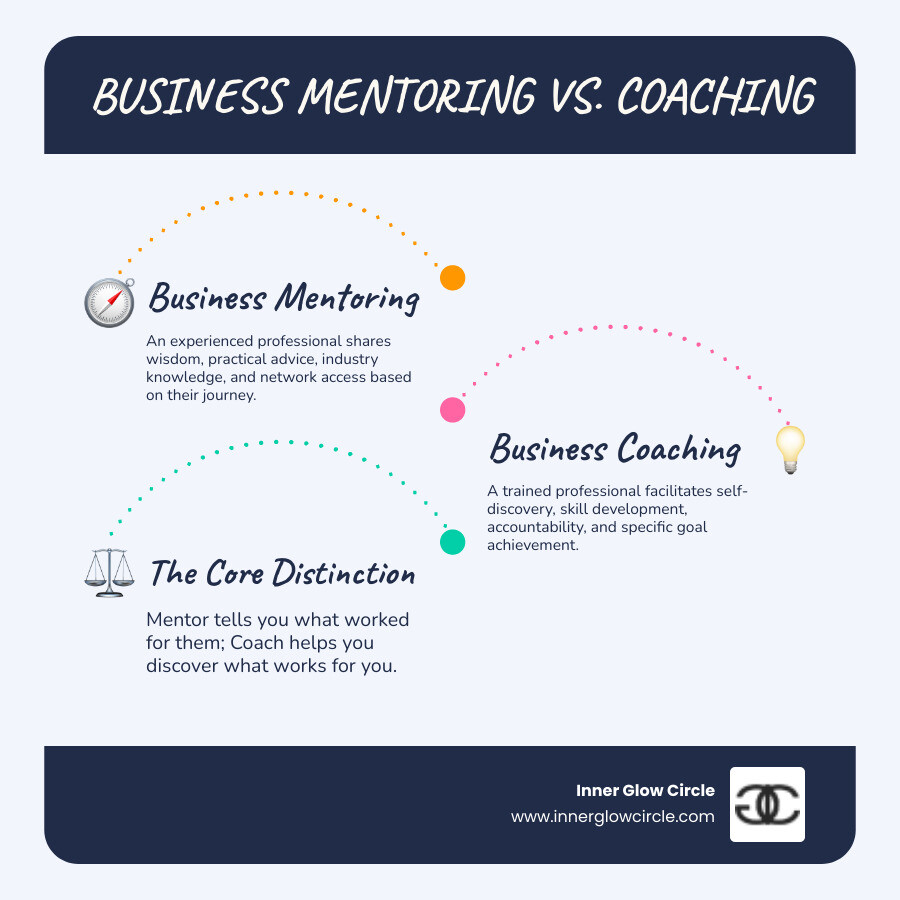
- Business Mentoring: An experienced professional shares wisdom from their own journey. This long-term guidance focuses on industry knowledge and network access, often at no cost through volunteer programs.
- Business Coaching: A trained professional uses questioning to help you find your own solutions. This structured approach focuses on specific goals, skill development, and accountability.
The key difference: A mentor tells you what worked for them. A coach helps you find what works for you.
Success is more likely with support. The data is clear: 92% of Fortune 500 companies use mentoring, and small business owners with mentors report higher revenues and faster growth. Whether you’re launching or scaling, the right guidance can transform your trajectory.
The challenge is knowing which approach fits your current needs, where to find quality support, and how to budget for it. This guide will break down how mentoring and coaching differ, when to seek each, and how to find the right guide for your journey.
Understanding the Core Differences: Business Mentor vs. Business Coach
While the terms are often used interchangeably, business mentoring and coaching are fundamentally different. A mentor is a wise guide who has walked the path before you, sharing shortcuts and warnings. A coach is a skilled facilitator who asks the right questions so you can chart your own course.
Both approaches are transformative, but they work in distinct ways.
| Aspect | Business Mentor | Business Coach |
|---|---|---|
| Role | Experienced guide, trusted advisor, role model | Performance partner, facilitator, accountability holder |
| Focus | Long-term career/business development, sharing wisdom, network access, broad perspective | Specific goals, skill development, behavioral change, self-findy |
| Experience | Has “been there, done that” – offers direct advice based on personal experience and industry insight | Trained in coaching methodologies; may or may not have direct experience in your specific industry, but is an expert in process |
| Relationship | Often informal, long-term, driven by mentee’s needs, can be reciprocal | Formal, structured, time-bound, goal-oriented |
| Approach | Provides practical advice, shares lessons learned, opens doors, offers solutions | Asks powerful questions, challenges assumptions, encourages self-reflection, facilitates client-led solutions |
The Mentor: Your Experienced Guide
A mentor’s greatest asset is their experience. They offer practical advice based on what actually worked (and what didn’t). When you face a tough decision, they might say, “Here’s what I did in that situation.”
Mentors also open doors. Their professional network becomes accessible to you, creating opportunities for introductions to investors, suppliers, or partners. This access can be a game-changer.
The relationship is typically long-term and informal, focused on your overall growth. Many mentorships are available at no cost through volunteer programs like SCORE, where experienced owners give back by sharing their wisdom freely.
The Coach: Your Performance Partner
A business coach operates differently. Instead of giving answers, they ask powerful questions to help you uncover your own. A skilled coach knows you have more answers than you realize and helps you turn them into action.
Coaches are trained in methodologies for growth and change. As the Harvard Business Review notes, coaching combines practices from consulting and therapy, creating a unique approach to building leadership and self-awareness.
A coaching relationship is structured and goal-oriented, with a defined timeframe. You’ll set clear objectives and your coach will hold you accountable. The magic of coaching is self-findy; solutions you find yourself are more likely to stick. While coaching involves a fee, the investment often pays for itself through increased productivity and breakthrough results.
Understanding these differences allows you to choose the right support for your current needs. Sometimes you need an experienced guide, and other times you need a partner to help you find your own way.
The Mentor’s Playbook: Gaining Wisdom from Experience

A business mentor offers a shortcut through the entrepreneurial maze, sharing hard-won wisdom from their own journey. The value of business mentoring and coaching via a mentor lies in practical, experience-based guidance.
A mentor acts as a strategic sounding board, providing an objective perspective to refine your vision. You also get to learn from their mistakes, saving you time, money, and stress. The data supports this: small business owners who receive mentoring report higher revenues and faster growth, with those getting three or more hours of mentoring seeing measurable improvements. SCORE, a network of volunteer mentors, helped start over 30,000 businesses in a single year.
Beyond strategy, mentors aid in leadership development, share their networks to open doors, and provide crucial emotional support during the lonely periods of entrepreneurship.
When to Seek a Business Mentor
You’ll get the most value from a mentor in these situations:
- Starting a new venture and needing foundational guidance.
- Navigating a specific industry challenge where direct experience is key.
- Seeking to expand your professional network for introductions.
- Planning for succession or an exit strategy.
A mentor is ideal when you need practical, experience-based advice on “how it’s done.”
Challenges a Mentor Can Help Address
A mentor applies real-world experience to your business challenges. They can guide you on:
- Business Strategy: Developing your plan, spotting opportunities, and setting long-term goals.
- Financial Management: Budgeting, funding, pricing, and profitability.
- Marketing and Sales: Customer acquisition and building effective sales processes.
- Operations and Scaling: Streamlining processes to manage growth.
- Human Resources: Hiring, managing teams, and building company culture.
The relationship with a mentor is about growing as a leader with a trusted guide in your corner.
The Coach’s Toolkit: Open uping Your Own Potential

While a mentor shares their map, a coach helps you draw your own. The power of business mentoring and coaching through a coach is that it open ups your own capabilities. It’s not about being told what to do; it’s about finding what you’re capable of through deep questioning and reflection.
This process is empowering because you own the solutions you find, making you more likely to implement them. The International Coach Federation reports an 88% client satisfaction rate, confirming that coaching works. Key benefits include:
- Increased productivity: Coaches help you clarify priorities and overcome procrastination.
- Improved team performance: Focusing on communication and leadership can boost collective output by up to 50%.
- Improved self-awareness: A coach acts as a mirror, revealing your strengths, blind spots, and limiting beliefs.
- Better work-life balance: A coach helps you define a sustainable balance that fits your values.
- Improved leadership skills: Coaching develops your communication, decision-making, and delegation abilities, which is why many companies have mentor and coaching programs for leadership.
- Overcoming limiting beliefs: Coaches are skilled at identifying and challenging the subconscious barriers that hold you back.
When to Seek a Business Coach
The right time to hire a coach is often when you feel a gap between where you are and where you want to be.
- Feeling stuck or overwhelmed? A coach provides clarity and momentum.
- Need to improve specific skills? Coaching offers targeted, customized support for skill development.
- Facing leadership challenges? A coach helps you hone an authentic leadership style.
- Want to boost performance? A coach provides the structure and accountability to achieve significant improvements.
- Seeking personal breakthroughs? A coach is an ideal partner for addressing personal roadblocks that affect your business.
Challenges a Coach Can Help Address
A coach is skilled at navigating internal and interpersonal challenges. They help with:
- Overcoming limiting beliefs to foster a growth mindset.
- Improving communication skills with employees, clients, and stakeholders.
- Time management and prioritization to reduce overwhelm.
- Decision-making processes to build confidence and strategy.
- Building confidence and executive presence to own your leadership role.
- Achieving work-life balance by creating sustainable, integrated practices.
Coaching is a profound investment in yourself, leading to breakthroughs that ripple through your business and life.
Navigating Your Path: Finding and Funding Your Guide
Once you know whether you need business mentoring and coaching, the next step is finding a guide and understanding the cost. Quality support exists at every price point, from free mentors to premium coaches.
Finding the Right Fit in Business Mentoring and Coaching
Finding a mentor or coach is like dating—chemistry and trust are essential. You need someone whose expertise and style resonate with you.
- SBA Resource Partner Network: In the U.S., the Small Business Administration offers an incredible ecosystem of free and low-cost support. Find a Business Mentor Through SBA’s Resource Partner Network to connect with organizations like:
- SCORE: The nation’s largest network of 10,000+ volunteer business mentors. It’s free and has a 60-year track record of success.
- Small Business Development Centers (SBDCs): Nearly 1,000 locations offering advising and technical assistance.
- Women’s Business Centers (WBCs) & Veterans Business Outreach Centers (VBOCs): Specialized support for women, veterans, and military spouses.
- Professional Associations: The International Coaching Federation (ICF) has a Credentialed Coach Finder to locate qualified professionals who meet rigorous standards.
- Networking: Industry events and local meetups are great places to meet potential mentors or get recommendations for coaches.
When evaluating a potential guide, ask about their background, philosophy, and process. Trust your gut—the right fit is crucial.
Understanding the Investment
The cost of business mentoring and coaching varies widely.
Mentoring is often free or low-cost. Organizations like SCORE are powered by volunteers, and other non-profits charge only nominal administrative fees. For example, Business Mentors New Zealand charges a small one-off fee for a year of access.
Coaching is typically a financial investment. Fees can be hourly, per session, or packaged for a set term. Rates depend on the coach’s credentials, experience, and specialization. Executive coaching for senior leaders is at the higher end.
However, focus on the return on investment (ROI). ICF studies show a median ROI of 788% from coaching, with clients reporting significant increases in productivity and team performance. Small business owners with just a few hours of mentoring see higher revenues and faster growth. Think of this not as an expense, but as an investment in your future success. The right guidance can save you from costly mistakes and accelerate your growth, making it one of the best investments you can make in your business.
Maximizing Success with Business Mentoring and Coaching

Finding the right guide is the first step; how you engage in the relationship determines your success. Think of business mentoring and coaching like a gym membership—you get results by doing the work.
Setting Clear Expectations
A successful partnership starts with clarity. Discuss goals, meeting frequency, duration, and communication methods upfront. This prevents misunderstandings and makes the relationship more effective. Confidentiality is also key; you must feel safe enough to be vulnerable, as that’s where real growth happens.
The Mentee/Coachee’s Role
Your guide can only be as effective as you allow. To get the most out of the relationship:
- Communicate Openly: Be honest about your struggles and progress. Your guide needs feedback to support you effectively.
- Commit to Action: The real change happens between sessions when you implement what you’ve discussed.
- Be Prepared: Come to meetings with questions and updates to maximize your time.
- Be Open to Feedback: Discomfort is often a sign of growth. Welcome challenges to your thinking.
Measuring Progress
Set clear milestones and track your progress. Measure tangible outcomes (sales, clients) and intangible ones (confidence, work-life balance). Both are important indicators of success.
Can You Use Both? The Power of a Hybrid Approach
You don’t have to choose between business mentoring and coaching. Using both simultaneously creates powerful synergy. A mentor can guide your business strategy based on their industry experience, while a coach helps you develop the leadership skills and personal capacity to execute that strategy.
Your mentor advises on what to do; your coach helps you find how to do it in a way that aligns with your strengths. This hybrid approach provides holistic support for both external business challenges and your internal growth as a leader.
The Role of Business Mentoring and Coaching in Leadership Development
Leadership is a developed skill, and mentoring and coaching are two of the best tools for the job. They help build resilient leaders, foster strategic thinking, and improve emotional intelligence. This is why 92% of Fortune 500 companies offer mentoring programs—they see the direct impact on retention, engagement, and the bottom line.
Investing in your leadership capabilities through mentoring and coaching is an investment in the long-term success of your business. At Inner Glow Circle, we combine practical training with deep personal development, empowering women to become effective leaders and coaches.
Conclusion
Your entrepreneurial journey doesn’t have to be a solo mission. The most successful entrepreneurs use guides to help them steer new territory. Business mentoring and coaching are two distinct but powerful forms of guidance.
A mentor shares their experienced-based map, while a coach helps you draw your own. You don’t have to choose; many successful leaders use both. A mentor provides strategic wisdom, and a coach helps develop the skills and mindset to execute that strategy.
The data is compelling: mentored businesses see higher revenues, and coaching delivers a median ROI of 788%. Beyond the numbers, these relationships provide accountability, encouragement, and the perspective needed to become the leader your business requires.
So, where do you start? If you need practical, experience-based advice, connect with a free mentor through SCORE or another SBA partner. If you feel stuck or are ready to open up your next level of performance, a qualified coach may be the right choice.
The most important step is the one you take today. You’ve learned about these resources; now it’s time to invest in yourself. Your business deserves it, and so do you.
At Inner Glow Circle, we understand the transformative power of quality guidance. We’re passionate about empowering women to step into their full potential as coaches and leaders. Learn more about our approach to mentor coaching and find how we can support your journey toward confidence and success.


